

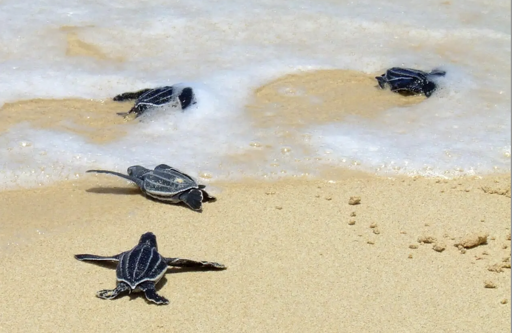
Composting keeps organic waste out of landfills, where it can produce methane, a very potent greenhouse gas. But a new study from Costa Rica’s Guanacaste province finds that when not disposed of properly, organic waste can also trigger a cascade of events resulting in fewer sea turtles. “Normally in Costa Rica we are very used to throwing the peels of the vegetables or fruits in the backyard,” Keilor Cordero, lead author of the study and a Ph.D. student at Menéndez Pelayo International University in Spain, told Mongabay. “I used to do it, I remember possums every night coming to eat the organic trash, and for us it was fun and we didn’t think about the impacts.” But he found impacts in Las Baulas Marine National Park, which was established in 1991 to protect one of the most important nesting areas for threatened leatherback sea turtles (Dermochelys coriacea) along the Eastern Pacific. Costa Rica invested in infrastructure in and around the park to enable ecotourists to enjoy the beaches and observe nesting sea turtles. Ecotourism makes up a big part of Costa Rica’s economy, and all was well In Las Baulas until around 2012, when researchers began seeing a big increase in animals preying on turtle eggs. Cordero suspected rapid urbanization had something to do with it. So, he looked at satellite images of urban growth from 1990, just before the park was established, to 2024. “Despite being a national park, the urbanization grew exponentially through the years,” Cordero said. He also set up…This article was originally published on Mongabay
From Conservation news via This RSS Feed.