

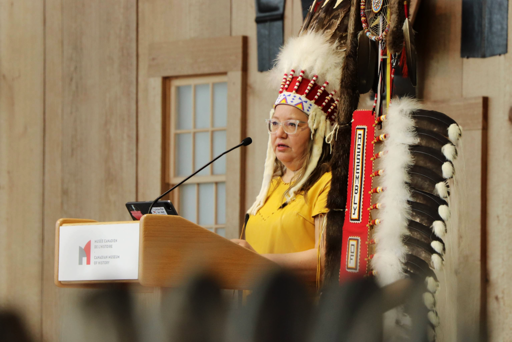

Flanked by the Assembly of First Nations eagle staff, National Chief Cindy Woodhouse Nepinak speaks at the Canadian Museum of History in ‘Gatineau’ on March 10 to mark the repatriation of ancestral items from the Vatican. Photo by Julie Chadwick
Prime Minister Mark Carney has earned a “mixed” report card over his first year in office, according to the national chief of the Assembly of First Nations (AFN).
Asked to grade the Liberal leader’s performance, Cindy Woodhouse Nepinak told IndigiNews he “is at a crossroads” if he wants to earn Indigenous people’s trust while also achieving his economic ambitions.
She gave the former central banker positive grades for his willingness to meet with and hear from chiefs, Woodhouse Nepinak noted.
Carney marked one year since being sworn into office on March 14.
He raised hopes for many Indigenous leaders with his subsequent election platform.
“At the core of a Mark Carney-led government will be a fundamental commitment to advance the process of reconciliation,” the Liberals vowed.
In Carney’s first budget last fall, he committed $2.3 billion for clean drinking water on First Nations over three years.
But as he now attempts to fend off a “U.S.” trade war, his other plans have run afoul of a growing number of Indigenous communities.
The budget slashed two per cent from the funding of the ministries of Indigenous Services, and Crown-Indigenous Relations and Northern Affairs — cutting $563 million a year.
And his government’s legislation to fast-track resource mega-projects in the “national interest” sparked criticism from First Nations concerned about their right to be consulted.
In November, Carney signed a memorandum of understanding with “Alberta,” promising to support a new oil pipeline to the West Coast.
The AFN condemned the move, unanimously passing an emergency resolution.
At the time, Woodhouse Nepinak warned governments against using development as “a wedge to try and divide us.
“Chiefs of course have different views on development and this is to be celebrated,” she told chiefs at a Dec. 19 meeting.
“But chiefs are united when it comes to approving large national projects on First Nations lands — there will not be getting around rights-holders.”
IndigiNews spoke to the Pinaymootang First Nation member — at 43, AFN’s youngest national chief since its founding — about why bands across the country are increasingly concerned, and what they hope to see change from “Ottawa.”
This interview has been edited for length and clarity.

A week after being sworn into office, Prime Minister Mark Carney meets AFN National Chief Cindy Woodhouse Nepinak on March 21, 2025 in ‘Ottawa.’ Photo courtesy AFN/Facebook
David Ball: Has some of the optimism worn off when it comes to Carney’s knowledge or willingness to work with First Nations? What are you hearing across the country?
Cindy Woodhouse Nepinak: I just have to say the new prime minister does have a hard act to follow. Because, while not perfect, Prime Minister [Justin] Trudeau did so much more than any other prime minister for First Nations.
From a First Nation perspective, I think the rating for the current Prime Minister Carney’s first year may be mixed. There have been some really good things, and maybe some not-so-good things.
We have gotten to know the prime minister more over the past year, and we believe that he’s a decent man.
He’s been accessible. He’s participated in our AFN election forum with our First Nations, and had a strong platform.
He appointed two strong First Nations women to Cabinet: Minister [Rebecca] Chartrand and Minister [Mandy] Gull-Masty.
He’s responded quickly to the crises we faced with natural disasters and other emergencies.
He’s protected the $48.7 billion we negotiated for long-term reform of the child welfare system.
He’s agreed to host a First Ministers’ meeting focused solely on First Nations issues later this year.
First Nations stand with the prime minister against Trump’s illegal tariffs, and we support plans for growth — but not at the expense of our rights and the government’s legal obligations.
What about the ‘not-so-good’ things?
I think, however, some of the not-so-good things would be the ramming of Bill C-5 [the Building Canada Act] through Parliament last June in 20 days.
I think that was, in hindsight, completely unnecessary. The legislation has not even been applied since.
The November federal budget was also a lost opportunity to make up for the trust lost with Bill C-5 through actual deeds. Instead of doing more, as the prime minister promised last summer, the budget does much less.
It will make socioeconomic gaps worse, not better.
In the ‘very concerning’ category is how Canada is treating the First Nations clean water legislation [First Nations Clean Water Act]; despite promises and court victories, we still don’t have that.
What we have is reports of watered-down legislation at an unknown date in the spring. More delays to implement clean-water legislation are an infringement on our First Nations rights, and the health and well-being of First Nations people.
First Nations understand that it is a critical, uncertain time for Canada.
Why is that?
We understand Prime Minister Carney is at a crossroads in his personal relationship with First Nations. And we understand First Nations rights are under threat in new ways by this government and, of course, by the provinces.
We are not afraid of that, though. We are far from it.
First Nations across this country, we are stronger than we have ever been.
And we look forward to working with the prime minister, with the opposition leaders, with members of parliament from all parties, and premiers over the coming year — to try and move the dial on First Nations issues at the next First Ministers’ meeting.
It can’t be a one-and-done meeting in this country. It has to be ongoing.
There’s just so many issues of jurisdiction between First Nations — who are the first levels of government — and the federal and provincial governments.

AFN National Chief Cindy Woodhouse Nepinak speaks in ‘Gatineau’ on March 10. Photo by Julie Chadwick
I wanted to take you back to November, when Carney signed a memorandum with Alberta to get a pipeline to the B.C. coast. Why was that a significant moment?
We continue to hear chiefs say, First Nations people stand with Canada against Trump’s illegal tariffs — but not at the expense of our rights, and of being overlooked.
I hope that there’s actual goodwill to strengthen the relationship between all, and to not leave us to the sidelines every 25 years when First Nations are needed.
We’re here, we’ve always been here, we’ve always fought for this country; in every single world war, First Nations have been at the frontlines.
There were two Quebec separation referendums; First Nations were fighting to keep Canada united. Now, First Nations are leading the way [against] the separatist movement in Alberta.
Trying to sideswipe or push aside First Nations people when there’s agreements between provinces and the feds — they have to remember that First Nations are here, they are governments, and they are to be respected in their own homelands.
What are your thoughts about fast-tracking resource extraction projects? Because it’s obviously divisive, with some nations invested in those projects, and some who are fiercely opposed.
First of all, if you want to fast-track anything, you better make sure that First Nations are being included right off the bat — when it’s even a thought, not when plans are drawn up and decisions are made.
That’s when difficulties happen.
To learn to live on one land together means that we all have to talk to each other.
And by not talking to each other — leaving each other out of discussions, and First Nations hearing about it in the press — that’s not the way that the relationship needs to happen in this country.
We need to do better than that.
The post ‘Carney is at a crossroads’ with First Nations, says AFN national chief appeared first on Indiginews.
From Indiginews via This RSS Feed.