

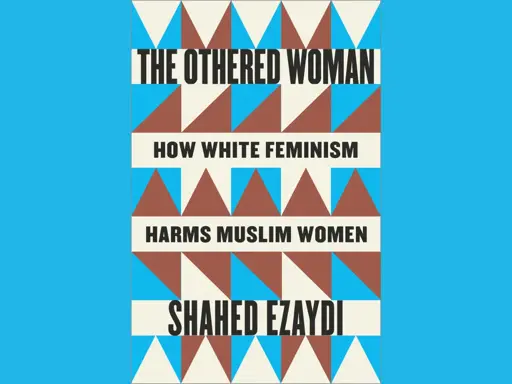

In her debut book—*The Othered Woman—*Shahed Ezaydi blends sociopolitical analysis, multimedia research, and personal experience to critique white feminism. She explores the phenomenon as a mindset, unchecked ego, and a place of privilege (with race playing second-fiddle).
Ezaydi’s no-holds-barred approach challenges reductive framings of Islam as the ball-and-chain holding back women. She flips the script, delivering a sobering account of how white saviorism silences Black and Brown voices, and assumes the unelected role of ‘representing’ them— think ‘comic relief,’ colonial Britain, and Priti Patel.
The Othered Woman is sorely needed
In her own words, Ezaydi writes:
It’s a feminism that does not consider the intersectionality of women, ignoring how misogyny intertwines with racism, Islamophobia, and ableism, for example.
Its adherents, she adds, use “representation” to “reinforce existing structures of oppression behind a mask of superficial progress”.
This rigorous study—written with her younger self in mind—reminds readers that Muslim women are not your Cinderella story. Our pain should never justify another person’s congratulatory posturing, especially when it inspires neoliberal policies detrimental to Muslim women and their societal inclusion and employment prospects.
The main charge across Ezaydi’s chapters (mini-essays, as she calls them) is the “box of silence” white feminism imposes on Muslims. Its proponents are unable or unwilling to look past Islam as “the single issue of oppression”. Islam is their boogeyman, the antithesis of ‘girl boss’ or ‘lean-in’ feminism, which overlooks wider and varied structural factors of oppression.
White feminism routinely sidelines Muslim women
Rather than acknowledging the agency of Muslim women, this kind of feminism suggests Muslims can only be ‘saved’ by ditching the hijab, adopting a ‘work-life balance’ lifestyle or embracing ‘pussy power’ slogans (think FEMEN)—while blaming Brown and Black ‘sisters’ for not achieving so-called feminist wins. It tells Muslim women “what their problems are,” instead of passing the mic. In other words, the metrics of Western feminism are skewed: short skirt (check), free flowing hair (check), immodesty (check)—not exactly what panned out in Iraq or Afghanistan whose women were promised unconditional freedom as it never existed.
This isn’t naive nor incidental, as laid out in Chapter 3. White feminism—borrowing from its colonial brethren—villainises Islam to promote itself as the ‘rescuer.’ The author demonstrates how this ideology is embedded in popular culture, where hijabis are either haplessly oppressed, submissively docile, or are would-be-terrorists (think Shamima Begum). Each of these uphold an image of Islam as backwards and uncivilised — precisely the tunnel vision this book tackles head-on.
Ezaydi singles out hit TV series such as Homeland (2012) and Bodyguard (2018) as contemporary examples which flit “between [these] two stereotypes”. Ezaydi views these dangerous portrayals as an extension of colonialism’s ‘civilising’ mindset. Her research uncovered a 1950s French colonial poster addressing Algerian women. It depicts two faces, one with and one without a veil, emblazoned with: “Are you not pretty? Then unveil yourself!”
It’s evident from the rich body of literature and case materials she relies on that the hubristic underbelly of colonialism is replicated by white feminist crusades. They operate from the same playbook, denying Muslim agency, neglecting their voices, and grand-standing on their struggles for self-gratitude and political point-scoring. It’s the old ‘you need saving’ chestnut.
Ezaydi’s ability to support her argument with stats, media coverage, and public interviews is a particular strength, adding muscle to her argument. Of particular interest are the TV interviews The Othered Woman discusses, in which Muslim subjects are belittled through aggressive, interrogative interviews that uphold the view of Islam as inferior. In terms of the selection process, Ezaydi told the Canary that her social media algorithm provided ample material evidencing the “otherisation” of muslim subjects.
Saviourism meets bigotry
Ezaydi and I discussed the deeply offensive Women’s Hour interview with Zara Mohammed, the first woman to lead the Muslim Council of Britain (MCB). Emma Barnett, in her combative signature style, was less interested in shining a light on Mohammed’s leadership success. Instead, Barnett set about berating her guest relentlessly over the question of “how many female imams are there in Britain.” Mohammed answered the question but was interrupted, spoken over, and mocked. Barnett’s intent was clear: reinforcing damaging, prejudicial tropes about Islam.
Ezaydi explained to the Canary that Barnett—whom she wasn’t so familiar with before this saga— asked questions that weren’t “coming from a willingness to learn” but aimed at “packaging and reinforcing these harmful tropes into your five-minute interview”. It’s a “perfect example,” she said of how white feminism manifests itself in real-life interactions and underwrites the successes of its Muslim counterparts.
Another striking example of the hostility Muslim guests face appears in chapter 4 of The Othered Woman, recalling a controversial interview between TalkTV host Julia Hartley-Brewer with Palestinian MP, Mustafa Barghouti. Despite repeatedly speaking over her guest, she accused him of exactly that, and ended the conversation (if you can call it that) by saying: “Sorry to have been a woman speaking to you but there you are*.*”
The inference here is that Barghouti doesn’t know how to address women because, you know, Muslim men act from a place of ‘unique” misogyny—which is the very title of the chapter. By projecting this false image, Hartley-Brewer sought to vilify Barghouti for expressing views she disagreed with.
Minimisation emerges as another tool used by White feminism to maintain superiority, glossing over and reducing the nuanced political views held by Muslims. Hartley-Brewer’s attack on Barghouti—accusing him baselessly of misogyny—serves as another classic example of how white feminists invalidate Muslim women.
White fragility
The most poignant argument at the heart of both the book and white feminism is the proclaimed innocence and fragility of its adherents. Ezaydi sharply critiques this mindset, explaining how it’s rooted in self-perceived innocence—a cornerstone of this feminist brand. Its followers bristle at the slightest criticism of unconscious racism, often responding with familiar defenses like “I have a Muslim friend” or “my partner is of Muslim heritage”. Other times, they tone-police their Brown and Black counterparts—many of us have encountered that one boss who insists on having ‘good intentions’. “It’s that discomfort which festers into fragility and defensiveness in white feminists,” Ezaydi writes.
Speaking about the book’s origin story, Ezaydi told the Canary how she wrestled with the idea of writing a “half narrative memoir, half fiction,” adding:
A memoir wouldn’t have worked. My sole voice wouldn’t have quite worked for the topic. The introduction is quite personal as I want people to relate to me.
Instead, she opted for a nonfiction text in the form of The Othered Woman—academic in tone, yet widely accessible through its concise approach. In doing so, Ezaydi deftly avoids being cast as a token Muslim voice (a role she’s often been thrust into), and instead highlights the scholarly contributions of Muslim thinkers and writers whose work is anything but marginal. It’s clear that Ezaydi has written the book many of us wished we had in our school curricula, libraries, and bookstores. For Muslim women in particular, it serves as a reminder that the two aspects of our identities—faith and feminism—are not at odds with each other.
To purchase a discounted copy of The Othered Woman add the code ‘CANARY’ at checkout to apply a 40% discount. The code is valid until July 2026.
Featured image via Pluto Press
By Nazli Tarzi
From Canary via This RSS Feed.