

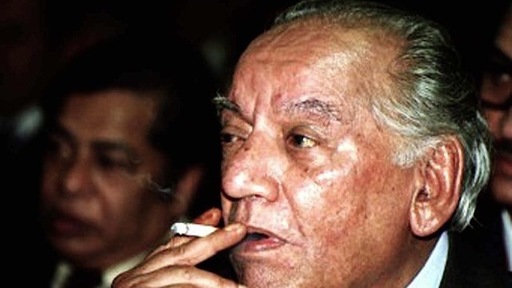
It was in 1973 that Faiz Ahmed Faiz landed at the José Martí airport in Havana, and the first voice he heard was the echoes of Fidel Castro’s speech on the loudspeaker. The most renowned communist poet of Pakistan opened his travelogue by saying he has stepped into the country where people once accustomed to hunger, poverty and exploitation are building a new society that will be the beacon of hope for the oppressed of the world. This piece of writing also shows us Faiz as a political analyst – a comrade who took it upon himself to document a journey which shed light on the experience of the Cuban revolution for the people of his own country. His own words profoundly capture the task he set out to do;
“About Cuba, we had no clear image, no picture in our minds. We knew only that there were American gangsters there, and many bars and gambling dens … Then came the revolution. A strange feeling arose – that in this distant, unknown island, a peculiar flame has been lit, the light of which begins to dazzle the eyes of Russia and America, and you and me. You too must have wondered what this flame is and why. Last month I had the opportunity to see the sparks of this fire with my own eyes and to feel its warmth in my own body.”
The land where everyone sings
The travelogue is also a documentation of people’s history and the flow of writing is chronological. In 1959, Faiz wrote that Cuba was a whisper, a footnote in newspapers owned by men who called revolutionaries bandits. It was not a nation but a plantation where two-thirds of the land was owned by just 8% of the landowners. The United Fruit Company and American corporations controlled vast stretches of the most fertile soil. Peasants tilled the land that was never theirs, their labor feeding the profits that flowed North. Illiteracy stood at over 40%, with entire villages without schools, where no one could read or write. This was the Cuba that the revolution inherited, a US colony in all but name headed by the military dictator Batista.
Faiz goes on to narrate the story of Fidel Castro which is layered in deep emotion. It is impossible to ignore that the events of the struggle in Cuba that are mentioned, evoke memories of the 1968-1969 revolutionary uprising in Pakistan which toppled the military dictatorship of Ayub Khan. Upon reading Fidel’s account of Moncada – of young revolutionaries slaughtered after attacking a barracks, of comrades tortured but refusing to betray – he recognized a familiar spirit. Just five years earlier, he had witnessed Pakistani students in Rawalpindi, worker-student protests burning police stations, and peasants in Hashtnagar taking up arms. The names and geography were different, but the courage was the same. In Cuba’s martyrs, Faiz saw the unfulfilled promises of Pakistan’s own revolution. In Fidel’s defiant words, “history will absolve me”, he heard an echo of every young revolutionary that had fallen, from Asia to Latin America.
The words of Fidel struck the poet so deeply, that he ended up translating the entire speech into Urdu for the readers, instead of summarizing it in his own words. Faiz then turns his attention to the achievements of the Cuban Revolution he saw at the time. The Agrarian Reform Law broke the estates and the land was redistributed amongst the peasantry. Clinics were built in every district and preventive care reached villages that had never seen a doctor. In his beautiful prose, Faiz describes the conversion of the Moncada Barracks into a school. Former military installations were being turned into classrooms and education was made completely free, from primary schools through university. Illiteracy had been reduced to just 3% within 14 years of the revolution’s victory. Faiz contrasts this to pre-revolutionary times by observing that “Now, anywhere you go in Cuba, from one end to the other, you will see schools.”
Faiz concludes this section with the experience he found most unforgettable about the Cuban Revolution: how there is no distinction between the government and the people of Cuba. He recounts that in his exchanges with ordinary Cubans in the streets, fields, factories and campuses, the leaders are talked about by their first names – as if everyone carries Fidel, Che, Celia and others in their everyday lives like they know them. The leaders labored and struggled with the people, through crisis and hardship to build socialism. The darkness that engulfed Cuba under direct US-backed dictatorship is lifted by the melodies, arts and music hummed by a nation that stood up for its revolutionary ideals. Joy emanates from the pages as Faiz writes, “Here, everyone sings.”
The debt we owe to humanity
Towards the end of the travelogue, we are presented with the threats and pressure that US imperialism is continuing to exert upon Cuba to undermine the revolutionary project. Faiz was writing this at a time when Cuba was being embargoed and had already triumphed against US interventions such as the Bay of Pigs. He cut through Cold War propaganda by stating clearly what the bourgeois historians deem the “Cuban missile Crisis” was nothing but a defense of sovereignty by the Cuban people in the face of foreign aggression by former colonizers. This stranglehold of Cuba at the hand of imperialism is seen clearly today by the unilateral sanctions, blockades, and threats that the United States makes against it. Faiz understood the impacts of these counter revolutionary attempts and wrote, “Revolution is not a luxury, it is a class war. And in war, there are wounds.”
In 2005, Pakistan was devastated by a 7.6 magnitude earthquake which claimed over 73,000 lives and left millions homeless. The world pledged aid but Cuba’s response was unlike any other. This country 13,000 kilometers away, under a punishing US blockade, did not even wait for diplomatic formalities or political gain. Within a week, the first Cuban medical brigade landed in Rawalpindi, with surgical kits and field hospitals. What followed was the largest medical mission in history of Cuba’s Henry Reeve International Brigade. Over the next seven months, more than 2,400 Cuban medical personnel would serve in Pakistan. They established 32 field hospitals in Khyber Pakhtunkhwa and Kashmir. As other international teams left, the Cubans stayed and went to affected villages without roads that the world had forgotten. Experts warned of a second wave of deaths from disease exposure. However, that wave never came due to the tireless efforts of Cuban doctors.
Once again in 2006, Fidel Castro made yet another gesture of solidarity to the people of Pakistan. Cuba would provide scholarships for Pakistani students to study medicine free of cost. To date, approximately 1000 Pakistani doctors have graduated from Cuban universities, having been trained to serve their communities often in the same neglected regions where Cuban doctors first worked. Cuba has welcomed Pakistan’s Health Minister in 2025 to observe the healthcare infrastructure firsthand. Even last year, three students from rural Punjab were enrolled with full scholarships in Cuban universities to continue this program. History stands as proof of Faiz’s words half a century since he wrote: Cuba’s revolution was never just about Cubans, but about the dignity of all of the oppressed.
We must ask ourselves whether we have given the same support to Cuba as it faces fuel shortages and blackouts due to the US oil embargo. What Cuba gave to Pakistan was aid without conditions, in stark contrast to the structural adjustment programs that institutions like the IMF place upon countries like ours which cut public spending and pull us deeper into debt. Cuba sent doctors to save the lives of millions of Pakistani citizens. The United States sponsors wars that have killed and displaced millions in the region. What we owe to Cuba is thus a debt to humanity itself. I want to end with this lesser known poem by Faiz which he recited in an evening in honor of Cuba:
“Yesterday
You had been the voice for a blooming island
If not more, you were the leader of some 7 million people
Today
Millions more in China stand shoulder to shoulder with you
And thousands of tongues pay homage in your name
Today
You are the voice of three continents
You have been inscribed in history as an eternal call
You are for the ages and generations to come,
You have bestowed the grace of struggle upon enslaved peoples
In every era, you are the harbinger of spring
Which despite hardships, will always mark the rights of humanity.”
Fatima Shahzad is the general secretary of Progressive Students Federation (PrSF), an organizer with Socialist Reading Group (SRG), and an artist from Pakistan.
The post Faiz in Cuba: a revolutionary poet’s account and why it still matters appeared first on Peoples Dispatch.
From Peoples Dispatch via This RSS Feed.