

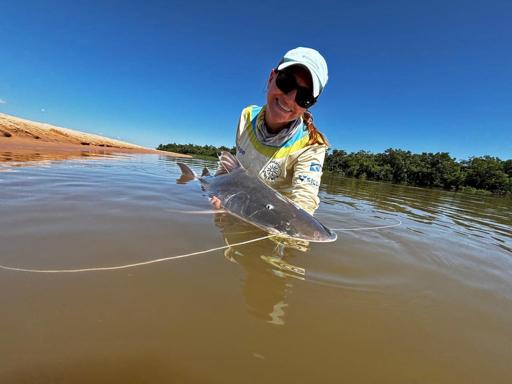
CAMPO GRANDE, Brazil — In the wide, sandy stretches of Brazil’s Araguaia River, the piraíba, South America’s largest catfish, is a cornerstone of local fisheries. Fishers often recognize individual fish by markings and scars, catching the same fish in the same places over time, leading many to believe the species did not move very far. But new work by researcher Lisiane Hahn reveals something surprising: The piraíba travels hundreds, if not thousands, of kilometers to spawn. Using acoustic telemetry, Hahn and her colleagues implanted transmitters in nearly 100 catfish, some nearly 2 meters (6.5 feet) long, and tracked their movements via a network of receivers. The data provide the clearest evidence yet that piraíba (Brachyplatystoma filamentosum), which can reach 200 kilograms (more than 440 pounds), undertake extensive, long-distance migrations. “As a researcher, it’s emotional to discover this in such an iconic species,” said Hahn, who leads Projeto Peixara at the Federal University of Mato Grosso in Brazil. “You imagine the largest catfish in South America moving across entire river systems.” Researcher Lisiane Hahn and her team implant acoustic transmitters in a piraíba on Brazil’s Araguaia River as part of a project tracking the long-distance movements of giant catfish. Image courtesy of Lisiane Hahn. The finding underscores a broader reality: Some of the most important wildlife migrations in South America — and around the world — have remained largely out of view. In the Amazon and other rivers in South America, giant catfish move underwater between nations along routes that connect…This article was originally published on Mongabay
From Conservation news via This RSS Feed.