

Bullets:
Inside China / Business is a reader-supported publication. To receive new posts and support my work, consider becoming a free or paid subscriber.
Of all the major Asian economies, China’s is the least impacted by the war in the Middle East.
China spent decades reducing its dependency on foreign fuel supplies. They electrified transportation systems, and developed the world’s most comprehensive power grids for renewables.
China also has an estimated 1.3 billion barrels of crude oil in reserves, and continues to receive oil shipments from Russia, and even Iran.
Other economies across Asia have high reliance on crude and gas imports from the Persian Gulf, and already face severe shortages, while policymakers are rationing fuel.
Hundreds of Western companies diversified manufacturing out of China, to reduce geopolitical risk and strengthen supply chains. Those factories now see soaring electricity and fuel costs, if they can secure energy supplies at all.
Report:
Good morning.
Energy markets across the world are freezing up, because of the war in the Middle East. A handful of ships are allowed to pass through the Strait of Hormuz, for the ship owners who pay in Chinese renminbi, and in particular who will be bringing cargoes to China. That leaves other countries in Asia in a bad spot.
Of the major economies, the Chinese are in a better position than anyone else in Asia, except Russia obviously, to muddle through these massive oil supply disruptions. Decades ago China put in policies to reduce their dependency on foreign suppliers, and today have two huge advantages over countries elsewhere.
First, over half the vehicles sold in China today are electric vehicles, and that electricity is generated with domestic energy supplies.
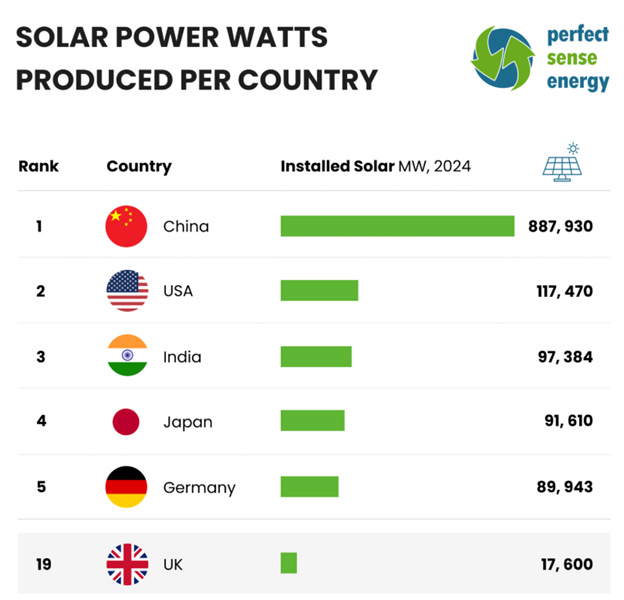
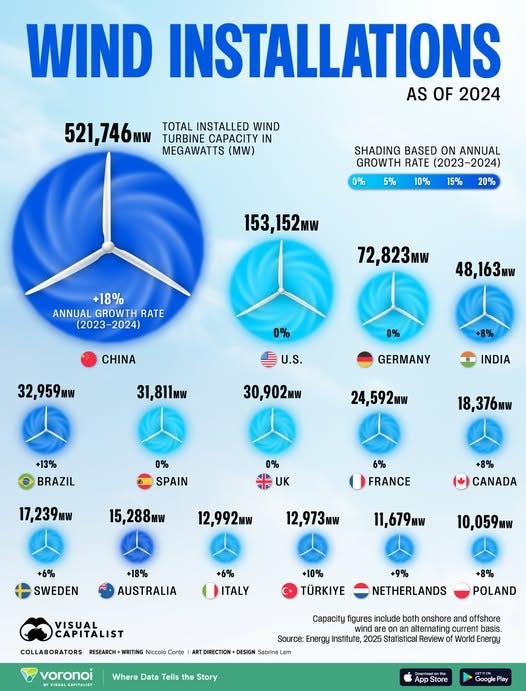
Further, the Chinese electric grid is powered by a far higher share of renewable energy than anywhere else. China installs more new solar capacity than the rest of the world combined, and just adding to their lead in solar power generation. They also dominate in wind power. Currently the United States leads in nuclear power plants online, but China has more nuclear plants under construction than the rest of the world combined:
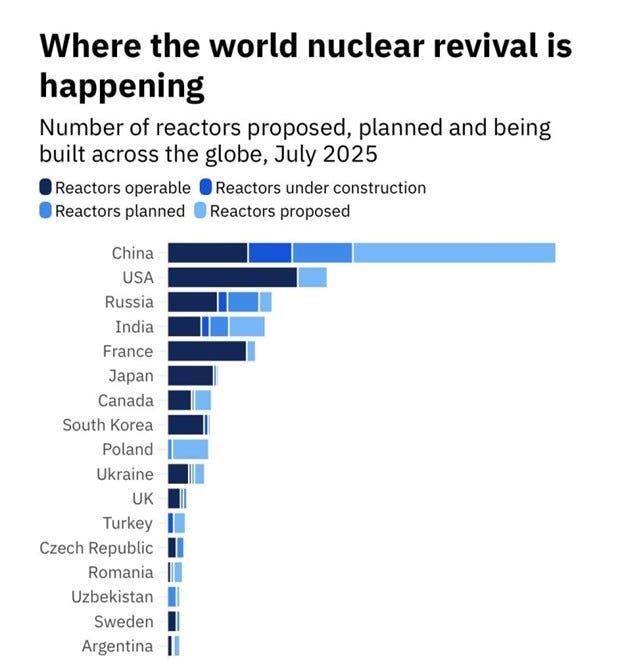
So as China has electrified their transportation networks, they’ve also built out an electric grid that’s fed by renewables and domestic sources of supply. China still does import three-fourths of its crude oil. But for the past several years China has been overbuying, and stashing surplus crude into storage tanks.
They don’t publicly disclose their stockpiles of crude—our analysts are guessing at the import numbers because they’re not really sure what comes across from Russia, or on tankers that are under sanction. So they are also just guessing how much is going into stockpiles, but industry insiders put the number at around 1.3 billion barrels. Remember, too, that there still is oil flowing from Iran to China, despite the war. So compared to the other countries in Asia, China is the least impacted by the war in the Middle East.
South Korea is capping prices, which won’t do anything. Pakistan is increasing gas prices by 20 percent for car drivers to free up supplies for trucks and buses, even though wholesale gas prices are up much more than 20 percent. In Vietnam, gas stations are already running out, and the government there says they have oil for another month or so and are telling their populations not to hoard fuel.
The Philippines gets 90% of its oil from the Middle East, and government workers there are working 4 days a week. Bangladesh is rationing fuel and closing universities to save electricity. In India, the crematoriums can’t get enough LPG to burn bodies, so they had to close down.
These are the countries who sold themselves as viable manufacturing centers, to global companies looking to de-risk from China. Thousands of companies attempted a “China+1” strategy, and moved some production out of China to these neighboring countries to reduce geopolitical risk, just traded one problem for a bunch more.
The idea was that diversifying production away from China means a reduction in risk, and somehow a stronger supply chain. But that was an illusion. These countries are dependent on the smooth flow of fossil fuels from the Middle East, at low prices, to run their power plants and transportation systems.
That’s gone, and today those factories are paying a lot more to keep the lights on, and get their people back and forth from home.
Be Good.
Resources and links:
China Is Filling Up Its Oil Reserves Fast
https://www.wsj.com/business/energy-oil/china-is-filling-up-its-oil-reserves-fast-444b8edb
West Asia crisis: Pune gas crematoriums shut temporarily amid LPG restrictions
https://economictimes.indiatimes.com/industry/energy/oil-gas/west-asia-crisis-pune-gas-crematoriums-shut-temporarily-amid-lng-restrictions/articleshow/129306252.cms
Price Caps, Rationing and Stockpiling: Alarm Swells Over Oil Disruptions
https://www.nytimes.com/2026/03/09/business/iran-oil-gas-asia.html
New York Times, China’s Edge in an Oil Shock: Electric Cars and Renewables
https://www.nytimes.com/2026/03/14/business/china-oil-cars.html
Hundreds of petrol stations across Australia run out of fuel as Labor inks supply deal with Singapore
https://www.theguardian.com/australia-news/2026/mar/23/petrol-stations-australia-fuel-crisis
Chinese oil imports boom, with giant volumes going to strategic reserves. How much? Nobody knows.
Top 5 Countries Leading in Solar Power Adoption
https://perfectsenseenergy.com/solar-insight/top-countries-leading-in-solar-power-adoption/
The China+1 manufacturing diversification strategy
https://china.acclime.com/guides/china1-strategy-diversifying-manufacturing/
Chinese boxship pays Iran for Hormuz passage as corridor traffic grows
https://www.lloydslist.com/LL1156689/Chinese-boxship-pays-Iran-for-Hormuz-passage-as-corridor-traffic-grows
Iran still exporting millions of barrels of oil through Strait of Hormuz even as other traffic paralyzed
https://www.cnn.com/2026/03/16/business/iranian-oil-exports-horm
Inside China / Business is a reader-supported publication. To receive new posts and support my work, consider becoming a free or paid subscriber.
From Inside China / Business via This RSS Feed.