

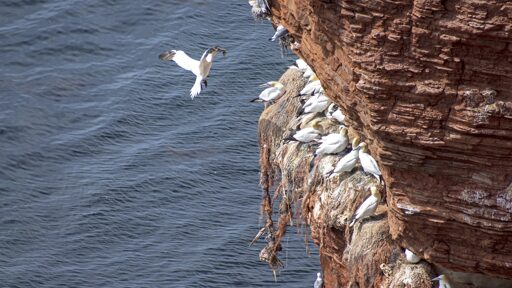
The northern gannet, a seabird that lives across the northern Atlantic Ocean, typically builds its nests from seaweed and other aquatic plants. But more recently, its nests have started to include plastic material fished from the ocean. Martin Brogger, a researcher at Argentina’s Institute of Marine Organisms Biology (IBIOMAR), photographed several gannet nests containing plastic fishing lines, nets, plastic rope and other garbage in Heliogoland, a North Sea island off the coast of Germany. And the northern gannet (Morus bassanus) isn’t the only seabird running afoul of plastic waste. A 2021 study looked at more than 10,000 seabird nests across five countries in northwest Europe and found 12% of them contained plastic. Sometimes, the plastic in the nests leads to entanglement, or young birds being accidentally fed pieces of plastic. Another study, published in 2020, found five species of European seabirds commonly incorporated plastic into their nesting behaviors. They built their nests with plastic and even fed plastic to their chicks, raising concerns about breeding success and survival. The study found plastic was found in 32% of herring gull (Larus argentatus) nests, 53% of great black-backed gull (Larus marinus) nests and 80% of European shag (Gulosus aristotelis) nests. Banner image: Northern gannet (Morus bassanus) nest made largely of plastic debris. All images courtesy of Martin Brogger.This article was originally published on Mongabay
From Conservation news via This RSS Feed.