

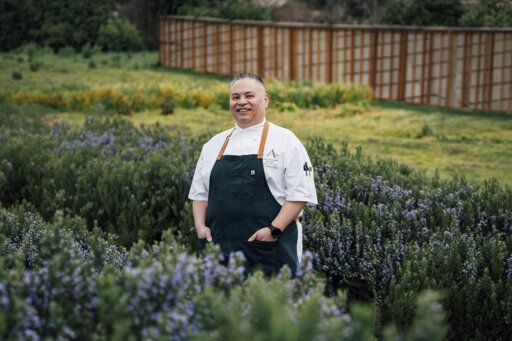
My name is Jack Strong, and I’m a member of the Confederated Tribes of Siletz Indians. I’m the executive chef of The Allison Inn and Spa in Newberg, Oregon, and I’m a partner with the Siletz Valley culinary program at the school that I went to as a kid.
Students in the course cook from-scratch meals for the entire school (K through 12), located just outside the Siletz Reservation, in central Oregon. They also run a food truck, which is named YA-TR’EE-YAN (“a gathering of people around food” or “feast” in Dee-ni) and offers free meals to students and tribal members during the summer. They serve some recipes from my cookbook, too, with Native ingredients like venison, elk, salmon, and sablefish.
I’ve heard Native foods described as the first cuisine of the Americas and the last to be discovered. All these different Asian and European cultures are represented in the U.S., but until recently people wouldn’t even say there is a Native cuisine. Coming up, I didn’t have any Native chefs to look up. Telling that story, at the restaurant and to my students, has been something I’ve really tried to do.
I was raised on the Siletz reservation in central Oregon by my grandmother and grandfather. I enjoyed growing up in a small town. It felt safe; you knew everyone; there was no traffic. There was the forest where you could run around a little bit, and the river for fishing, and this place called the play shed, where I played basketball. You got to experience different sports because there weren’t a lot of kids—they needed everybody to make a team.

One of Strong’s signature dishes at JORY: Pan-roasted Skuna Bay King salmon with a salmon skin chip, set on sunchoke purée and quinoa and topped with cranberry relish and radish microgreens. (Photo credit: Kari Rowe)
My grandma would tell me stories about the history of our family and tribe. There was a time when we were a recognized tribe. Then, from the 1950s to the 1960s, the U.S. government eliminated federal status for tribes. We lost all federal recognition, access to land, resources, benefits. We call that the “termination” period.
What we have now in Siletz is a mere fraction of what our original land was. We moved here from our ancestral homelands, which are primarily from Southern Oregon into Northern California.
Termination was a tough time for our tribe, but they continued to fight to be recognized as a sovereign nation again and have land to create a home that would be ours for generations. Many tribal leaders made trips to Washington, D.C., to speak in front of Congress on our behalf, including my grandfather, who was on our tribal council as well as being a war veteran. In 1977, we regained federal status.
I was fortunate because as I grew up, the tribe started do more culturally important activities that we hadn’t done during termination. Our community started what we call “culture camp” that we still do every year over a weekend. They were teaching the youth things like basketry making and preparing eels to eat. My grandma would tell stories about teaching herself everything—like her amazing beadwork —and was a big part of making sure I went to that camp to learn about our culture.
“Friends and family knew there was always some kind of meal happening at the Strong house.”
My grandfather passed away when I was ten, but growing up, my grandmother was working and he was retired, so I originally started cooking for him. It was basic stuff that I learned from my grandmother—who cooked everything from scratch for us—and I learned I had a love for being in the kitchen.
I got into fishing as a young teenager. The Siletz River runs through the town and reservation, then it joins the ocean in the Siletz Bay. Growing up, I’d see salmon and steelhead trout spawning in the river.
My family was connected with seafood. My uncle was known for his smoked salmon—he would barter with smoked salmon like currency. He’d dig for clams and mussels, too. My other relatives worked in seafood processing. They would bring my grandma salmon heads. She would boil them and eat all the parts—the eyeballs, the cheeks. Later, in my first job out of culinary school, I did a lot of seafood butchery, and we would break down all of our salmon, and I’d bring the heads to her as gifts.
I’ve been asked quite a bit throughout my career about my grandma’s cooking. Her time was so much about survival. It was being taken from your homelands and away from your native foods. Growing up toward the end of that in the ‘80s, we were still on commodity foods—the flour and fats and sugars that were given to us. One of my first early times helping her in the kitchen was making noodles from scratch for chicken noodle soup.
Friends and family knew there was always some kind of meal happening at the Strong house. It was never just us eating by ourselves—it was always people coming over. I had this connection that food equates to taking care of other people, it gives you a sense of home and community.
My Culinary Influences
My first job was in high school at a fish-and-chips place in Newport, along the coast, 20 minutes away. It was a husband and wife who owned it, and they were mentors for me. He would go down to the boats on the bay front and get fresh fish, bring it back, and teach us how to fillet it.
I learned to appreciate fresh products and also the basics of hospitality, like cleanliness and multitasking, and how to interact with guests and the importance of being a strong player to support the team.
Afterwards, I enrolled in a two-year hands-on culinary program at Lane Community College in Eugene, and then at a local restaurant. That chef asked me to do a dish that might speak more to my culture.
I thought of fry bread, which was such a big part of our culture, but also came out of survival. My chef was Jewish, so I made a play off of lox and bagel with fry bread and cold-smoked cured salmon lox. That was probably the first-ever dish highlighting some part of my culture. That’s when I started to do what I do now every day.
After eight years at the restaurant, I started to get itchy. I wanted to try something else. I got an offer from the Phonecian Resort, near Phoenix, that had over 1,200 employees—more staff than people who lived in the town I came from. Arizona was the opposite of Oregon. Here, it’s beautiful and green and wet. There, it was dry and sunny every day. It was completely different from what I was used to. It was overwhelming, but I grew quickly there because I was like a sponge, absorbing everything.
I learned about the foods from the other beautiful tribes around there—the Navajo, Hopi, Gila River, Tohono O’odham. They’re all so different, and they’re all based off of place. Southwest foods include so many different chiles, beans, and corn—all Native foods. It was just so clear to see how these foods have sustained people for generations.

Students at the Siletz Valley School culinary program butchering local albacore tuna. (Photo credit: Rachelle Hacmac)
My Local Foods
After many years of working in Arizona—including at the Sheraton Grand at Wild Horse Pass, on the Gila River Reservation, and KAI, which is influenced by the food of the Akimel O’odham and Piipaash peoples—I ultimately came back to the Northwest to be close to family. Now, at The Allison in Newberg, I get to highlight Native foods in the kitchen and garden. I really love that—it’s my culture and home, and it’s nice to be able to share all the great things that come from here.
My role as a chef is about taking care of others, nourishing people. I’ve always felt like my part in this ecosystem is to support the farmers, the fishermen—to put money back into community.
If you’re getting any kind of tribal foods or just even local foods, usually they’re not really set up with infrastructure, so it takes extra effort on your part. At JORY, the fine-dining restaurant at The Allison, we use a lot of local.
“I’ve always felt like my part in this ecosystem is to support the farmers, the fishermen—to put money back into community.”
We have local fishermen through Northwest Fresh Seafood, which is a cute little fish shop right in Newberg. Our meats all come from Northwest Premier Meats nearby in Tualatin—her name’s Tina, and she takes care of us. Our cheese is from Briar Rose Creamery, 15 minutes away. Bread comes from our baker, Tim, at Carlton Bakery. We get our mushrooms and huckleberries and black and white Oregon truffles from Misty Mountain. We have a guy down at Oregon Royal Sturgeon, which is in the Fort Klamath area, and their fish is so fresh. For special events I might get something specific, like the Ozette potatoes from the Makah tribe up in Neah Bay, Washington, which I get through a gentleman who works for the Northwest Native Chamber.
Our produce is from local farms or our 1.5-acre garden, and last year we grew some Ozettes too. Anna, our master gardener, is so cooperative and passionate about what she does. We recently planted miner’s lettuce out there, which is a Native food. I do this dish called The Allison Garden, with a “soil” out of dark rye bread and vegetables stuck in that soil, with greens on the side. I use the miner’s lettuce as part of this dish.
Reconnecting With Native Traditions
Growing up, our Siletz language, Dee-ni, wasn’t taught in school. Now they have an online dictionary and programs in the elementary schools, so younger generations have access to our language. I learned what I know when I moved back to the reservation as an adult, going to once-a-month classes and coming home to put sticky notes on objects in the house. I mostly use our language around food—for things like lhuk (salmon), gus (potato), or ch’aa-ghee-she’ (egg)—especially on menus, because it relates to me that way.
When I was young, as far as I’m aware, the tribe wasn’t really foraging for traditional foods like huckleberries, and camas was only for ceremonies. Now every year I go picking huckleberries on tribal lands, and they’re one of my favorite foods. We serve them often at The Allison. You can go savory or sweet with huckleberries, and I’ve worked with the pastry chef, Shelly Toombs, to develop a huckleberry semifreddo.
My Work With Native Youth
In 2024, I got a message from Patrick Clarke, the director of the Siletz Valley School culinary program, which started the previous year. He said, “You should come out to the school and meet the kids sometime.”
I invited the class out to The Allison for a field trip tour of the garden and kitchen, followed by lunch and a Q&A. The class of about 20 students got to learn about cooking and other aspects of hospitality, including marketing, housekeeping, HR, accounting, admin—all these different jobs you can have under one roof at a place like The Allison. They asked me questions about my path and my advice for them. I feel like my path into the culinary world is very approachable, very driven by taking care of others and just pushing yourself to be the best you can.
It could have been just the one tour, but Patrick and I kept talking. Next, the school hosted me. They made lunch and gave a tour of the school and their food truck. The kids used the recipe out of my cookbook for fry bread, and I hopped in the food truck to make it with them.
Since then, a lot of what I do with the culinary program is giving them opportunities to learn and connect with other Native chefs—like at the Native American Heritage Month event we hosted at The Allison last November. The students helped with everything, from prep days to shucking oysters that night.
“I do whatever I can to give them experiences. The more experiences they have, the bigger and better picture they’ll see.”
I try to give them a path toward a good career in the kitchen, about being happy in what you do. But I’m also very transparent about the difficulties. You’re going to work holidays and your birthday, and you’re going to be taking care of others on their special days. It can be long days of physical work.
Siletz is a small town with no stoplights, a thousand people, and really no business besides a mini-mart gas station—unless you work for the tribe, and those jobs are limited. So it’s really all about exposure to new things. That’s half the battle—getting out of Siletz a bit and seeing what’s in the world. I do whatever I can to give them experiences, like going up into Portland and being part of the governor’s conference [in April 2025], feeding lawmakers and representing the tribe. The more experiences they have, the bigger and better picture they’ll see.
Last month, there was an event called the Blue Foods Forum in Portland, all focused on foods from the ocean. The kids cooked Oregon albacore and supported the chefs, including helping with a plating for a demonstration I led with tribal-caught salmon from Iliamna Fish Co.
Through the Oregon Albacore Commission, they also got to go out on a boat—which I know for some kids was their first time. They received a donation of whole albacore tuna that they learned to butcher. As part of the lesson, they took the fish heads and other parts of the skeletons and buried them to help create a natural fertilizer, as part of this full-circle journey so that nothing goes to waste and everything stays in the ecosystem.
It was like one of the times, as a kid, that I came back home with trout for my grandma. I didn’t clean the fish at the river, and she reprimanded me. She was happy I had caught trout, but she was like, ‘You need to gut those at the river. You need to wash the inside of their flesh with the water. All of what you cleaned out is going to be eaten by the crawdads and all the other life that’s in the river, and that’s part of the process.’ With the students learning how to break down albacore after the boat trip—that was their teaching moment of how everything is connected.
It’s really impressive to see how far some of the students have come. The program gives them direction; it pushes them to see what they can do, and it benefits the school and the community. I try to do whatever I can to support the students. For the past two years at JORY, we’ve had a special dish on the menu that highlights traditional Siletz foods, with some of the proceeds going towards the culinary school program.
I really connect with the youth in Siletz. As someone who came from that school, I understand what those kids are going through, what their opportunities are. For me, it’s personal—I can say: “I’ve sat where you’re sitting.”
This conversation has been lightly edited for length and clarity.
The post ‘Native Foods Have Sustained People for Generations’ appeared first on Civil Eats.
From Civil Eats via This RSS Feed.