

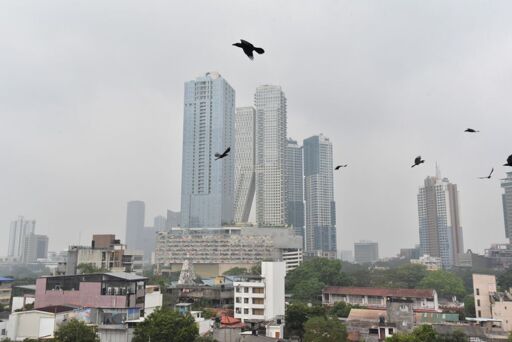
COLOMBO — On certain days, Colombo’s skyline is barely visible. This is due to a thick haze that envelops Sri Lanka’s commercial capital, resulting in low air quality conditions. The fouled air is making people tear and cough more without knowing what causes such irritation. Santhanam Mary has been a municipal worker for 13 years. Her daily job is to clean an area near the heart of Colombo. “Even though we physically clean the streets, there’s so much pollution around us,” she told Mongabay. Over the years, Mary recalled falling sick more frequently. “We [municipal workers] get frequent headaches, itchy eyes and cough and cold-like symptoms. We were asked to wear face masks when working, but it is difficult to wear them for a long time,” she said. Meanwhile, the latest real-time air quality monitoring map by the National Building Research Organization (NBRO) shows a reading of 82 micrograms per cubic meter in Badulla, the largest city in Uva province and 52 mcg per m3 in Kotte in Western province. This may answer a question Mary did not ask: the reasons for increasingly falling ill. In issuing warnings, the NBRO has said that Air Quality Index (AQI) fine particulate matter (PM2.5) readings between 101 and 200 are unhealthy for sensitive or at-risk groups. These groups include children, pregnant women, the elderly and people with preexisting heart or lung conditions. Santhanam Mary, a street cleaner, complains of frequent headaches and itchy eyes. Image by Kamanthi Wickramasinghe. According to the index, readings…This article was originally published on Mongabay
From Conservation news via This RSS Feed.