

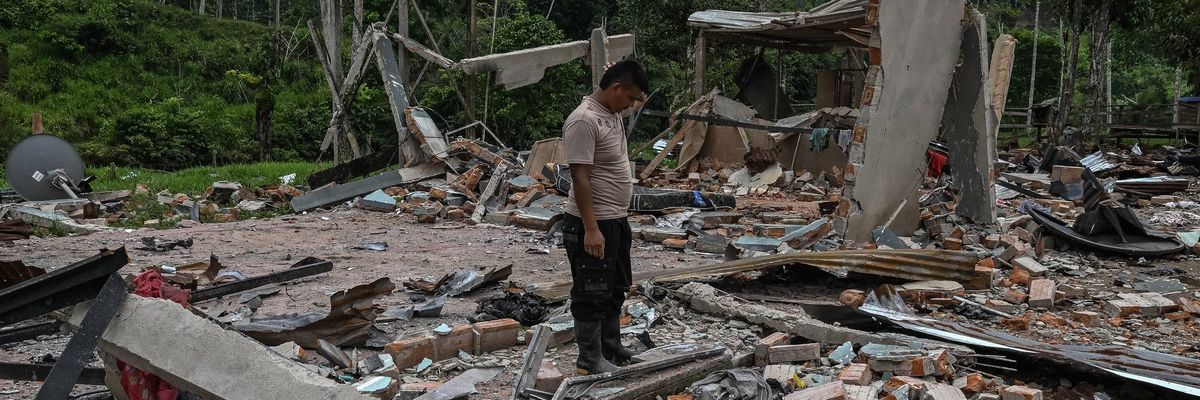
Just a day after President Donald Trump suggested that he’d use his crushing economic blockade in a bid to “take” Cuba, an administration official said much more American warfare is on the horizon across Latin America.
It’s called “Operation Total Extermination,” according to Joseph M. Humire, the acting assistant secretary of war for homeland defense and Americas security affairs, who testified last week before the House Armed Services Committee.
Humire explained in written testimony that beginning on March 3, the US Department of Defense (which the Trump administration refers to as the Department of War) “supported, at the request of Ecuador, bilateral kinetic actions against cartel targets along the Colombia-Ecuador border.”
“The joint effort,” Humire said, “is the start of a military offensive by Ecuador against transnational criminal organizations with the support of the US, setting the pace for regional, deterrence-focused operations against cartel infrastructure throughout Latin America and the Caribbean.”
The operation with Ecuador, led by the right-wing president Daniel Noboa, is part of “Operation Southern Spear,” the Trump administration’s illegal bombing campaign in the Caribbean and eastern Pacific Ocean, targeted at boats accused, with little evidence, of ferrying drugs to the US.
The latest of these bombings, which killed at least two more people, occurred on Friday and brought the total death toll since September of last year up to at least 160.
No casualty counts have yet been released by the US or Ecuadorian government for its operations to target what they said were “domestic terrorist organizations.” But reports from those on the ground suggest they may have been similarly bloody.
Víctor Gómez, a journalist for the Ecuadorian outlet Radio Sucumbíos, conducted interviews with the residents of the rural town of San Martín in northeastern Ecuador near the Colombian border, who said their community was attacked twice by Ecuadorian and American forces on March 3 and 6.
Noboa celebrated the attacks on the area, which he said housed “a training ground for drug traffickers,” and reportedly the home of “Mono Tole,” who is the leader of the Colombian drug trafficking group known as the Border Commandos.
But Gómez described the town as having “no trenches, no firing ranges, no traces of a clandestine military infrastructure,” adding that “the only things there are horses, cows, and donkeys, at least that’s what can be seen on the Radio Sucumbíos cameras.”
Locals, many of whom did not have their names published to avoid retaliation, describe military patrols landing on the riverbank on March 3 and launching an “ambush” against four farmers.
“They tied my hands and feet and then hung me up. They put me in a bucket of water, as long as I could stand it… they kicked me, they hit me with the butt of a gun," one of the workers described.
Another said that the soldiers “were looking for someone we didn’t know… they told us to hand things over, but we had nothing to hand over.”
The soldiers then reportedly “doused the main house and the wooden kitchen with gasoline” and set it ablaze, leaving the flames to consume large amounts of farm equipment.
As residents attempted to advocate for their loved ones, the farm owner said, “The commander in charge wouldn’t let us near; they greeted us with gunfire until they took them away.”
The four captured farmers were reportedly transported by helicopter to the capital of Sucumbíos, Lago Agrio, where one of the young men described being taken to a tiny room and tortured.
“They shocked us with that thing they called a taser," he said. “They poured water on me and placed it on my ribs and asked us questions.”
After finding no evidence of guilt, authorities released the four men near a hospital in the capital.
Three days later, planes and helicopters flew over San Martín, dropping bombs on the ruins of the same house that had already been burnt to the ground three days earlier and on another abandoned house.
Video of that bombing was shared on social media by the Ecuadorian Armed Forces.
“First they burned it on the 3rd, and then on the 6th they came to bomb it. That’s what they did," said the farm’s owner.
“How can it be a training camp if this is a livestock area?" he asked. “There is nothing to justify it, there are no training grounds, there is nothing.”
The Alliance for Human Rights Ecuador has called for an investigation into the military’s alleged “bombings, burning of homes, arbitrary detentions, torture, and threats against the civilian population,” which it said were “serious violations of international humanitarian law.”
The fallout from the attack has spilled over to create an international incident with neighboring Colombia. Two weeks after the bombing of San Martín, an unexploded 500 lb. bomb was discovered on a farm on the other side of the San Miguel River in Colombia’s Putumayo region.
The bomb was identified as a US-made Mark-82. According to the New York Times, “had the bomb exploded, it would have done so with the force of 192 pounds of TNT” and could have harmed people as far as over 1,900 feet away.
“We’re being bombed by Ecuador,” said Colombian President Gustavo Petro in response to the explosive’s discovery. Noboa denied the accusation, saying that “we are acting in our territory, not yours.”
Following the US military’s January abduction of Venezuelan President Nicolás Maduro, whom the US Department of Justice accused of drug trafficking, leaks have suggested that the US may soon attempt to bring similar charges against Petro, another left-wing leader who has resisted cooperation with Trump. Petro has denied accusations of drug trafficking.
One unnamed official told Nick Turse of The Intercept that attacks along the Ecuador-Colombia border “increasingly look like a coordinated campaign to foment ‘discord’ if not conflict” in the country.
In his hearing before Congress, Humire said that the US military was providing Ecuador with “capabilities that they otherwise would not have."
Humire said he was not sure how many strikes have been conducted on land so far as part of Operation Total Extermination, but responded “yes” when asked by the committee’s ranking member, Rep. Adam Smith (D-Wash.), if the Department of Defense would “be moving to a lot more terrestrial strikes."
He said that these attacks were “just the beginning” of a much broader campaign, adding that the US has entered into agreements with 17 partner nations in the Western Hemisphere as part of the so-called Americas Counter Cartel Coalition.
While Humire said the nations that have reached these agreements "want this support and most of them all are looking for this,” the same cannot necessarily be said for the people living in the crossfire of the operation.
Gomez said that the people of San Martín are still living with “psychological trauma” following the attack. According to the town’s vice president, Vicente Garrid, families are living in constant fear that their homes could be targeted next.
From Common Dreams via This RSS Feed.