


A parliamentary debate on Thursday 26 March will aim to give much-needed publicity to a group of chronic, genetic illnesses that most medical professionals class as ‘rare’ – when in fact they are just rarely diagnosed. Moreover, it will hopefully shine a light on two even less diagnosed conditions that are comorbid with this group – but which can be life-threatening.
EDS: not rare, just rarely diagnosed
The Ehlers-Danlos syndromes (EDS) are a group of 13 complex genetic tissue disorders. These conditions affect the entire body, often leaving people in daily pain, exhaustion, and isolation. The hypermobility spectrum disorders (HSD) are connective tissue disorders whose features overlap with the most common type of EDS, hypermobile EDS.
These conditions are lifelong, incurable, and chronically under-recognised, with limited treatment options and far too little understanding. EDS and HSD also often come with other long-term conditions such as mast cell activation syndrome (MCAS), postural orthostatic tachycardia syndrome (PoTS), gastroparesis, myalgic encephalomyelitis (ME), and Long Covid.
Peer-reviewed studies indicate that as many as 1 in 500 people in the UK (over 135,000 individuals) are living with EDS or HSD, many of whom remain undiagnosed for years or even decades. The lack of awareness means people are often misdiagnosed with anxiety, depression, or psychosomatic illnesses. This leaves them feeling dismissed, isolated and without access to the care they need.
Life-threatening conditions
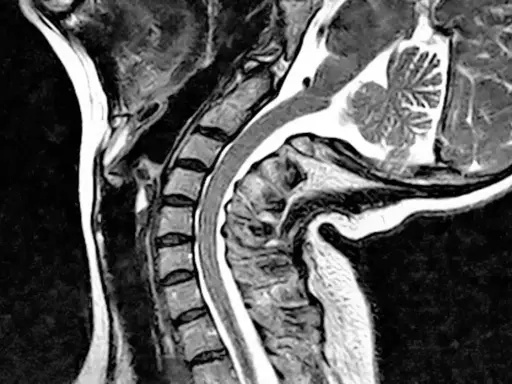
However, what are even less-readily diagnosed are craniocervical and atlantoaxial instabilities (CCI and AAI). These conditions are characterised by the joints in the cervical junction moving in ways they wouldn’t in someone without EDS. It means that often, blood flow to the head is restricted, and nerves in the neck are compressed or even damaged.
In the worst cases, any injury to a person’s neck or head can cause cerebrospinal fluid leaks from either the neck or head areas. Crucially, CCI and AAI can also be so severe that a person’s brain and skull begin to sink onto their cervical junction – which can be life-threatening.
Yet on the NHS, these conditions are not recognised in the context of EDS and HSD. They cannot readily be diagnosed due to the need for an upright MRI scanner. And if they even are, there are no treatment options available.
For people in the UK with severe CCI and AAI, the only options are to pay privately abroad for surgery to effectively fuse their cervical junctions in place – and this carries huge risks.
Neglected and ignored
Yet the government knows all too well about EDS, HSD, and CCI/AAI. However, successive administrations have failed to take any meaningful action. The Canary was told by one senior NHS neurosurgeon that he and a group of other senior practitioners advised the-then health secretary Jeremy Hunt in 2013 that upright MRI scanners were desperately needed in the NHS. He ignored them.
Fast-forward to earlier in March 2026, and the now-Labour government effectively batted-away an MP’s question over CCI and AAI; failing to recognise the disastrous state of care for people living with the conditions.
There are a lot of reasons why medical professionals and successive governments have ignored EDS and is associated comorbidities. Misogyny is one. Most people living with the conditions are women. Prejudicial tropes are another. For too many years, people called those living with EDS ‘double jointed’ and they were all too often misdiagnosed with other illnesses. The psychiatry lobby is involved, too – as it all too often seems determined to psychologise what are actually physical illnesses. Plus, a lack of robust research is another.
So, on 26 March Labour MP Josh Newbury organised a Westminster Hall debate on EDS, HSD, CCI, and AAI. You can get involved by asking your MP to attend. Charity EDS UK has created an online letter tool, which you can access here.
EDS must be properly recognised
EDS UK is calling for urgent, practical changes to improve care:
- Integration of EDS and HSD into NHS service specifications and long-term condition strategies.
- Joined-up, multidisciplinary care across primary and secondary services.
- Training and support for healthcare professionals.
- A national multidisciplinary team (MDT) for rare complex cases like CCI.
However, the Canary is well aware this will not be easy. So, the more MPs that attend the debate the better. EDS and its comorbidities are devastating for the people living with them and their loved ones. The government needs to do so much more – and this debate could hopefully be the start of that.
Featured image via the Canary
By Steve Topple
From Canary via This RSS Feed.