

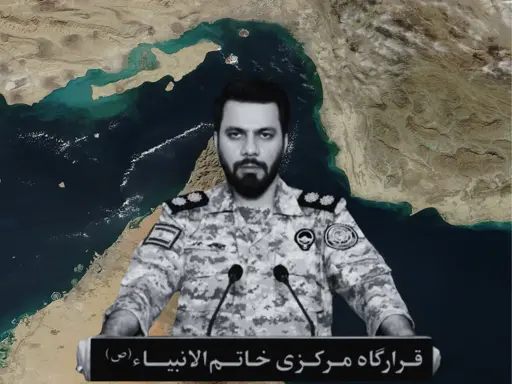

Iran appears to be asserting its power over the Straits of Hormuz, a key maritime route which carries a fifth of the world’s oil and gas shipments.
The US-Israeli war against Iran—as the Canary previously reported and predicted—saw Tehran lock down the narrow channel.
The conflict began with unprovoked US-Israeli strikes on 28 February. It has been since been reported by the Pentagon, its European allies, and the UN atomic watchdog, that there was no imminent threat from Iran, nor evidence to suggest it was developing a nuclear weapon.
If it wasn’t clear from Trump’s fuzzy comments, the war has been going terribly from the get-go. Donald Trump is still searching for off-ramps while threatening to strike Iran if it obstructs vessels passing through the narrow strait.
And as the war of words continues, the US still appears to be sending thousands of US troops to the region.
While Trump says he’s holding talks with Iran, the U.S. is still deploying thousands of troops against Iran.
— USS Boxer ARG + 11th MEU (~2,500 Marines).
— USS Tripoli ARG + 31st MEU (~2,200 Marines).
Total in region: 50,000+ US troops
82nd Airborne Division (paratroopers):…
— Clash Report (@clashreport) March 23, 2026
And Trump has even suggested that the US and Iran could control the straits jointly.
Iran’s approach has been much less erratic. The country has locked in for a long war and turned off a key tap in the global energy economy.
Iran’s new power
The Straits of Hormuz is a narrow channel between the Persian Gulf and the Gulf of Oman. They are natural chokepoint. Like the English channel, they are only 21 miles wide at their narrowest point. 20% of the world’s oil supply passes through annually.
Shipping experts reported on 23 March that China has paid Iran $2m to let a ship through a new ‘safe route’. This may suggest China has at least tacitly accepted Iranian sovereignty over the strait.
So the first confirmed mainland Chinese vessel just paid Iran $2 million to transit Hormuz. This is the moment Beijing effectively recognized Tehran’s de facto control over the strait. Every Chinese ship that follows legitimizes the toll a little more, and that $2 million per…
— Supply Signal (@SupplySignalAI) March 23, 2026
As one supply intelligence account noted this could mark a major shift in global economic power:
So the first confirmed mainland Chinese vessel just paid Iran $2 million to transit Hormuz. This is the moment Beijing effectively recognized Tehran’s de facto control over the strait.
Adding:
Every Chinese ship that follows legitimizes the toll a little more, and that $2 million per crossing gets baked into global freight rates before you can say “supply chain costs.” The question isn’t whether more Chinese vessels pay. It’s how long before this becomes just another line item in shipping contracts.
Ship tracking website Marine Traffic said Iran was using its control of the straits to selectively signal its newfound power:
Hormuz traffic sends mixed signals
Iran appears to be pursuing a calibrated strategy in the Strait of Hormuz, using selective vessel passage as strategic signalling rather than imposing full disruption. According to #MarineTraffic data, some activity may be resuming, with nine… pic.twitter.com/fKjlPhdHYx
— MarineTraffic (@MarineTraffic) March 24, 2026
The Financial Times wrote on 23 March, as Trump appeared to signal he wanted negotiations, that Tehran’s leverage was formidable:
Iran has for years threatened to shut down the strait, through which a fifth of the world’s oil and gas passes. And now they have done so, Iranian officials have indicated, it will no longer be business as usual.
Tehran’s ability to slow the flow of traffic to a near halt through attacks and threats has been its main point of leverage over Trump and the global economy, pushing energy prices to multiyear highs.
The FT added that:
An Iranian MP said that would be the new normal, suggesting Iran would extract a toll from vessels.
Economic commentator Shanaka Anslem Perera said on 24 March:
The Strait of Hormuz is no longer closed. It is no longer open. It is something the world has never seen before: a permissioned corridor run by the Islamic Revolutionary Guard Corps, priced at $2 million per vessel, payable in yuan.
And Lloyds List reported:
the pace of vessel transits across the Strait of Hormuz picked up over the weekend with at least 16 vessels crossing the chokepoint since Friday. Twelve of those vessels sailed through the new route that transits Iranian territorial waters.
The US and Israeli attacks have not panned out as the aggressors planned. Apart from widespread destruction across the region, one result has been to hand Iran greater control of a vital energy corridor.
Whether or not the US and Iran return to talks, the terrain of global economic power seems to be being re-shaped before our eyes.
Featured image via the Canary
By Joe Glenton
From Canary via This RSS Feed.