

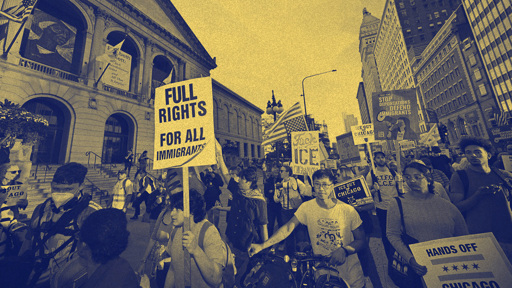
Immigrant communities across the United States have been facing an escalating wave of attacks. In response, from Los Angeles to Chicago and beyond, tens of thousands have taken to the streets, organized rapid-response networks, and refused to let their neighbors, coworkers, and friends be taken away. Nowhere has this been clearer than in Minneapolis, where thousands mobilized in the dead of winter to block ICE operations, forcing ICE to scale back its operations. As Trump’s attack on immigrants continues, we have to go on the offensive to fight not only against the violent detentions and deportations, but also challenge the very system that maintains immigrants in precarity.
Our fight has immediate, concrete demands: abolish ICE, end deportations and detention centers, and reunite families that have been torn apart. At the center of this struggle, however, we have to put the fight for full rights for all immigrants, including full democratic rights and citizenship for all.
The fight for full rights for all immigrants is the civil rights struggle of our time. Just as the Civil Rights movement wasn’t satisfied with simply softening the edges of Jim Crow and fought for the full equality of Black Americans, our fight can’t settle for moderating the worst expressions of Trump’s anti-immigrant agenda or maintaining the tiered system that keeps immigrants excluded from the social and political fabric of the country that they live, work, and build their lives in. Immigrants deserve more than the bare minimum of not being persecuted or terrorized; they deserve the same rights and opportunities as everyone else living in the United States. Winning those rights would place the entire working class in a stronger position to defend itself and fight for better conditions for all.
Immigrants Are Essential
The attacks on immigrants has been one of the core pillars of the second Trump administration. From describing migrants as criminals and invaders to pushing mass deportations and expanding immigration enforcement, Donald Trump has run a campaign to vilify immigrants with the hopes of sowing distrust and discontent among one another. Immigrants are routinely blamed for economic hardship, crime, and social instability, despite overwhelming evidence to the contrary. This narrative is not only false; it is dangerous. It fuels policies that separate families, criminalize communities, and justify the expansion of agencies like ICE that terrorize immigrant neighborhoods and anyone who stands in solidarity with them.
The reality is that immigrants are not a burden on the United States, but are essential to its economy and social fabric. Nearly 48 million immigrants live in the United States out of a population of roughly 335 million. In 2023 alone, immigrants generated about $1.7 trillion in economic activity and paid roughly $652 billion in local, state, and federal taxes.
Undocumented immigrants—estimated to number between 11 and 14 million people, or roughly 3 to 4 percent of the total population—are denied even the most basic rights and protections. Yet they remain deeply embedded in the country’s economy and communities. In 2023, undocumented immigrants held approximately $299 billion in spending power and contributed close to $90 billion in taxes.
Behind these numbers are the workers who keep the country running. Immigrants pick the food that ends up on American tables, build homes, care for the elderly, stock warehouses, drive trucks, and clean offices long after the workday ends. Entire industries—from agriculture to logistics to care work—depend on immigrant labor.
Yet despite their indispensable role in society, immigrants continue to face relentless attacks and are continued to be denied basic civil and democratic rights.
Minneapolis Showed the Way
Trump’s targeting of immigrants has not gone unchallenged. The brutality of his attacks has sparked an outpouring of resistance across the country. In Los Angeles last summer, people mobilized in force to fight against the deployment of the National Guard. In Chicago, workers and community members fought against similar deployments to protect their neighbors.
In Minneapolis, we saw thousands mobilized to defend their neighbors when immigration enforcement operations threatened to tear families apart. Despite crippling cold, community members organized protests and rapid-response networks to prevent ICE from taking people from their homes and workplaces, showing the power of a people mobilizing together from below. Under pressure from community defense efforts, labor action, student walkouts, mutual aid networks, and sustained protests, immigration enforcement agents were forced to withdraw from the area.
But the danger has not disappeared. Despite pulling back its operations in many places, ICE still remains and has gone on the offensive again on new fronts. Hundreds of agents remain in Minnesota, for one, and the broader deportation apparatus is still intact, with the agency planning for new and bigger detention facilities. Thousands of immigrants taken during these operations are still missing, either in detention or deported, and separated from their families and communities. Meanwhile, the federal government continues to redirect enforcement elsewhere, leaving immigrant communities across the country vulnerable to new waves of raids and arrests.
At the same time, Democratic leaders have offered little relief. Politicians who claim to support immigrant communities have largely cooperated with the federal enforcement system or failed to challenge it in any meaningful way. In Minnesota, Democrats such as Governor Tim Walz and Minneapolis Mayor Jacob Frey, despite symbolic words of solidarity, have done little to actually support immigrants. Indeed, while Walz’s state forces arrested people protesting ICE operations, Frey vetoed an eviction moratorium that would’ve protected immigrants who had lost income because they sheltered in place during the raids.
Across the country, Democrats and Republican are working together to increase the collaboration between ICE and local law enforcement. At the same time that Trump is terrorizing immigrants with deportations, furthermore, he and the bipartisan regime have also made clear the economy needs to keep exploiting their labor. While the bipartisan regime continues to fund the expansion of ICE detention centers, the H-2A visa program is being amended to meet labor shortages in agriculture. Indeed, despite all their attacks on immigrant rights, both parties are united in finding ways to guarantee the continuation of a cheap labor force.
This reality points to a clear conclusion: managing or moderating the harshest expressions of Trump’s immigration agenda is not enough. We have to challenge and dismantle the very system it stands on.
Abolish ICE & Full Democratic and Civil Rights for All
Central to Trump’s attacks on immigrants has been the deputization of ICE to carry out his program. ICE is one of the central instruments used to criminalize immigrants and fracture communities. It also has become an extension of Executive Branch’s authoritarian policies, with a budget that is larger than the military budget of entire nations. Ending detention centers, shutting down the deportation pipeline, and dismantling ICE would represent a decisive step toward protecting immigrant families. Just as urgently, those who have already been taken must be returned to their communities. Families must be reunited, and those unjustly detained must be released.
We can’t stop there. To bring an end to the deportations and so that every immigrant can live with dignity and equal rights, we have to put the fight for full rights for all immigrants at the very center of our struggle.
At its core, this is has to be a fight for basic democratic freedoms. Indeed, Trump’s attacks are only the latest and most vicious chapter in a long and ongoing assault on immigrants. Even before Trump, millions of immigrants have lived as a permanent underclass within the country that they help build every day. They are denied the right to vote, barred from numerous public benefits, face severe limits to their rights to organize and are constantly excluded from full participation in the political and social life of their schools, workplaces, and communities. The fear of retaliation is a constant presence that shapes their daily existence. Trump has used that fear as a weapon, but the system that maintains immigrants as second-class citizens in the country not only predates him, but will also outlast him, unless we fight to dismantle it.
This is why the fight for full rights for all immigrants must include the right to assembly and free speech. Immigrants face constant threats to these rights everyday. Workers who speak out against exploitation risk retaliation not only from employers but also from immigration authorities. The ability to organize, protest, and demand better conditions is undermined when millions of people live under the constant threat of detention or deportation.
And it must include the demand for citizenship for all. This is not something Congress or either of the two parties will hand down — it can only be won through massive struggle, the kind that builds in every workplace, neighborhood by neighborhood, city by city, until it becomes a national force. The level of mobilization required is not unlike that of the Civil Rights movement: coordinated, from below, and unrelenting.
In the history of the United States, a central demand of the colonial elite in their struggle for independence from Britain was the principle of “no taxation without representation.” Yet today that basic right is denied to millions. Immigrants contribute billions of dollars in taxes while being denied the most basic political rights. They work, raise children, build communities, and participate fully in the country’s social and economic life, yet they remain excluded from the democratic process.
Winning full citizenship rights would not only address this injustice—it would strengthen the entire working class. This is precisely why the labor movement must be at the center of this fight.
The Labor Movement Must Be at the Center of This Fight
The fight for immigrant rights cannot be separated from the fight for workers’ rights. Unions represent millions of workers, including large numbers of immigrants, and they have the power to challenge the system of raids, deportations, and intimidation that keeps immigrant workers vulnerable. When immigrant workers are denied rights, employers use that vulnerability to drive down wages, weaken organizing, and divide the working class.
Those divisions are not abstract—they play out inside workplaces every day. Employers constantly create layers within the same workplace—between drivers and warehouse workers (like at UPS), full-time and part-time staff, permanent employees and temporary workers, and union and non-union workers. Race and immigration status are often used to reinforce these divisions, with immigrant and racialized workers disproportionately pushed into the lowest-paid, most precarious positions. These divisions are tools used by employers to weaken solidarity, justify unequal pay and conditions, and make it harder for workers to organize collectively. When workers are separated into different tiers, it becomes easier for companies to pit one group against another while keeping wages low and working conditions poor for everyone. The fight for full rights for all immigrants is intrinsically tied to our right to work and unionize.
Our unions, thus, have to be at the forefront of the struggle for full rights for all immigrants. Leaders of major unions have to use their platforms to demand the abolition of ICE, an end to deportations, and full democratic rights and citizenship for all immigrants.
But instead, figures such as Shawn Fain of the United Auto Workers, who even speaks of working-class unity on both sides of the border, and Sean O’Brien, the President of the International Brotherhood of Teamsters, have either upheld Trump’s attacks, such as defending his tariffs, or stayed conspicuously silent as Trump has reversed immigration protections or as ICE has raided workplaces and torn families apart. It is a glaring contradiction, especially these policies continue to separate the struggles of U.S. workers from that of immigrants and the working class around the world. This silence only reinforces the divisions that employers and politicians rely on to weaken workers’ power.
Indeed, for Fain, who has been championing a general strike in 2028, the fight for immigrants rights needs to be the center of the campaign. Any aspirations of “shutting it all down” will remain hollow as long as millions of immigrant workers are excluded from that project. There is no working-class unity worthy of the name that leaves immigrants behind. In that, it is urgent that Fain calls and puts the vast resources of the UAW towards organizing that fight, complete with assemblies and open meetings to defend immigrants from ICE and openly demanding full rights for all.
Similarly, O’Brien continues to tout his desire to unionize Amazon, but any real attempts to do so must account for the tens of thousands of immigrant workers who are constantly under threat. On the contrary, the Teamsters leader has not only brokered and overseen a UPS contract that maintained the structural divide between warehouse workers and drivers, but has also backed Trump’s new DHS Secretary, Markwayne Mullin, who is going to oversee further attacks on immigrant workers, and did nothing to protect Haitian and Venezuelan workers at Amazon who lost TPS protections and were consequently fired because of it. The struggle to unionize the logistics giant is inseparable from the fight for full rights for all immigrants.
When unions stand up for immigrant rights—including the demand to abolish ICE and win full civil rights for all—they strengthen the power of the entire working class.
The events in Minneapolis showed us that possibility. When immigration enforcement threatened members of the community, divisions within our class melted away. Workers from different sectors showed up for one another. People mobilized in droves to defend their neighbors regardless of their immigration status. It showed that unity across the working class can flourish if we prepare along these lines. At the height of the backlash against the ICE surge in Minneapolis, furthermore, an assembly of hundreds of workers and community members not only voted for a day of “no work, no school, no shopping” on May Day, but also resolved to form strike committees across workplaces to make it real.
The experience in Minneapolis points toward what we need nationwide. The fight for immigrant rights must become a fight taken up by unions, community organizations, students, and social movements together. It requires consciously rejecting the divisions that are imposed in our workplaces and across society. Everything that we win will come from organizing and strengthening this fight from below: workers, students, and communities linking their struggles, building the committees and assemblies that can coordinate action across neighborhoods, cities, and industries.
When workers — immigrant and non-immigrant alike — stand together to demand the abolition of ICE, an end to deportations, and full right for all, including the right to citizenship, they challenge the system that keeps the working class fragmented and weak. Building that kind of unity will not come from politicians or cautious statements by union leaderships. It will come from organizing and fighting from the ground up, in every workplace, school and neighborhood, building the kind of power that no raid, no detention center, and no deportation machine can withstand.
From Left Voice, we put our pages to the service of this struggle. We invite you to write, share your experiences, and contribute analysis that can help sharpen and expand this fight. We encourage artists, and creators to produce visuals and media that can bring these demands to life across social media and beyond. Take this discussion into your unions, workplaces, schools to expand on the fight for immigrant rights.
The post The Movement to Abolish ICE Must Fight for Full Rights for All Immigrants appeared first on Left Voice.
From Left Voice via This RSS Feed.