

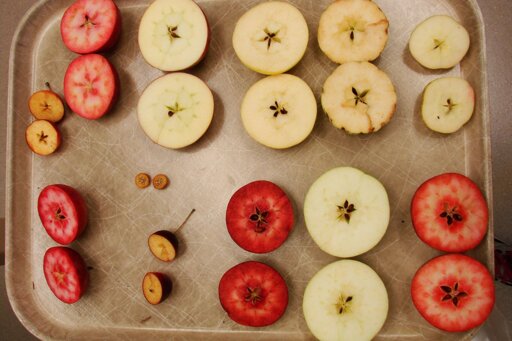
In the fall of 2004, Diane Miller, a tree-fruit specialist, began a two-part expedition on a Fulbright to Kazakhstan and Kyrgyzstan, in Central Asia, the birthplace of the apple. Her quest: to bring back seeds from the region’s wild apple trees that could infuse domestic breeding programs with biodiversity.
The American apple industry is concentrated almost entirely on a handful of varieties. Just 15 apples account for roughly 90 percent of the market. In contrast, Central Asia’s thousands of wild apple varieties offered untold diversity from trees that had borne fruit across centuries of cultivation.
On the second half of the expedition in 2005, Miller, accompanied by her teenage daughter, Amy, journeyed through dramatic Kyrgyz landscapes. The pair traversed alpine passes and arid valleys on the way to a mountainous area in the west that was blanketed by apple and walnut forests. They were awed by the breathtaking abundance.
There was something else, too: The steep, wooded slopes and sandstone bluffs, surrounded by a wash of dense greenery, reminded them of their home in Appalachian Ohio.
“If I squinted a little bit, I could have thought I was at home,” said Amy Miller, now a fruit grower and plant pathologist. “That was our first indicator that these trees might be well adapted to our region.”
“It can be the foundation to a future of apple growing that ensures clean water and biodiversity and the health of farmworkers.”
The Millers returned to Ohio with hundreds of seeds from trees whose longevity suggested they might carry disease resistance—a trait that could be bred into American varieties, potentially reducing domestic reliance on chemical sprays.
In spring 2007, they planted seedlings in a research plot at Dawes Arboretum, a 2,000-acre preserve in an agricultural community east of Columbus, Ohio. The seedlings became part of a much larger collection, spanning roughly 6,000 trees and 15 acres, including controlled crosses of domestic varieties and selections from previous U.S. Department of Agriculture collection trips to Kazakhstan.
At Dawes, the Kyrgyz apples thrived. For nearly two decades they’ve lived there, some 800 trees growing into a unique repository of wild apple genetics that many breeders and growers now view as critical for the future of the domestic apple industry. Apple growers face a host of challenges, including global competition, climate change, rising costs, and many more.
“It can be the foundation to a future of apple growing that ensures clean water and biodiversity . . . and the health of farmworkers,” said Eliza Greenman, a germplasm specialist at the agroforestry nonprofit Savanna Institute. “It’s a foundation to unlocking apple flavors, too—to extending the boundaries of what we think apples can taste like.”
That future, however, is now uncertain. In mid-December 2025, Dawes’ executive director, Stephanie Crockatt, sent Miller a letter asking for the trees to be removed by the end of March.
“We have made the decision to adjust our research priorities and land management strategies,” the letter stated.
The directive left only enough time for “triage,” Greenman said. More than 100 plant breeders, researchers, fruit growers, agroforesters, and nonprofits signed a letter, written by Greenman, that pleaded for an extension so the collection “can be used, studied, and evaluated for years to come.”
Dawes pushed its deadline out a year to March 2027. Even with the extension, Greenman said, the decision risks dismantling an unrivaled resource for apple breeders that could take decades to reassemble.

Diane Miller surveys the wild Kyrgyz apple collection at Dawes Arboretum in Newark, Ohio. (Photo credit: Amy Miller)
Resilience Through Diversity
Diane Miller’s work is organized around a simple idea, she said: “genetic diversity for environmental resilience.” Through her work at Ohio State, the Midwest Apple Improvement Association, and the Midwest Apple Foundation, she’s long championed plant breeding that can increase disease resistance and reduce reliance on fungicides and insecticides.
Domestic apples are susceptible to pests like the codling moth and diseases like apple scab, a fungus that blemishes the fruit’s skin, and fireblight, a destructive bacteria that can rapidly kill trees. Because of these vulnerabilities, apples are sprayed with pesticides intensively, often weekly.
The domestic apple industry has veered toward a high-risk, high-reward model, Greenman said, accepting the added frustration and increased costs—in both sprays and systems—of working with delicate but delicious apples like Honeycrisp because the price they fetch can be three times that of sturdier alternatives.
In Kyrgyzstan, where the Millers gathered their genetic material, apples have been cultivated for centuries but never domesticated in isolation like American apples. In that wild setting, the trees remain largely unbothered by pests and disease. For the Millers, that made them invaluable for breeding programs that could cross their hardy traits with the intense sweetness and trademark crunch consumers crave from the Honeycrisp and numerous varieties it’s inspired.
“The future of the apple industry needs more disease resistance built in,” Greenman said, “or else breeding will be replaced by creating chemicals.”
“The future of the apple industry needs more disease resistance built in or else breeding will be replaced by creating chemicals.”
With American apple growers concentrated on a small range of varieties, “there’s a real risk of a genetic bottleneck,” said Matthew Moser Miller, an Ohio orchardist and cider maker who is familiar with the Dawes collection (and who is unrelated to Diane and Amy Miller).
A limited genetic pool can weaken disease resistance, making trees more vulnerable over time, he said. The Kyrgyz trees at the arboretum offer a safeguard—an immense variety of flavors and the promise of greater crop resilience.
As the seedlings grew into a forest of mature, 20-foot-tall trees, Diane Miller selected the best candidates for breeding, propagating them by grafting cuttings, called scionwood, onto rootstock and letting them grow. To cross two varieties, she applied pollen from the flowers of one to the flowers of the other.
Miller worked at this for years, promoting desirable qualities through generations of breeding while maintaining a library of traits breeders could use into the future. The Kyrgyz trees “have inherent vigor that is lacking in domestic apples,” she said. They also boast unusually high quantities of phenols, the chemical compounds that give fruits their antioxidant and anti-inflammatory power.
But plant breeding is a long-term process that will be interrupted by the forced exit from the arboretum. Moving the entire collection would be impossible, and moving just a selection wouldn’t capture its diversity. Miller will spend the next year collecting scionwood to propagate clones from the planting, but she will lose mature trees whose age is an integral part of understanding their potential.
“It takes time to sort and sift all that out,” Miller said. “They don’t just jump out and say, ‘I’ve got multi-gene disease resistance. Take me.’”

An apple tree bred with wild Kyrgyz genetics from the Dawes Arboretum collection. With its disease resistance and large fruit, it’s a prime candidate for breeding with existing commercial varieties to produce a crisp, delicious, yet resilient apple. (Photo credit: Diane Miller)
Rebuilding a Repository
Despite the protests of the apple breeding community, Crockatt, who took over as Dawes’ executive director in November 2024, says genetic research and crop production no longer align with the arboretum’s priorities.
Although Dawes hosts other research collections, including for maple, buckeye, and witch hazel, those are governed by formal research agreements outlining responsibilities and expectations. The Kyrgyz apple collection hasn’t met those guidelines, Crockatt said.
“It really is a situation where we have been a host, not a partner,” Crockatt said.
The relationship between Dawes and the nonprofit Midwest Apple Foundation, whose members have tended and monitored the entire 15-acre collection since its planting, developed out of a handshake agreement between leaders who are no longer at their respective institutions, Amy Miller said.
The foundation tried to formalize an agreement with Dawes in 2024, while the arboretum was under interim leadership; its intention was to rehabilitate the full planting, replacing trees whose evaluation was completed with new seedlings to observe. With a funding plan in place and apparent support from Dawes, the Millers were optimistic about their proposal. But the next time they heard from the arboretum was the December letter, sparking frustration and a rush to find a new home for the plant material.
“The new leadership team didn’t show any interest in actually learning what we have there,” Amy Miller said. “They didn’t reach out with any questions or to get any background information on what is even going on there. They just suddenly said, ‘Pack your stuff and get out.’”
According to Crockatt, research had been concluded on one plot when she arrived and left unattended at another, allowing invasive species to proliferate and threaten nearby collections. The arboretum’s decision was “based on alignment to our nonprofit mission,” she said.
With no other recourse, the Millers are hoping to replicate through grafting the seedling orchard they first planted in 2007, perhaps with duplicates in multiple locations to ensure longevity. They have yet to identify suitable host sites.
In late February, Diane and Amy Miller visited Dawes, along with Matt Thomas, a conservation biologist and Amy’s partner, to collect scionwood from 120 trees to begin rebuilding the repository. They will have two more opportunities to do so—in late summer, when they can gather budwood, and again during the trees’ dormancy next winter.
The group won’t be able to salvage everything, and what they do collect will no longer be growing on its own roots, which diminishes their ability to fully evaluate a tree’s potential, Diane Miller said.
Once the Millers have rescued what they can from the collection next spring, Crockatt said the trees will all be taken to local zoos to be browsed on by animals.
“It’s not like they’re going to be destroyed and forgotten,” Crockatt said. “They will serve a purpose.”
For apple breeders and growers, though, the trees’ highest purpose would be to remain in the ground at Dawes, where they can continue to serve as a vast library of genetic material whose potential can be explored over time.
“While we have it, we should protect it and try to preserve it, lest we shortsightedly allow it to be lost,” Matthew Miller said. “At that point, it may be difficult, if not impossible, to recover those lost genetics.”
The post In an Ohio Apple Grove, Researchers Race to Save Rare Varieties appeared first on Civil Eats.
From Civil Eats via This RSS Feed.