

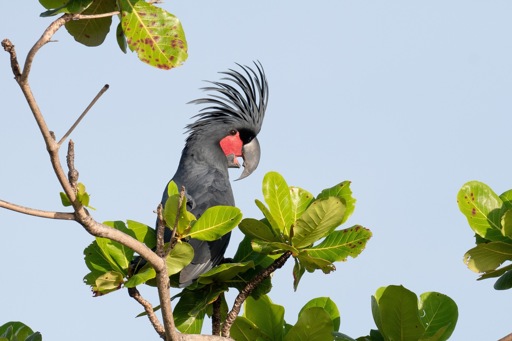
Conservationists in Australia are celebrating the fledging of a palm cockatoo chick, a species considered endangered in the country. It fledged from an artificial log hollow installed on a tree for breeding cockatoos. The structure is one of 29 such spaces created as part of People For Wildlife’s (PFW) Breeding Habitat Restoration Project, in partnership with Apudthama Traditional Owners and palm cockatoo expert Christina Zdenek. The palm cockatoo (Probosciger aterrimus) is a stunning large parrot, with smokey-black feathers, red cheek patches and a dramatic crest. As part of their courtship displays, males fashion tools out of sticks and seed pods to drum on hollow trees. Palm cockatoos live in Australia and on the neighboring island of New Guinea. In Australia, they are confined to a patch of rainforest and savanna woodland on the remote Cape York Peninsula of northern Queensland. They’re one of Australia’s most threatened parrots, with possibly fewer than 2,000 left in the wild. “They disperse the rainforest seeds,” Robert Heinsohn of Australian National University told U.K. state broadcaster BBC. “They have these massive great beaks, and they’re the only creatures that can break into some of the larger seed pods.” The species is a slow breeder. Females lay just one egg roughly every two years. For nesting, the mating pair carefully selects a hollow in an old-growth tree and builds a deep platform out of sticks, where the female lays her egg. The loss of such natural hollows is a major threat to the species. Zdenek told…This article was originally published on Mongabay
From Conservation news via This RSS Feed.