

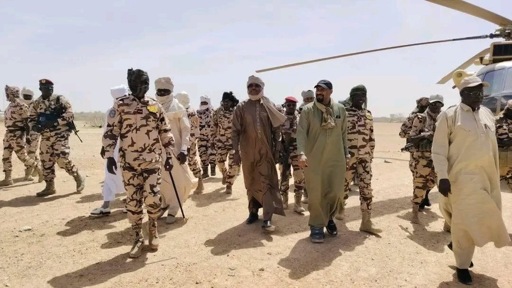
Chad’s security forces launched an operation on March 19 to search for weapons in the eastern region of Tine, which extends across the border into war-torn Sudan, from where a drone took off and struck the Chadian town of Mabrouka a day earlier. It killed at least 17 civilians and wounded dozens.
Both parties to the civil war in Sudan – the Sudanese Armed Forces (SAF) and the paramilitary Rapid Support Forces (RSF) – have blamed each other for this strike, amid pitched battles for control over the Sudanese side of Tine in the state of North Darfur.
Most reports indicate that the drone was of the RSF, which controls most of the Darfur region, with the exception of some border towns in North Darfur state, where it is fighting to root out the last of the SAF units and their allied militias holding out in Darfur, alongside local fighters.
Weapons and fighters cross the border
When outnumbered and outgunned, their soldiers and fighters often retreat across the border to Chad to regroup and return to Sudan to continue the resistance to RSF, which is on an ethnic cleansing campaign, depopulating entire cities after overrunning their defenses.
The SAF, on the other hand, has long maintained that the Chadian territory is being used by the UAE to supply weapons and ammunition to the RSF. Although the UAE and RSF have denied this, it is widely regarded as a “credible allegation”, including by UN experts.
Taking off from Sudanese soil amid a battle in Tine, where both the SAF and the RSF were using drones, one of them flew into Chad and struck an army base on December 26, 2025. The death of two Chadian soldiers marked the start of the spillover of this nearly three-year-old civil war into its central African neighbor. Both SAF and the RSF blamed each other.
Read more: Sudan civil war spills over into neighboring Chad
Then on January 15, RSF troops pursued the retreating fighters of the SAF-allied militias across the border into Chad, where they were confronted by Chadian soldiers of the garrison in the town of Birak. Attacking the garrison, the RSF killed seven soldiers, wounded many more, and destroyed several of Chad’s military vehicles.
A month later, on February 21, after the SAF and its allies repelled an attack on the town of Tine, the retreating RSF troops crossed over into Chad, where they clashed with its soldiers again and killed five more.
Amid this escalation, Chad – which hosts a million Sudanese refugees, mainly fleeing the RSF from Darfur – shut the borders, making only “exceptional exceptions, strictly justified by humanitarian reasons.” While the civilians were thus left stranded, attacks continued on the border.
On March 12, an SAF drone struck the fuel reserves at the Adikong border market, just inside the Sudanese border, barely 50 meters from a Chadian security post. The resulting explosion killed at least 13 civilians, including five women. Among them were both Sudanese and Chadian nationals. The SAF maintains that it targeted an operation to smuggle fuel from Chad into El Geneina, the capital city of West Darfur, which is under the control of the RSF.
Civilians bear the brunt on either side of the border
However, the El Geneina Coordination Council of the Emergency Rooms, a network of local volunteer groups organized in cities across the country, said that the victims were small traders. They earn a livelihood carrying fuel and goods across Chad to Sudan on animal-drawn carts through the Adre crossing, which is also a key route for humanitarian aid supply.
The medical charity Doctors Without Borders (MSF), which supports a hospital in the Chadian town of Adre, reported receiving “23 injured civilians—including four women and seven children under [the age of] 15.”
In the meantime, fighting between the SAF and the RSF was intensifying on the Sudanese side of Tine. On March 16, 123 wounded people fled across the border to the Chadian side of Tine, where they were received at a newly built hospital.
“This new hospital lacks everything. We treat patients without water or electricity, using a generator and solar panels. With the massive influx of patients, our stock of medicines is running out, and it is difficult to get more,” said a staff member of the MSF, which provides medical service here.
17 of the patients succumbed to their wounds, while 66 others remain in a serious condition. 17 more were killed two days later, on March 18, in the drone strike on Mabrouka town.
They were local residents, gathered for a Ramadan Iftar meal, according to Sudan Tribune and Radio Dabanga. Reuters reported they were mourners, gathered for a funeral.
Calling this attack an “outrageous and excessive aggression” against Chad’s territorial integrity, Chad’s President Mahamat Déby ordered his military to retaliate against any future aggression coming from Sudan, be it from the SAF or the RSF. His government dispatched a team of explosives experts to Tine on March 19 to determine the source of the drone attack.
Refugees left in the fray
He also ordered the total closure of the 1,300 km-long border, tightening its security with the deployment of about 200 military vehicles. There are no “exceptional exceptions” made for “humanitarian reasons”, unlike in February, which means a further squeeze on the aid flow to the Darfur region, where civilians remain trapped, unable to cross over. Those who already have are now coming under suspicion.
Several Sudanese refugees were detained by the Chadian army during an operation on March 19 on its side of Tine, where it conducted house-to-house searches for weapons.
The post Sudan war spillover kills 17 more civilians in Chad appeared first on Peoples Dispatch.
From Peoples Dispatch via This RSS Feed.