

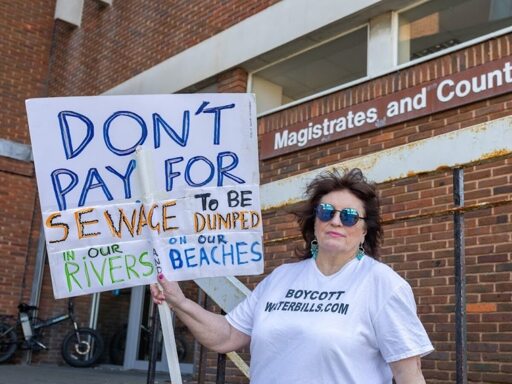

Campaigners for the boycott of water bills gathered in Margate on Thursday 19 March. They were protesting ahead of longtime boycotter Julie Wassmer’s court showdown against Southern Water.
Supporters came from all part of Kent including Whitstable, Broadstairs, Deal, Folkestone as well as from Sussex, London and Oxford. They were united in their condemnation at the dire state of the water industry.
Crime writer and environmental campaigner Wassmer has withheld payment for the wastewater part of her bill for over four years. She gave an impassioned speech arguing that the state of water is both a national and an international disgrace.
She said she intends to argue in court on 26 March that regulation has failed. She’ll claim there’s no accountability for poor service and this, in principle, contravenes Article 6 of the Human Rights Act:
It cannot be right that in a modern civic society consumers are forced to pay for services which are not being provided at all, or which seriously pollute our seas and waterways and damage our precious environment – while denying us a means of challenging this effectively through the legal system.
I’d like to see the back of every water company CEO in this country for whom, by the way, the average pay is £1.7m a year – while OUR bills have gone up 40% in real terms since privatisation and are set to increase far more.
The broken water industry
Johnbosco Nwogbo is lead campaigner at We Own It, an organisation that campaigns for public ownership of public services. He queried what it was that Southern Water wanted Julie to pay for:
Southern Water dumped sewage for about 304,000 hours in our rivers and seas in 2024. Is that what they’re asking Julie to pay for, so they can continue to dump sewage in our rivers and seas? They paid out £2.3 billion in dividends to their shareholders since the water company was privatized – it that what they’re asking Julie to pay for?
Nwogbo pointed out that when Southern Water went private in 1989 it had no debt, but it has since taken on £5.7bn of debt. This money clearly hasn’t been invested in infrastructure, but rather paid out in dividends to shareholders. He said:
Instead of people like Julie finding themselves in court defending themselves, Southern Water should find itself in court!
And he added that there is currently a proposal in front of the environment secretary to try to ‘save’ failing Thames Water from bankruptcy. This deal would allow the company to pollute illegally until 2040. He insisted the government should reject the deal and take Thames back into public ownership. Otherwise fellow water companies will simply follow suit in a race to the bottom:
Or rather, a race to the sewer!
Two Green Party councillors from Kent spoke at the event, Rob Yates and Andy Harvey.
Margate councillor Yates said he had personally investigated Southern Water by submitting Freedom of Information requests. These revealed the number of times the company had breached its permits by pouring untreated sewage into the seas. And the results formed part of a criminal case against Southern Water.
He added:
Privatisation without competition is exploitation. England and Wales are the only country in the world with a fully privatised water industry – now is the time to reverse Thatcherism.
Surge in boycott support
Katy Colley co-founded boycottwaterbills.com with Wassmer. She said that since the screening of Dirty Business, the Channel 4 three-part drama about the sewage scandal, the website had seen a surge in new signups.
She quoted submissions from a host of new boycotters from all over the country whose water companies included United Utilities, Southwest Water, Severn Trent, Thames Water and Southern Water.
These were people, she said, who had had enough of:
spiralling bills while water companies pour increasing amounts of sewage into our seas and waterways with impunity.
She insisted that for many, this was not a first step but a final resort:
because we see no other way to make a difference.
Like her, many had complained to their water company, to the Consumer Council for Water, to the Water Redress Scheme, Environment Agency and OFWAT.
At every stage we are told no, you cannot hold your company accountable for their failures. But if we’re consumers and we’re unhappy with a service we should be able to go elsewhere. We can’t because water is a natural monopoly.
We protested, we wrote letters, signed petitions. The government changed. But with water, nothing changed.
That’s why so many of us decided, that despite the potential risks, the difficulties, we’re going to use the power we have in our pockets. We’re going to withhold payment for the wastewater service part of our bill.
She says the boycott movement is now spreading rapidly with thousands accessing the site every week. Many are now cancelling their direct debits as a ‘first rung on the boycott ladder’.
She said:
Nobody is obliged to pay by direct debit, only on receipt of a bill twice a year, and direct debit is how water companies hold money on account, treating us like cash cows.
Olivia Cavanagh is from Hastings Boycotts Southern Water. She expressed her disgust at the recent bio bead spill from an Eastbourne sewage treatment plant across the Kent and Sussex coast. Ten tonnes of toxic beads were released into the sea, causing catastrophic damage to the coastline and environment. She asked:
Did Southern Water come out and say we’re sorry this has happened, we’re going to clean it up? No, volunteers and voluntary organisations came out. As usual it was left to the community and the people that care about the environment.
It’s clear that Southern Water, like all the water companies, don’t give a damn about the environment, the wildlife and the plant system.
The large and noisy protest drew dozens of encouraging honks from passing cars and trucks. Attendees said the energy and passion of the speakers was inspiring. One passerby said:
It’s encouraging to see ordinary people doing something and not just accepting this situation. With the sewage and the price increases here, you get the feeling that we are just being taken for mugs. I don’t think I would want to go to court myself, but I think I might cancel my direct debit. It’s better than nothing.
Wassmer’s case has its hearing at Canterbury County Court on Thursday 26 March at 10am.
Featured image via Andrew Hastings / Boycottwaterbills.com
By The Canary
From Canary via This RSS Feed.