

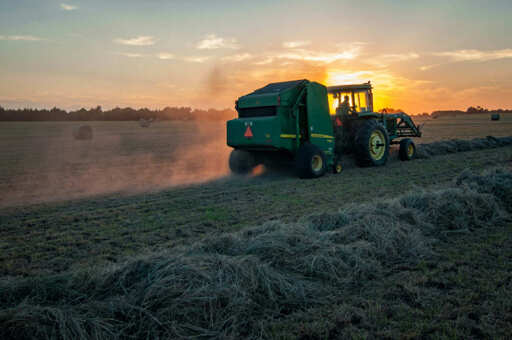
Andrew Nelson is a self-described “tech-forward” farmer near Garfield, a tiny town in eastern Washington close to the Idaho border. He uses popular precision agriculture services, paired with artificial intelligence, to produce wheat, canola, lentils, garbanzos, and green peas across 7,500 acres.
Precision farming technologies gather data from a variety of points, such as GPS coordinates from tractors, seeding rates from planters, pesticide volumes from sprayers, moisture readings from soil probes, and yield estimates from combines.
The services—from Bayer, Deere, Corteva, Trimble, and others in the ag-tech sector—increasingly use artificial intelligence to detect patterns, weaving together farmers’ data with other feeds, like satellite images and weather station readings. Farmers can open dashboards on their smartphones or computers to see overviews of conditions and trends, along with suggestions about practices to tweak.
“Giving some of that information to the person that I’m having to buy a three-quarter of a million-dollar machine from just doesn’t sit quite right.”
Nelson takes advantage of many of these capabilities, feeding his spraying data to Bayer Climate FieldView to receive recommendations on chemical applications. He allows John Deere Operations Center to collect data from his tractors and combines to provide him insights on equipment performance and efficiency.
But the fifth-generation grower doesn’t share all his field-level data with the services. “I’ve read the terms and conditions,” says Nelson. “But giving some of that information to the person that I’m having to buy a three-quarter of a million-dollar machine from just doesn’t sit quite right.”
Ads for these AI-powered services promise to “empower” farmers to “harness” their data and “make better decisions,” boosting yields and unearthing efficiencies. In the U.S., uptake is relatively high, with 27 percent of farms or ranches using the tools, according to the U.S. Government Accountability Office. And market analysts project double-digit growth for these tools, expecting them to reach as high as $27 billion by 2030 worldwide. Aiding the growth are multiple tailwinds, including incentives bundled in the latest draft of the U.S. farm bill.
With the industry poised to expand exponentially over the next few years, small-scale farmers and sustainability advocates worry that big companies will leverage their data to sell more products and services, corner markets, or even threaten their livelihoods.
‘Small’ Data in Big Hands
While 70 percent of precision ag-tech users globally are large operators, smaller farms are slower to buy in.
California almond grower Rebekka Siemens has resisted sales pitches for expensive “smart” irrigation systems. “On the one hand, it’s attractive that the reporting can be integrated or exported for reporting purposes easily,” says Siemens. “On the other hand, it could harm you . . . . It feels exposing, the lack of privacy. We don’t know who’s doing what with it.”
There may be little value in “small” data from more modest plots of land, but corporations see aggregated pools of information as a gold mine. And training AI systems on the capture of feeds from thousands of farms raises questions of who should hold the intellectual-property rights.
“It’s essentially like we’re being charged to use the service and then the company is making even more money off of us by selling our data,” Siemens says.
Most ag-tech services insist that they are granting farmers ownership of their data. “Farmers own their own data—full stop,” said Brian Leake, a spokesperson for Bayer, pointing out that the Climate FieldView technology has been certified by the auditing nonprofit Ag Data Transparent since 2021. “They can choose to share their data with others and request that their individual farm data is deleted.”
Watchdog groups warn, however, that legalese within click-to-sign contracts favors the businesses. Surprises can lurk within a 10,000-word software license agreement, they say. And a contract that prevents a tech company from selling data to a third party may nevertheless grant a business partner broad rights to exploit and share anonymized pools of data.
A gray zone exists regarding who controls the bits and bytes, which the ag-tech providers store with the likes of Amazon Web Services, Microsoft Azure, and Google Cloud.
Advocates also raise red flags about the perceived marriage between Big Tech, which profits from people’s data, and the Big Ag companies blamed for industrializing agriculture and squeezing out family farms.
The fears are manifold. What if the main purpose of collecting all this data isn’t to help farmers, but to sell more products? Where does data go if a startup folds? What if a bad foreign actor uses intelligence to disrupt the food system? Could government use evidence of fertilizer use today to punish a farm later for nitrogen pollution? What if the data lands with hedge funds or investors who manipulate commodity markets or drive down land prices to further concentrate land ownership?
Elizabeth Vaughan, senior manager of the Small-Farm Tech Hub at the Community Alliance with Family Farmers, worries that AI might further concentrate power outside farmers’ hands.
“Is Amazon going to be our food producer 50 years from now, or Microsoft—or are we still going to have small farmers that provide for their local communities, grow culturally relevant crops, and have resilient community food systems?” she asks.
Related suspicions led Bayer to drop a planned partnership with startup Tillable, often described as an “AirBnb for farmland,” in February 2020, four months after it was announced. When Tillable sent unsolicited cash rental offers to farm owners, farmers accused it of crafting its bids using data about farm yields gleaned from Bayer’s Climate FieldView. Bayer, however, said it did not establish any backend data-sharing with the startup.

(Infographic courtesy of IPES-FOOD)
Protections and Alternatives
Federal regulations have not caught up with the rapidly developing AI and machine-learning tools that harvest masses of data. Tech companies have lobbied against bills they say would hamper innovation. And members of Congress overwhelmingly agreed to remove a proposal from the One Big Beautiful Bill Act, passed in July 2025, which would have barred states from making new laws regulating AI for up to a decade.
However, state lawmakers are acting.
In Nebraska, the Agriculture Data Privacy Act (LB525) is the first bill anywhere claiming privacy rights for business data, according to attorney Reed Freeman, a partner with ArentFox Schiff who specializes in data privacy and security. The latest version, watered down since it debuted in 2025, would bar third-party companies from monetizing farm data without the farmer’s permission.
If the bill becomes law, it could have broad business implications beyond agriculture, according to Freeman. “This is saying there’s value in non-personal data, and . . . the guy who generated it is the guy who should wrest the value out of it,” he says.
Meanwhile, a handful of coders, farmers, and educators are looking to enable small-scale farmers to benefit from data-driven insights without having to surrender their information to big tech companies.
“It’s important for you to control this data, but there’s no value in it if you just put it on a hard drive on your desk and never do anything with it,” says Ben Craker, who grows corn, soybeans, wheat, and hay in central Wisconsin. Craker serves as president of the Ag Data Coalition, a nonprofit that allows farmers to retain, share, or restrict access to their farm data while choosing to enable universities to use it for research purposes.
Other digital tools are emerging that sidestep the corporate giants. For instance, farmers and researchers at the University of British Columbia created open-source LiteFarm software to help farmers with crop planning and tracking tasks.
And Washington grower Nelson is working on a low-cost service, Ag Answers, which would use AI-based text chats to help farmers gain insights from their fields, fill out USDA forms, and suggest when equipment may be overdue for maintenance.
Beyond the Data
Advocates of sustainable farming practices want more for farmers than just retaining data sovereignty, however. They feel that most ag-tech tools do not adequately serve small-scale, diversified farms and are concerned that high-tech services prioritize maximizing yields of monoculture crops over soil health and climate resilience.
They also doubt the ag-tech claim that precision agriculture is environmentally beneficial—a way to decrease the use of fossil-fuel-heavy pesticides and fertilizers—a point bolstered by a new HEAL Food Alliance report that shows that the use of fertilizers and pesticides have actually climbed alongside the rise of precision agriculture.
In addition to making farmers dependent on proprietary corporate offerings with questionable data protections, digital technologies remove farmers from the land, says soil scientist Jessica Chiartas, who serves as board president for RegenScore, a tool that collects data on regenerative farming practices. “The best way to manage your farm is to be out there on the ground, looking, smelling,” she says.
Nettie Wiebe, a professor, farmer, and longtime farm activist in Saskatchewan, contributed to a February report by the International Panel of Experts on Sustainable Food Systems (IPES) that challenged the “false promise” of digital agriculture. Industrial agriculture is concerned mostly with mechanical innovation, she says, and is “premised on a view that the natural world is just made up of many, many, many data points.”
She holds a different view: “Those of us who farm in a small-scale way, we know that actually it’s [about] the interrelationship between various organic elements that make up the natural world.”
The post A Hidden Crop for Corporate Tech: Farm Data appeared first on Civil Eats.
From Civil Eats via This RSS Feed.