

1
If the subject is nothing other than that which is determined within the pre-articulated network of relations of power, regulatory institutions, language, and history — so that one cannot posit a separation among these — then the subject’s action becomes possible only within the structure. In this sense, any conception of an autonomous subject who cries out in the negation of evil is itself dependent upon the addressee of its own cry.
2
And because these structures operate not merely through direct coercion but through the reproduction of desire, consciousness, and experience, subjectivity — even in its purest forms — will be nothing other than the deterministic functioning of self-concealing forces from within the subject. Thus, any claim to freedom, so long as it has not grasped its relation to its own coercive foundations, is nothing but the fantasising offspring of that very determinism.
3
Here one must pause and say that evil is precisely that illusory boundary between the possibility of action and the ignorance of the conditions that made action possible: evil is ignorance of the mechanisms that have produced the very possibility of the emergence of any action arising from subjectivity. Hence, evil should not be sought in an act or a particular event itself, but rather in ignorance of these conditions of possibility.
4
Now, if the condition of war operates as the condensation of regulatory forces in their pure form — state, nation, symbolic and physical violence, or discursive order — then living in war, without having having taken the side of one party to the war, is merely the acute and intensified form of that everyday life which, even in its normal form, has been nothing other than a soft and courteous coercion that has lived life in place of the subject.
5
For this reason, the question of the possibility of action in the condition of war — even against war — without understanding the deterministic condition of the subject in the condition of peace will be a false question. For war is merely the ruthless revelation of the same logics that had been operating silently in peace; and if action is possible, it is only through understanding the necessities present in both conditions, not through the false distinction between “exception”/war and “rule”/peace.
6
To understand this determinism means abandoning moral, emotional, and voluntarist illusions, in the sense that the subject must not only recognize the presumption of its own agency as the product of its misunderstanding of freedom; it must also realize that only through identifying the network within which it has been constituted can it reach a position from which it might perhaps discover the possibility of introducing a rupture in the reproduction of the structure.
7
But this rupture does not take shape through exiting the structure; rather, it emerges through a radical immanence within it: the moment when the subject understands that even the desire for liberation has already been articulated in advance. Consequently, true resistance does not mean the denial of determinism, but rather its critical acceptance and movement according to its map — precisely, where the structure, of necessity, becomes internally strained or incomplete. Can the tensions of structures and networks be shown? Can the absence of that final moment of stitching be thrust before the eyes of the tyrants? Can the coordinates of the holes in the symbolic order be drawn? And if the answers are affirmative, would such an ability and such a mapping serve determinism — or freedom?
8
Therefore, only through accepting that the subject is a product and not an origin; only through understanding that freedom is an illusion produced by a prior coercive order; and only through confronting evil directly as ignorance of this causal network, can a possible action be recognized: not an action for salvation, not an action for reform, but an action for standing still, observing, and mapping the coordinates of the prison. Only such an action can truly mark the beginning of thinking about life — not outside determinism, but within it.
9
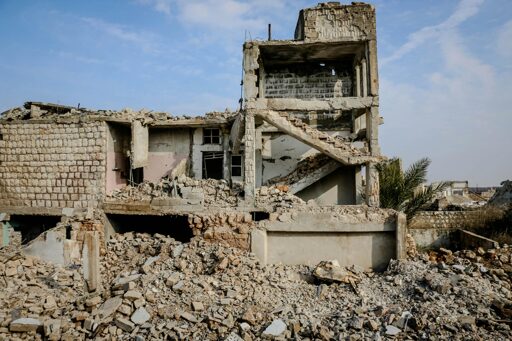
And since no event, even in its most naked and violent form, is exempt from the fundamental logic of historical determinism, war too is not a rupture but a continuation of those same relations of power that had already been shaping the subject in apparently non-violent forms: war is the more condensed continuation of the coercion present in the condition of peace. A recent example of this continuity became clearly visible in the moment of war between Iran, and the US-Israel in a region where the boundaries between geography, ideology, and theology have long become indistinguishable. There, bodies — against their own will — were transformed into instruments translating a conflict that neither relied on their will nor returned to the language of their everyday life; rather, it depended on systems whose aim was not the immediate control of violence but the continuation of a fractured condition as the very possibility of their minimal existence. In this situation, the those who occupy the position of the subject finds themselves not as agents but as points of intersection of antagonistic forces of power, ideology, borders, historical memory, and military discourse, a position in which individual or collective agency is either appropriated by one side or stripped of possibility by another. From this perspective, war is not the origin of evil but the compressed display of the very mechanisms that operate within peace as well — appearing distinct to the subject only because of temporal density, massive casualties, and disruptions. What truly differs is not the nature of the forces but the intensity of their manifestation. Thus, war can only be understood when the subject is able to recognize within it the same logics that had already been ruling over the field and over its life with coercive and decisive force. Such recognition becomes a precise gesture of innovation and resistance against coercion only when it yields a non-sloganistic, non-voluntarist, and non-fetishizing image of one’s position within the network of power: that is, not against war, but from within it — through a gaze that analyzes rather than rejects, and that formulates rather than merely cries out.
The post Theses on Determinism and War appeared first on The Philosophical Salon.
From The Philosophical Salon via This RSS Feed.