


This story was originally published by Daily Montanan.
Micah Drew
Daily Montanan
As members of the Trump administration order National Park Service staff change or remove hundreds of signs, exhibits and other interpretive materials at NPS sites across the country, a public database was uploaded earlier this month compiling all flagged material under review.
A group self-described as “Civil Servants on the Front Lines” uploaded the database to two public websites in early March. The data was first reported by the Washington Post, whose reporters confirmed its authenticity with federal employees.
The Daily Montanan went through the database to find flagged interpretive materials associated with Montana and verified the accuracy of the specific items with current and former federal employees.
The review of scientific and historical information across public lands came from an executive order President Donald Trump issued last year on “restoring truth and sanity to American history.”
Interior Secretary Doug Burgum subsequently issued an order directing all agencies in the department to identify “images descriptions, depictions, messages, narratives or other information that inappropriately disparages Americans past or living … (or) that emphasizes matters unrelated to the beauty, abundance, or grandeur” of natural features.
Nationally there has been pushback to some higher-profile changes to park service sites.
In Philadelphia, federal workers removed signs about slavery at George Washington’s former house at Independence National Historic Park, and the city promptly sued the federal government, leading to the restoration of the signage.
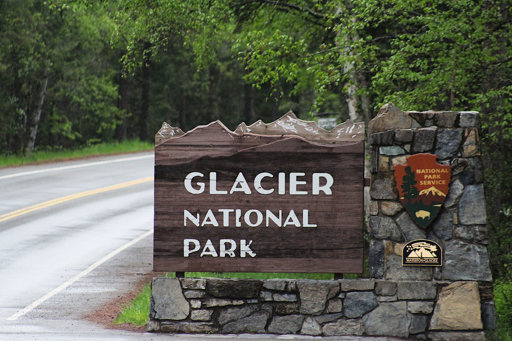
Glacier signs flagged, podcast episodes removed
Jeff Mow, former superintendent of Glacier National Park, previously told the Daily Montanan of his views of the problematic erasure of science and history in the park. He said that the park’s exhibits were planned and created based specifically on natural locations in the park, what types of visitors will see them and what questions they will likely have.
“With 100 years of experience and having hosted over 120 million visitors over that time, I trust that the park staff have developed these exhibits and their content based on what our visitors want to know,” he told the Daily Montanan.
The oftentimes vague reasoning for flaggingexhibits for higher review illustrate what some current and former federal employees have told the Daily Montanan was a lack of direction and clear criteria for carrying out the orders, coupled with worries by employees that their jobs could be on the line if they were seen as not following through.
In the database, five wayside interpretive signs are flagged. A note says that all waysides are “well-researched, thoroughly reviewed by resource experts for accuracy, and are directly tied to Glacier National Park’s resources and primary interpretive themes,” but they are included for higher level review to ensure compliance with the Secretarial Order.
One sign is about wolves as a symbol of controversy and includes multiple graphics of a wolf, including the Glacier High School Wolfpack logo, and a sign that reads “save a deer, kill a wolf.” The note for review says that the images could be considered to be a negative portrayal of wolves if taken out of context.
Another sign, “Blame it on the Grain,” talks about the building of the Sherburne Dam, which flooded two lakes inside the park boundaries. Park Service founder Stephen Mather is quoted saying it was “a glaring example of what is to be avoided in national parks,” which was flagged as potentially disparaging a past American.
Another exhibit at a trailhead talks about fire and its effects on the park. The sign was flagged to ensure it complies and “does not ‘emphasize matters unrelated to the beauty, abundance, or grandeur of the park.’” A similar exhibit about poor air quality due to wildfire smoke was also flagged for the same reason.
The last sign, noted as slated for regular update in 2026, talks about the NPS mission and how future generations might see impacts from a warming climate. It was flagged to ensure the text is compliant and see if “there is anything to consider for the update.”
In 2005, the Glacier Park film was copyrighted and shared information about geology, history, wilderness, biodiversity and other interpretive themes for viewers. One segment about climate science was flagged for being outdated — it uses the latest research at the time and forecasts that the glaciers in the park would likely be gone by 2030.
During the first Trump administration, park officials were told to remove interpretive signs that used the same research indicating the expected loss of glaciers by 2020. Many such signs were removed in 2019 and 2020.
According to the database, park staff flagged a brochure about glacier loss, “Losing a Namesake,” described as a well-researched and popular interpretive tool. The brochure is to be reprinted and updated soon, but was flagged for feedback.
“Specifically, we are interested in any comments on the second page under ‘why are the glaciers shrinking?’ and ‘what can be done?’” the comment states.
One flagged piece of interpretive media has already been removed from public consumption — the park’s podcast.
Since 2020, Glacier Park staff have put out Headwaters, now in its sixth season.
Each season revolves around different themes, such as the park’s most popular locations, the importance of whitebark pine to the landscape, and other stories about historical events and figures.
The staff comment states that while the episodes are historically accurate, extensively researched and reviewed by department staff, some episodes may be perceived as disparaging to historical figures.
Four episodes from the podcast’s sixth season, released in 2024 and 2025, have been removed from all podcasts feeds until “additional review can be completed.”
Of the removed episodes, one, “Wild, Scenic, and Dammed,” has a description that reads, “This is a colonial history of rivers told through three dams.” Another one about the Civilian Conservation Corps is tagged with “segregation,” “racial inclusion,” and “National Park Service diversity.” A third focuses on Glacier as a “crucible for anti-war movements,” during World War II.
A spokesperson for the Department of the Interior did not respond to questions about the criteria used to evaluate mediums such as podcasts, or about a timeline for re-releasing the episodes if they pass review.
A final flagged item at Glacier is decor in the campstore of a park concessionaire about climate change affecting national parks.
Other Montana site
Little Bighorn Battlefield National Monument
For its 150th anniversary, Little Bighorn Battlefield has received a makeover in the form of a new visitor’s center with a new package of content.
Several specific pieces of interpretive material were flagged in the NPS database as noncompliant, including an exhibit that mentioned the United States breaking promises to Native Americans and describing how U.S.-run boarding schools for Indigenous children “violently erased cultural identities and language.”
In response to reports of the flagged material, the Northern Cheyenne Tribal council unanimously passed a resolutionto “prevent changes to or removals of Native American markers, monuments, and signage at the battlefield.”
The tribe cited Montana’s constitution, which outlines the state’s educational goals for the preservation of the cultural integrity of American Indians, and is implemented through Montana’s “Indian Education For All” law.
But the entry for Little Bighorn in the database notes that the NPS regional director has requested the entire new content package for review.
The package has been “delivered for review and feedback received from all affiliate Tribes and stakeholders,” the entry states, but much of that process occurred under the Biden administration, before Trump’s executive order was in place.
Grant-Kohrs Ranch National Historic Site
This working cattle ranch near Deer Lodge, which is overseen by the Glacier Park superintendent, showcases the legacy of cowboys and cattlemen during the “open range cattle era.”
The flagged sign was submitted for higher review “out of abundance of caution” to determine if the portrayal of settlers is disparaging, despite a lower level review team determining the content is appropriate and has sufficient contextual information.
A separate database lists this sign as “in conformance.”
Grand Teton National Park
A flagged exhibit in Grant Teton National Park marked for revision asks visitors to examine how to acknowledge the good and the bad of historical figures — in this case, Gustavus Cheyney Doane.
Doane is known for his explorations and contributions to western national parks, but he is also known for participating in the Marias Massacre in 1870, where the U.S. Army killed more than 170 Piegan Blackfeet, including women, elders and children.
The post What National Park Service interpretive material in Montana has been flagged for review? appeared first on ICT.
From ICT via This RSS Feed.