

This article by José Romero originally appeared in the March 21, 2026 edition of La Jornada, Mexico’s premier left wing daily newspaper.
The USMCA is presented as a success. There’s talk of record exports, integration, and attracting investment. But this narrative obscures the essential point: we’re not facing a successful trade agreement, but rather a mechanism that has orchestrated Mexico’s subordinate integration for over three decades. NAFTA promised development. It was said that opening the economy would bring sustained growth, better wages, and convergence with the United States. None of that happened. Mexico exports more, yes, but it doesn’t grow, it doesn’t converge, and it doesn’t transform its productive structure.
The country has become an export platform deeply integrated with the United States. More than 80 percent of exports are destined for that market. This concentration is not a strength; it is a structural condition that defines what we produce, how we produce it, and for whom we produce it. Mexico has inserted itself into global value chains without building its own capabilities. It exports with high imported content, participates without control, and produces without decision-making power. The maquiladora industry has not disappeared; it has become more sophisticated, consolidating a structure that limits learning, innovation, and value creation.
This logic is not limited to manufacturing. In agriculture, liberalization reshaped production without building internal capacity. While an export segment managed to integrate, vast rural regions were left exposed to unequal competition. The massive influx of subsidized grains from the United States displaced domestic production of staple foods, weakened food self-sufficiency, and deepened territorial inequalities. A similar situation exists in mining: a dynamic sector in terms of exports, but with low domestic added value, few supply chains, and strong foreign capital control. Agriculture and mining reveal the same pattern: uncontrolled specialization and limited use of their own resources.
Mexico exports with high imported content, participates without control, and produces without decision-making power. The maquiladora industry has not disappeared; it has become more sophisticated, consolidating a structure that limits learning, innovation, and value creation.
For years, this model rested on a premise that is now untenable: that the United States led a stable free trade order. That world has vanished. Today, strategic protectionism, active industrial policy, and the use of trade as an instrument of power predominate. Programs like the Inflation Reduction Act and the CHIPS Act reflect an economy that protects, subsidizes, and selects sectors based on geopolitical criteria. In this context, the USMCA ceases to be a trade agreement and becomes part of a strategic architecture.
The 2026 review will not be technical, but political. Mexico is not only commercially dependent on the United States, but is also beginning to align itself strategically without having chosen to do so. Integration is no longer driven by economic criteria but is instead conditioned by external decisions. However, the most profound implication is not economic, but political. The interplay between trade, technology, and security means that integration also shapes foreign policy. Trade dependence translates into strategic alignment. Mexico is beginning to adopt positions compatible with U.S. priorities not through sovereign decision, but due to the constraints of its own integration.
Mexico has chosen a path that is neither one of building its own capabilities nor of achieving strategic autonomy, but rather one of passive adaptation to an international architecture that subordinates it.
The pressure to exclude inputs or investments from third countries is not a response to a national strategy, but rather to external demands. Integration ceases to be an instrument and becomes a mechanism of control. Despite this, the internal response has been to preserve the treaty at any cost. This stance reflects the influence of sectors highly integrated into global value chains, in many cases linked to foreign capital. But these sectors do not represent the economy as a whole. The result is a structural bias: integration becomes an end in itself, displacing industrial policy and diversification.
Mexico cannot abandon the USMCA without significant costs, but neither can it continue substituting a trade agreement for a development strategy. Without industrial policy, technological development, and capacity building, integration reproduces dependency. And in an environment where trade is geopolitics, that dependency also becomes political. Mexico has chosen a path that is neither one of building its own capabilities nor of achieving strategic autonomy, but rather one of passive adaptation to an international architecture that subordinates it.
Under the guise of integration, the abandonment of defining a national development project has become normalized, and market access has been confused with productive transformation. The result is an economy that doesn’t grow, doesn’t develop, exports without learning, and integrates without making decisions. Mexico is not managing its subordination. It is not managing anything. It is surrendering, step by step, the very margins of its autonomy.
-
Clicks
March 22, 2026March 22, 2026
Our weekly roundup of stories in the English and Spanish language press including Cuba solidarity convoy sails from Mexico, CNTE 72 hour strike, Tornel workers shooting, USMCA dependency, ICE deaths, FEMSA cuts, PEMEX-Petrobras collab, & refinery fire.
-
The USMCA: Dependence In a World Without Free Trade
March 22, 2026
Mexico is beginning to adopt positions compatible with U.S. priorities not through sovereign decision, but due to the constraints of its own integration.
-
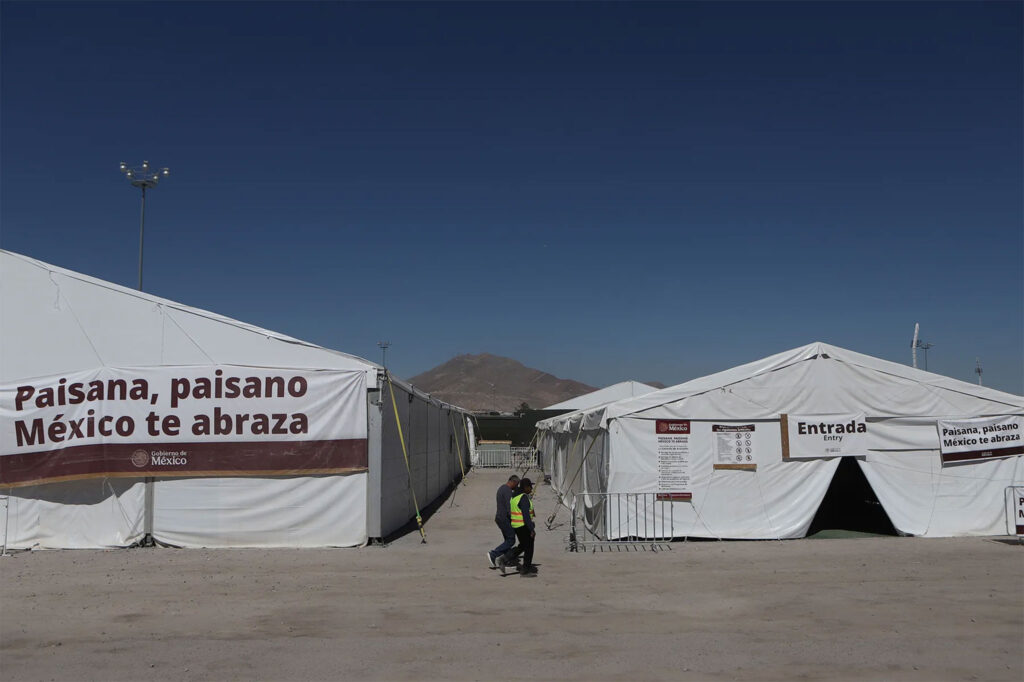
México te Abraza Program has Repatriated 189,830 Mexicans
March 21, 2026March 21, 2026
“Mexico is your home and we will always receive you with dignity and respect. Your country awaits you with open arms, and with all the services and programs to help you start over,” Secretary Rosa Icela Rodríguez assured.
The post The USMCA: Dependence In a World Without Free Trade appeared first on Mexico Solidarity Media.
From Mexico Solidarity Media via This RSS Feed.