

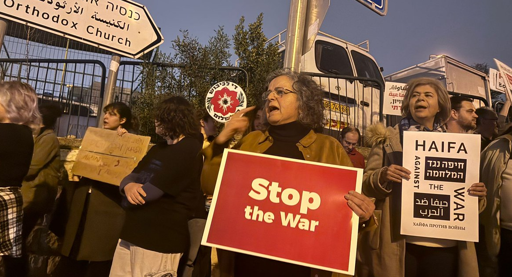

In an interview published this week in Zo Haderech amid the ongoing wars in Iran and Lebanon, Hadash MP Aida Touma-Sliman expressed firm opposition to the war, stressing that opposition to war must be the starting point.
“Two days ago someone asked me why I oppose the war,” she said. “I replied that answers should be demanded from those who start wars, not from those who oppose them. The default must be opposition to war, because wars will never bring security or peace.”
Addressing the objectives behind the escalation, Touma-Sliman pointed out that the Israeli government and the United States, while having different motivations, are acting in coordination. She emphasized that Prime Minister Netanyahu is seeking to establish Israel as the dominant military power in the region.
“Netanyahu is striving to turn Israel into the hegemonic military force in the region and to remove any force that could counterbalance the project of the right-wing government,” she stated. According to her, Netanyahu sees a “window of opportunity” to advance the vision of a “Greater Israel,” based on a fragmented and weakened Middle East.
She added that this vision relies on Arab states being placed in a position of fear, making them more willing to normalize relations with Israel and accept the continuation of occupation in the West Bank and Gaza, as well as in parts of Syria and Lebanon.
Regarding the role of the United States, Touma-Sliman underlined the broader economic and strategic interests behind the war. She noted that Washington seeks control over regions of major economic importance, including Iran’s energy resources, while also aiming to weaken global competitors.
At the same time, she highlighted that the war has a clear joint dimension. “It is important to emphasize that the war in Iran is the first ever joint war of Israel and the United States,” she said, noting that while the U.S. has always supported Israeli wars, “this time it is a joint war from A to Z.” In her view, this marks an upgrade in Israel’s role within the framework of U.S. imperial strategy.
Touma-Sliman also addressed the narrative promoted at the beginning of the war regarding regime change in Iran. She argued that this was never a realistic objective, but rather a pretext aimed at legitimizing the attack.
“They knew from the outset that the regime in Iran cannot be overthrown overnight,” she stated. Instead, she explained, the discourse about “saving the Iranian people” served as a media and political cover to justify “an attack that contradicts not only logic but also international law.”
She sharply criticized what she described as the hypocrisy of the Israeli leadership. “This is exceptional hypocrisy: those responsible for a war of annihilation and the killing of 72,000 Palestinians are trying to convince the world that they launched a war in Iran in order to save another people,” she said. “The Netanyahu government has no right to speak about democracy and human rights.”
Referring to developments inside Israel, Touma-Sliman noted that opposition to the war is gradually emerging. She observed that, although still limited, anti-war voices appeared from the very beginning, and that broader sections of the public are beginning to raise critical questions.
She pointed out the growing contradictions in official narratives, asking how previous claims of military success and long-term security have led instead to renewed and intensified war. At the same time, she criticized the government for failing to protect civilians despite initiating the escalation.
“The government is trying to normalize the war and make the public feel that ‘we will live forever by the sword,’ as Netanyahu said,” she noted, adding that public awareness is slowly developing and could lead to wider mobilization against the war.
Touma-Sliman emphasized the need to actively encourage critical thinking and public questioning. She stressed that people must be convinced that opposition to war is both legitimate and necessary, and that alternatives to war exist.
She also highlighted the importance of organizing around concrete social issues, including compensation for workers who lost their income, support for small businesses, and assistance for soldiers who refuse to take part in the war.
Addressing the situation within Arab society in Israel, Touma-Sliman made a strong statement regarding crime and state policy. “There is no policy of neglect in dealing with crime — crime is the policy itself,” she said. According to her, criminal organizations function as “subcontractors of the government” in suppressing the Arab population.
She argued that this situation is deliberately maintained in order to weaken the political weight of Arab citizens and to fragment their collective organization. “The right wants frightened and threatened individuals concerned with their basic survival, not a collective with political demands,” she explained.
In response, she stressed that the solution lies in collective organization and struggle. Individual advancement, she noted, cannot substitute for collective political power, and only organized pressure can bring meaningful change.
Finally, Touma-Sliman addressed the upcoming elections, warning of attempts by the right to reduce the political influence of Arab citizens and democratic forces. She emphasized that a high voter turnout among the Arab population will be decisive in confronting right-wing and fascist forces.
She also pointed to the possibility of disqualifications of Arab parties and candidates, as well as attempts to intimidate voters. “They may even use physical violence to create chaos on election day,” she warned, stressing the need to organize to defend polling stations.
At the same time, she underlined the importance of building a joint political framework and strengthening Arab-Jewish cooperation. Such a partnership, she noted, can help mobilize broader forces opposed to occupation and war, while also giving hope for real political change.
From In Defense of Communism via This RSS Feed.