

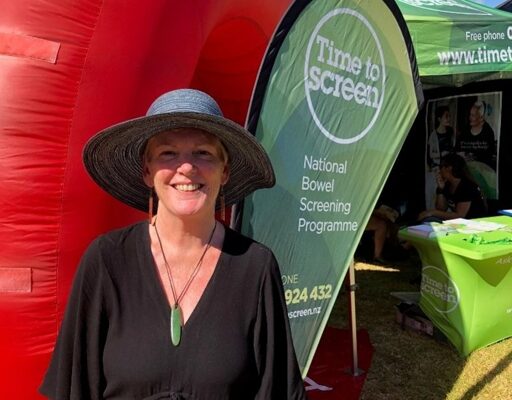

“I’ve been in a relationship with cancer for almost four years.” Jacquie Kidd, Professor of Māori health at AUT, was diagnosed with terminal bowel cancer in January 2023. (Photo supplied)
Jacquie Kidd, a professor of Māori health at Auckland University of Technology, has a memoir out in April, looking back on a life that focuses on health equity for Māori, especially in cancer care.
Here she is writing about how her whakapapa protected and guided her through her own terminal cancer experience.

Jacquie, during her first year of nursing training in 1980. (Photo supplied)
I grew up with images of medicine from books (like the Nurse Sue Barton series from the 1930s and ‘40s), and TV shows like M*A*S*H, Angels, and Casualty. Then I graduated to ER, House, The Resident, and now The Pitt.
There’s an obvious line to draw between their portrayal of nursing and my nursing career, which likely explains my fascination. But there’s also a strong message in these shows about how unacceptable dying is, and a desperate attempt to present a tidy version of death for public consumption.
On recent TV shows, with The Pitt a notable exception, there’s a hilariously predictable story arc. It starts with the scramble to find an elusive diagnosis, accompanied by lots of heroic (idiotic) posturing, whiteboards, and much thoughtful (vacant) staring into space.
Then the dreaded words “It’s cancer” are snapped out with great authority, and there’s a flurry of activity. First, the patient and family cry as the stars of the show assure them that “We’ll be with you every step of the way.” Then there’s the “We’ve got no choice!” surgery, with rushed and minimal informed consent.
When surgery doesn’t work, the final step is a highly risky and ethically questionable clinical trial with terrible side effects. But that’s okay, because the patient’s heroism is only surpassed by the staff who don’t take breaks or give handovers to other specialist teams because of the “every step of the way” thing.
The end might be a cure, or it might be a tear-jerking death. Either way, there’s a tidy end within a contained Euro-focused, biomedical paradigm. We can sigh happily or sniffle our way to the kitchen for a cuppa.
But here’s the thing. It turns out that going from being alive to a cancer diagnosis to dying isn’t a linear progression. Some days it doesn’t feel like anything at all. Other days, I wish it was all over with.
I was diagnosed with incurable, terminal bowel cancer in January 2023, following a colonoscopy and bowel resection in July 2022. The surgeon thought he “got it all”, but a scan showed that the cancer had metastasised to my lungs, so my prognosis tanked at that point.
In the same way that I know that my husband and I had our first date in December 1988 and got married in December 1990, I can track my diagnosis from first encounter to full commitment. In all, I’ve been in a relationship with cancer for almost four years.

Jacquie and her husband, Tony, at Waimārama in 2023. (Photo supplied)
That first encounter was very much like TV, but without the makeup. I used health insurance to get a colonoscopy because I wasn’t 60, the magical age at which bowel cancer becomes a possibility in the minds of service funders and policy writers, so no public hospital was going to accept me.
After the procedure, there was the inevitable “It’s cancer” proclamation and the flurry of activity. I let myself be rushed onto the cancer treatment pathway of more scans and surgery, and for a hot minute, we all thought it had worked.
A nice, tidy, happy ending, until it wasn’t.
This is where the concept of time gets slippery. Western notions of linear time, those rules that dictate how jobs, deadlines and finances function, just don’t work for me anymore. The widely accepted path of symptoms, tests, diagnosis, treatment, and cure or death is a deception for terminal cancer patients. It sneakily shapes how we make decisions, or how we abdicate them to the professionals, and how we experience the rest of our lives.
Time in te ao Māori is consistently portrayed in our lore as curving, shifting, and flexing between past, present and future. The ability to move around time, to experience more than one time at once, and to depend on a non-linear understanding, has been an essential part of my resistance to the medicalised cancer pathway. It’s been a crucial part of my journey so far. It has created time where it seemed like there was none, and has wrapped me in my history, mostly.
A significant challenge to my way of moving through the world came about almost immediately after my diagnosis, when I found myself frozen in the present.
I know from my research as well as my own experience that when a life-limiting illness is diagnosed, people feel powerless. It’s like you freeze in place until someone, anyone, comes to the rescue. That feeling leads to panic and urgency — people grasp at any treatment that offers a glimmer of hope. It can translate into blind trust in the expert behind the desk.
For me, that paralysis disconnected me from the values I had lived by, and I was temporarily lost.
As the oncologist reeled off the terrifying list of statistics, medications and side effects, I could feel myself emotionally folding in. My tinana (body) was curled up, shaking, while I inadvertently retreated from the wairua and tūpuna wisdom that could have helped me.
But two things came to my rescue that terrible day. Firstly, my husband, Tony, was with me, and we were united in our urgent need to ground ourselves in connection with our kids. And secondly, the oncologist saw what was happening and cut the appointment short so we could start to process the news. She sent us off with written information and a plan to return, and we practically ran out of her office.
Resurfacing from the panic took days. I focused on my estimated timeframe of one to five years to live, but knew that for Māori with late diagnosis, it could easily be less than a year. I imagined myself sick, frail, in pain, and bedridden from both the disease and the treatments. I felt guilty that I would make my whānau cry and grieve.
In short, I was filled with every kind of negativity I could imagine. The only thing I didn’t do was ask: “Why me?” My professional life as a researcher made it very clear to me that this was common. I wasn’t special, nor was my terror.

“Living while dying, grieving while anticipating, good days and appalling days, happiness and despair, all co-exist quite comfortably within te ao Māori.” Jacquie and Tony with their kids and mokopuna in 2023. (Photo: Abby Harrison)
What is special in this situation, though, is my whakapapa. Despite being historically disconnected from my home rohe, I nonetheless understand my origins, and I feel both my tūpuna and our future mokopuna in my present. In my ngākau, in my puku, in my wairua. They exist in real time.
And because of that understanding of time as fluid rather than linear, I can let go of my fears about what is to come. Not just death, but the manner of dying, and the passage of time that will lead me there and beyond. Panic and fear cannot survive in the presence of tūpuna wisdom and mokopuna aspirations.
And now I’m back where I started this story, about how death is often seen as an enemy that must be desperately fought against and ultimately tidied away.
In my research, I’ve talked with kaumātua and whānau who’ve had to choose either to reject health services because they’re required to “leave tikanga at the door”, or accept healthcare knowing they’ll have to navigate the systemic racism that’s so baked into our lives that a large part of our community doesn’t believe it exists.
Many of them told me that honouring tikanga was more important to them than extending their lives. So they had walked away from the system.
I thought they were displaying a kind of stoicism, even hopeless resignation. I understand those whānau better now. Not because I’m steeped in tikanga and mātauranga — I’m still in the pēpē stage of my understanding — but because my tūpuna whisper to me that they’ll see me soon, and because my future mokopuna will be cuddled and blessed by their nana before they come into te ao Marama.
Dying in te ao Māori not only defies tidiness, it also resists the idea of a finite life.
Time bends and twists to allow me to write some of my past life into a memoir for future readers while navigating treatment decisions. It allows me moemoeā — dreams of stepping into my unknown journey back to Te Pō and ultimately to Te Kore, while I anticipate my mokopuna graduating, travelling, and living their lives.
I’m at peace with having an open-ended but ultimately limited “best by” date on this tinana.
Without my whakapapa to guide me, I think I would have continued to struggle with my diagnosis. I may have accepted aggressive but ultimately futile treatments that could have extended my life by between nine and 20 months, but without improving its quality.
My particular type of cancer has no known cure, although there are a lot of young researchers working on it. I have no doubt that they’ll succeed, eventually. But not today, not this year, probably not this decade.
Living while dying, grieving while anticipating, good days and appalling days, happiness and despair, all co-exist quite comfortably within te ao Māori.
This isn’t stoicism or heroism, nor is it the “right” way of managing the unimaginable. It’s just the way my whānau and I are guided to navigate it today, whatever that might mean.
Kia whakatōmuri te haere whakamua. This in-between life feels like a tapestry of transitioning across time and space. It’s actually kind of delicious here.

“Because of that understanding of time as fluid rather than linear, I can let go of my fears about what is to come. Not just death, but the manner of dying, and the passage of time that will lead me there and beyond.” Jacquie at home in Ahuriri Napier, in 2023. (Photo: John Cowpland / alphapix)
Jacquie Kidd, Ngāpuhi, is a professor of Māori health at the Auckland University of Technology. She has a clinical background in nursing and almost two decades of expertise in whānau-focused Māori health equity research, examining inequities and racism in the health system.
Her current work includes lung cancer screening for Māori, whānau hauora assessment in the cancer pathway, and antiracism practice in healthcare. She is a trustee and co-chair of Hei Āhuru Mōwai, the Māori Cancer Leadership group, and a keynote speaker at the World Indigenous Cancer Conference in Aotearoa in 2026.
Jacquie lives in Ahuriri Napier with her husband and two dogs, just a short drive from her five mokopuna.
See also, this extract from Jacquie’s memoir Ngākaurua: My experience of cancer, identity and racism in Aotearoa, out on April 1.**
The post Jacquie Kidd: Living while dying appeared first on E-Tangata.
From E-Tangata via This RSS Feed.