

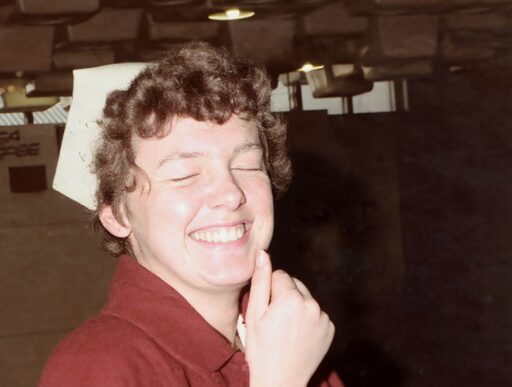

Jacquie Kidd, now a professor of Māori health at Auckland University of Technology (AUT), during her first stint of nursing training in 1980. (Photo supplied)
Two years ago, when we interviewed Jacquie Kidd, Professor of Māori health at Auckland University of Technology (AUT), she was coming to terms with a terminal bowel cancer diagnosis. She*’s* now telling her story in her own words, in a memoir that will be released on April 1.
In this extract from her book Ngākaurua*, Jacquie reflects on her last year of nursing training, which she undertook just as the* profession was trying to come to grips with the idea that Māori concep**ts belong in nursing too.
In my class time during that final year, cultural safety was beginning to be discussed as something that was central to nursing practice.
In 1988, a nurse called Irihapeti Ramsden (Ngāi Tahu, Rangitāne) was appointed to the Department of Education to oversee the inclusion of Māori health in all nursing programmes. Her work focused on the Treaty of Waitangi, poor Māori experiences of healthcare, and the cultural power imbalances inherent in the nurse-patient partnership. It was revolutionary.
I watched as the smugness of many of my lecturers turned into a kind of panic as they tried to incorporate ideas of historical wrongs into their teaching practices. They tried to hold on to their own cultural beliefs of what constitutes right or appropriate behaviours while simultaneously respecting Māori beliefs.
Predictably, it was all a bit of a mess.
The most memorable moment for me happened earlier in the nursing programme when our class went to a noho marae, an overnight stay on a local marae, for our “Māori experience”. I wasn’t all that familiar with traditional Māori life at that point and had only been to one other marae, when I was a child.
I was as wide-eyed and inexperienced as everyone else as we negotiated the tikanga and kawa of entering and settling ourselves into this largely unfamiliar environment. I felt immediately at home, cared for by mana whenua and enchanted by the whole experience. I thoroughly enjoyed myself, and so did the group of students I hung out with. The hau kāinga introduced us to the ancestors who were represented throughout the whare tupuna; we learned a lot about local history, and we were fed beautifully.
On our return to polytech, we were called to a class meeting with the senior departmental staff, where we were told that a large number of our classmates had complained about being forced to sleep communally and subjected to learning things that they considered irrelevant to their nursing programme.
As is usual with this kind of complaint, there was a strong scent of white supremacy, a stubborn refusal to value Indigenous customs or knowledge, and a big dollop of white fragility.
We packed into an uncomfortably small prefab classroom, listening while the basis of the complaint was described.
Instead of defending her reasoning for the noho marae, the head of the nursing department introduced a kuia, saying that she would explain to us why it was important that we understand Māori worldviews.
I was standing at the back of the room, feeling surprised that there had been a complaint, but also increasingly aware of the anger in the room. There was a heaviness, a feeling of nastiness just waiting to be given voice. The lecturers were uncertain and had no control over the large student group in front of them. The kuia, whom I knew as a warm and generous woman, was clearly nervous but wanted to help. My classmates were outraged and self-righteous.
The kuia was thrown to the wolves. I don’t know what she was told before this meeting, but my feeling was that she had no idea about the depth of the racism and entitlement these student nurses were about to display.
In an effort to explain how important the practice of tapu is for Māori, she said that if there was a pot of gold in front of us, Pākehā would use mechanical barriers like alarms or fencing to protect it, while Māori would use tapu.
In a remarkable display of wilful misunderstanding, one of my student colleagues stood and shouted at the kuia, “How dare you?” She announced that, in contrast to what Māori think, she would share the gold with her family. Then she burst into tears and was comforted by the lecturers.
What the hell?
At the time, I thought this was a bizarre and damaging process, but now I recognise the elemental techniques used by the students and lecturers that are still successfully employed by racists today.
Firstly, the students deployed the strategy of refusing to acknowledge any worldview other than their own as having value. They displayed “confusion” about how Māori ways are relevant to nursing and were not challenged on that perspective.
And while the lecturers and head of department had the authority to teach at that moment, they instead silently supported the students’ position by opting to demonstrate an apparent lack of clarity and accountability. Sometimes being racist is as simple as being silent.
The second strategy used was the manipulation of the narrative — the students were allowed to choose to misinterpret key messages and position themselves as the victims. This then generated an opportunity to deploy toxic tears to generate sympathy in their audience. One of the benefits of tears in this context is that even bystanders who are not entirely sure about the situation they’re witnessing are moved to pity and reassurance.
Once the sympathy card has been successfully played, the whole situation is wrapped up into a neat package that uses emotion to sustain the racist status quo. It’s a playbook that Pākehā women particularly excel at, and it needs to be systematically dismantled from within the Pākehā domain.
Once the initial stage of confusion has passed, any attempts by Māori to intervene and challenge or educate are able to be reframed as hostile, aggressive or misleading.
Antiracism allies are increasingly better at calling out reframed narratives and depriving the perpetrator of their cosy reassurance, but it’s not enough. This is only one example of strategies that are being played out in the media and in organisations across the country every day.
After this experience, our lecturers generally avoided any topics that might provoke a similar backlash, so the emerging national conversation about cultural safety was challenging for them to negotiate.
I do believe that some of them genuinely wanted to see changes to nursing theory and practice, but at that early stage, there were few mechanisms in place to support change and no mandate to independently push the existing boundaries.
Tensions increased even further when Te Kaunihera o Aotearoa (the Nursing Council of New Zealand) announced that cultural safety and Māori health would be included in the national state exams we were due to sit.
The students who had managed to ignore its importance throughout the three years were shocked, and I was worried that I didn’t know enough because we had only superficially touched on the topics. But in the end, the questions were predictable and deficit-focused, largely asking about the most obvious health inequities.
Those first tentative steps towards incorporating cultural safety into nursing education were brave but largely unsuccessful. However, what they did achieve was to set the stage for its development over the next decades.
For me, the visibility of Māori health inequities and the potential for nurses to make a difference meant that some of my frustrations about these injustices were validated. It contributed to an exciting and satisfying year overall, with increasingly complex lectures and placements as we moved towards the endpoint of our education: registration.

Jacquie Kidd’s memoir Ngākaurua will be released on April 1.
This is an extract from Jacqui’s memoir Ngākaurua: My experience of cancer, identity and racism in Aotearoa, published by The Cuba Press.
Jacquie Kidd, Ngāpuhi, is a professor of Māori health at the Auckland University of Technology. She has a clinical background in nursing and almost two decades of expertise in whānau-focused Māori health equity research, examining inequities and racism in the health system.
See also Jacquie’s piece on how whakapapa has guided and protected her since she was diagnosed with terminal cancer.
The post Cultural safety in nursing — brave but unsuccessful first steps appeared first on E-Tangata.
From E-Tangata via This RSS Feed.