


Kimiora Kaire-Melbourne, who directed Tīpene – A Legacy Reborn, pictured in front of carvings by Pakariki Harrison. (Photo supplied)
A new documentary, Tīpene – A Legacy Reborn, captures the effort and emotion that surrounded the renewal and reopening last year of the former St Stephen’s School, an Anglican boarding school for Māori boys in Bombay, South Auckland.
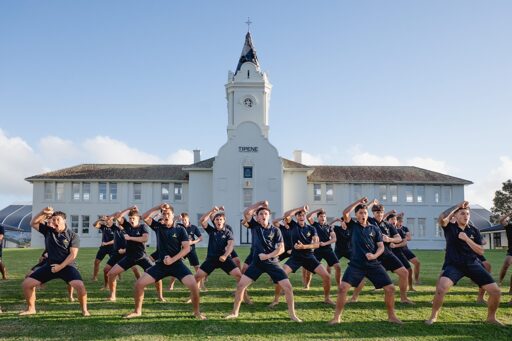
Twenty-five years after it was closed, it’s now a charter school, and officially named Tīpene, as it was always known by generations of former students.
Filmmaker Kimiora Kaire-Melbourne talked to Atakohu Middleton about why she wanted to make the documentary.
Kimiora Kaire-Melbourne remembers her introduction to St Joseph’s Māori Girls’ College, a Catholic boarding school in Napier, as something of a culture shock.
She grew up in the small Māori settlement of Rūātoki with te reo Māori as her first language, surrounded by kaumātua who were confident in their reo and their Tūhoetanga. And she was raised in the Ringatū faith, a blend of Old Testament scripture and Māori custom.
So when she first went to St Joseph’s, “I had to learn who Jesus was, and I had no clue. I swear to you, I had no idea! I didn’t even know I had a different dialect of te reo. I’d been in a bubble.”
Religious education aside, St Joseph’s had a hugely positive impact on her life, says Kimiora. Led by the inspirational Dame Georgina Kingi, the school provided an environment “where I felt supported enough to step outside my comfort zone and realise that I was more capable than I thought”.
“St Joe’s also exposed me to different ways of being. Because I was raised in my Tūhoe bubble, St Joe’s was the first time I was exposed to girls from other iwi with different mita (dialects), upbringings and beliefs. Rūātoki grounded me in my Tūhoetanga, but St Joe’s, in many ways, was my first introduction to my Māoritanga.”
That experience of attending a Catholic boarding school is what made her so interested in making a documentary about St Stephen’s.
“Tīpene has such a rich history and legacy, and many of the old boys were upset when it closed in 2000. Its closure had left an unfinished chapter in the school’s story. And there was an opportunity to explore issues around the education of Māori boys, and also to grapple with the relationship between Māori and hāhi (the church) at Tīpene.”
The school, deeply embedded in Māori memory, had shaped generations of Māori leaders since 1844, including politicians Hōne Heke Ngāpua (1869-1909) and Sir Maui Pomare (1875-1930), and Anglican minister Sir Kīngi Īhaka (1921-1993). In more recent times, Kīngi Tūheitia,politicians Hone Harawira and Shane Jones, Māori Language Commission head Ngahiwi Apanui, reo Māori champion Te Waihoroi Shortland, All Black Dallas Seymour, and many more.
Tīpene was “a taonga of Māori education”, said a former teacher, the late Te Aorere Awi Riddell, and had produced some of Māoridom’s most prominent leaders.
However, in 2000, the school’s trust board and the Anglican Church decided to close the school. According to an Education Review Office report from that time, teaching and management were poor, and there was a “culture of violence”.
After the school closed, the buildings were abandoned, and, in a further indignity, the army was allowed to blow holes in some of them for target practice.
Rebuilding a school and its community was never going to be easy or quick. Neither was making the documentary.

Joe Harawira being interviewed by Kimiora. Joe was the chairman of the school’s board of trustees when it was closed down, and had been leading the old boys’ since then in their fight to reopen the school. (Photo supplied)
Kimiora first took cameras to Tīpene in February 2021, on the day the old boys — led by educator Joe Harawira, who was the chairman of the board of trustees when it closed — mucked out buildings that had become home to squatters, birds, and graffiti.
She set the former students in the main building, Te Poho o Tīpene, and asked them why they were so invested in their old school. They talked about a strong sense of brotherhood and inspirational teachers. They wanted a new generation to experience that.
In their day, students were often from small rural communities, and comfortable in their culture and their reo. Nathan Durie, who was at Tīpene from 1977 to 1982, told Kimiora that he’d been deeply impressed by the senior boys’ confidence and competence. Coming to the school, he said, was the first time he felt like being Māori was powerful and cool.
The interviews also revealed lingering grief about the school’s closure, especially for the two old boys who returned as teachers in the late ‘90s to try to save it. Te Ururoa Flavell, who later became a co-leader of the Māori Party, had been at Tīpene between 1969 and 1974. He returned as the principal, bringing Nathan Durie in as a teacher.
Nathan is back at Tīpene once again, this time as co-tumuaki (co-principal) with his wife Yvette McCausland-Durie. The couple were among those who founded Manukura, the Palmerston North special-character high school that focuses on sporting and academic excellence in a Māori environment. They were both senior leaders at Manukura when Tīpene beckoned.
Kimiora describes Nathan as the visionary and Yvette as a doer. “I’d roll up, and Yvette would be doing the landscaping because it hadn’t been done yet. That’s just her.”
Both are very firm but fair, says Kimiora, and progressive. They want to build a school that honours the past but prepares students for the future. “They’re always thinking outside the box, thinking about what’s going to help this generation excel.”

Tīpene’s co-tumuaki, Nathan Durie and Yvette McCausland-Durie, want to build a school that honours the past but prepares students for the future. (Photo supplied)
One of the stories in the documentary that really moved Kimiora was the 13 large carvings that Pakariki Harrison, a tohunga whakairo or master carver, made between 1978 and 1983 to turn Te Poho o Tīpene from a bare assembly hall to a whare whakairo.
“They were a real assertion of our traditional beliefs in a space that wasn’t really created to acknowledge it, let alone embrace it. To me, it was quite visionary and revolutionary,” says Kimiora.
In 2004, to great dismay, the carvings were stolen from the derelict building. “For Māori, that’s horrific. Could you imagine your wharenui being stripped of its carvings, even if it wasn’t being used anymore?” asks Kimiora. “From what I heard, they were found in Taumarunui in barrels ready to be shipped overseas. Luckily, a police officer recognised them and called one of the old boys.”
The carvings haven’t been reinstalled at Tīpene yet, but Kimiora wanted them in the documentary, so she arranged to take three of them out of secure storage in central Auckland, transport them to Tīpene, and then return them, unharmed. She was guided by master carver Bernard Makoare, a Tīpene old boy who worked on them as a student.
It was one of her more stressful workdays. “That was the first time the carvings had been back in 22 years. There was a lot of negotiating in terms of moving them and making sure everyone was comfortable with it. I just thought, I pray nothing happens to them. I had certainly done my karakia for their protection.”
Another silent but important presence in the documentary is Kimiora’s mum, Tania Melbourne, who died two years ago. Kimiora didn’t have much money when she started making the doco, so Tania often accompanied her on her shoots, driving while her daughter reviewed her questions, and making sure the interviewees were well fed and cared for. “I wanted to manaaki everyone, and she was the best at doing that.”
Kimiora says that her mum’s influence is woven into Tīpene – A Legacy Reborn and, indeed, into every film she has made. “She taught me the skills I use in my work: Critical thinking, respect for people, and being open and willing to learn. Mum never got enough credit for how deep a thinker she was, because she was so humble and hated to be mentioned. But she’s not here to moan about it now, so we’re going to mention her.”
Tīpene – A Legacy Reborn charts a remarkable rebirth. When Kimiora first went to the site to film, the grounds were a mess, and the wairua felt heavy. “You could feel the weight of everything that had happened.”
But over time, as the reopening approached, Kimiora “felt a real shift in the wairua and the mauri of the grounds themselves. The reopening was a beautiful day, and there was lightness, as if a weight had lifted. It felt hopeful.”

Tīpene reopened in 2025 as a charter school, 25 years after it was closed. The new intake pictured in front of Te Poho o Tīpene. (Photo supplied)
Tīpene – A Legacy Reborn*, directed by Kimiora Kaire-Melbourne, airs on Whakaata Māori on Monday, March 23 at 8.30pm, and is available on the Māori+ app.*
The post Tīpene: A legacy reborn appeared first on E-Tangata.
From E-Tangata via This RSS Feed.