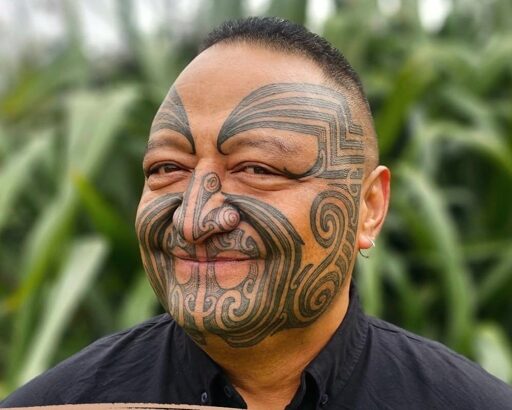

Hone Hurihanganui, composer and teacher. (Photo supplied)
Hone Hurihanganui has been a teacher all his life. A performer and composer of waiata and haka, too. It’s what led to him being part of the landmark play Waiora Te Ūkaipō – The Homeland — both in 1996 when it was first staged, and again this month, for its 30th anniversary season in Auckland.
Here he is talking to Dale Husband about how his life has been shaped by the decision to stay close to the reo and taha Māori.
Tēnā koe, Hone. It’s lovely to talk to you. Can we start with your iwi connections? And then perhaps you’d be kind enough to take us into the whare with your folks and your old people.
Āe. Kia ora, Dale. I whakapapa to Tūhourangi Ngāti Wāhiao, Ngāti Tahu, Ngāti Whaoa, Ngāti Whakaue and Ngāti Porou.
I was born in Rotorua, but I did all my schooling in Wellington, went to university and teachers’ college there, and then spent about 20 years teaching in the Wairarapa. Did a few other jobs all over the place as my children were growing, and now I’m back home in Rotorua.
Would you be kind enough to talk about your folks, please, Hone? I’m interested in their attitude towards reo, their attitude towards Māori development, and maybe you could tell us a little bit about the traits you admire from mum, dad, and those who helped to support you as a young fulla.
Both my parents — Aperahama, my father, and Hine Kihāwai, my mother — were Māori language teachers. They were very strong advocates for te reo and for us to remain connected to our identity. So while I was mostly raised in Wellington, we always knew of our roots and connections to Te Arawa and Ngāti Porou.
And I guess their determination to make sure that te reo survived and flourished, and that we were raised grounded in our identity, has shaped the way I’ve gone about my life.
So, following in their footsteps, I too became a teacher. I started teaching in primary schools, but it didn’t last very long there. I get hōhā too quickly trying to teach little kids, so I had to try secondary school, and that wasn’t much better. They’re too busy chasing each other.
But once I started teaching at polytechnics and universities, I really loved it because by then people had started paying thousands of dollars to attend university, and they wanted every dollar’s worth of what they’d spent on tuition. So they were engaged in the learning process from the beginning.
As a teacher with a young family, I did the best I could to carry on my parents’ legacy, as advocates of te reo and tikanga. I stayed with teaching all my life. And I now do some work with Te Puni Kokiri. Do some consultancy as well. So I keep pretty busy, e hoa.
So when you kōrero, you’ve got a native tongue then — it’s not a school tongue?
I suppose so. Te reo was very much alive in our upbringing. Mostly, though, it was the domain of our parents and our aunties and uncles, especially if they were debating a topic with a bit of passion. We just acquired it because of our proximity to that generation.
Over the years, I’ve tried to stay in vocations where te reo was being spoken or encouraged, just so I wouldn’t lose it.
There were six of us raised in our home. We all had conversational te reo growing up, but very few friends to speak with. And so I suppose what I’m left with now are some smatterings of reo from our upbringing, as well as the influences we have nowadays.
But like everything else in life, the reo is evolving, isn’t it, Hone? I was listening to an interview somebody recorded of our granddad back in the late ‘60s — and how he spoke differs markedly from the way our reo sounds today.
You were a teacher in the polytechnic sector, and I know that many non-Māori are seeking Māori knowledge and perspectives to strengthen their connection to this land and our people. Should that cause concern, e hoa, or should we embrace their interest?
In my teaching, I often say: “If you’re going to call this soil home, that privilege comes with responsibilities. And surely one of those responsibilities is to acquire the language that was built on this very soil.”
That aligns with the definition of indigeneity. Indigenous people aren’t just the people on the land, they’re people born of the land. They’re the people who built their language and culture on a soil before colonisation — the people who “spring forth” from that land.
In the last five years or so, we’ve seen the emergence of this notion of tangata Tiriti, and I see many Pākehā colleagues really taking their place as tangata Tiriti, trying to acquire the language of the soil they call home.
You’re right about its evolution. I mean, things move and change, and te reo does too. For me, that evolution is really great. It makes my heart full because I saw the years my parents tried hard to make sure our reo survived.
So all of those things — social media, tangata Tiriti, kura reo, wānanga, kōhanga reo, and so on — all of that contribute to the normalisation and naturalisation of te reo on this soil.
Given that we’ve had a violent colonial history that almost took it from us, I’m pretty happy about that, e hoa.
Tēnā koe, Hone. We’re also witnessing the denigration of Māori concepts within the current political climate. But we box on, and we treasure and cherish our reo.
You can’t be on the reo Māori journey unless your head and your eyes are looking at the world through a Māori lens, and this can take learners on a journey that they may not have expected. How have you reacted to the way some of the tauira, the students, you’ve worked with, have changed in the way they see the world?
Āe. There was a time when we were so enamoured with people using te reo and pronouncing our words properly that we accepted that having arrived at that point was enough. But now I see that it’s completely insufficient.
There’s a saying: “To know me, know my language, and if you don’t know my language, you can’t know me.”
And so what I’ve said to people is: “Don’t just be somebody who has a few words that you roll out every now and then. Build fluency in te reo because by being fluent in the reo, you gain insight into a whole world that your lack of te reo doesn’t give you access to. “
I’ve only recently arrived at that. In my experience, those who’ve put energy, heart, and time into acquiring or reclaiming te reo really do benefit from a depth of insight that they wouldn’t have gained without that strong fluency.
What about mentors? I know you mentioned mum and dad, but there might have been a kaiako or a lecturer at varsity, or even somebody who you sensed cared about you enough to take you under their wing?
Yes, many. I’ve had the privilege, Dale, of seeing and hearing many people whom I consider models and examples. That includes Dr Moana Jackson of Kahungunu, Ngāti Porou. And Dr Irihapeti Ramsden of Rangitāne and Ngāi Tahu. Irihapeti died in April 2003, and I miss her dearly. She was a nurse behind cultural safety training in nursing.
These people were thought leaders — and they were some of the finest people that I’ve been fortunate enough to have seen and heard in my time.
But I also had some non-Māori examples of excellence. When I was in the fifth form, I had an English teacher whose name was Nola Fox. This little Englishwoman stood about 4 feet tall. She was about 170 years old, and she loved us. And because she poured her love into us, I learned to like English. I wasn’t very strong at English, and I wasn’t a strong reader.
She probably didn’t know many Māori words. She probably never read Te Tiriti o Waitangi. But she was one of those people who knew her craft and invested her heart in her students, and I loved that. I try to do that, and sometimes I’m successful, and sometimes not.
Thank you, Nola Fox, for your kindness all those years ago.
I’ll say!
Hone, how deliberate was it for you to weave taha Māori into the work that you do and have done?
Well, because of my parents, I could see that if I’d chosen the wrong paths, I would find myself in places and situations in which te reo wasn’t flourishing and wasn’t encouraged — and I didn’t want to risk that. I feared that if I made the wrong choices, I would lose my grasp of te reo.
So, I would try hard to find jobs that ensured I’d have people around me who spoke te reo and encouraged it. I’ve been very deliberate and intentional about that. And you know, some of what I’ve been able to achieve wouldn’t have been possible if I had just grabbed any job as a young father.
You’re a poet and a musician and a playwright, too. How important is it, this side of your personality, Hone?
I must say, I jumped into composing waiata when I was teaching kapa haka because I got hōhā with people telling me: “My nanny told me it was like this.” And then someone would disagree with that, someone else would jump in, and on it would go.
So I started writing my own stuff so no one could tell me how it should or shouldn’t be done.
How did you come to write the original waiata and haka for Waiora Te Ukaipō – The Homeland?
I was teaching in Wairarapa in 1996 when Hone Kouka approached me. So I had a platform to compose and a group of students to realise those compositions. It was a great time. The creative juices were flowing, and I was doing a lot of compositions.
But I don’t consider myself a writer or a real artist. When you get writers like Hone and Riwia Brown and others, I think to myself: Those are real writers. I’m nothing like that. This stuff just sort of falls out of their heads onto a page. I can’t do that. I have to really think hard, and it can take me a couple of days to get around to creating the piece I want.
Hone had been commissioned to write a play for the 1996 New Zealand Festival of the Arts, where Waiora was first performed. And I jumped at the chance to be part of it, because I saw that this was yet another avenue where I could celebrate te reo.
And here you are again, 30 years later, for Waiora’s 30th anniversary season, which is finishing its run in Tāmaki this week (Sunday, March 22). What’s it been like being part of Waiora again after all these years? That must bring back a lot of memories.
Āe. I still remember the faces and voices of some of the cast in the years since that first 1996 production. They were some of the greats. Wi Kuki Kaa, Nancy Brunning, and Toni Huata, who’ve all passed on. And Rawiri Paratene, Jason Te Kare, Stephen Butterworth — so many people I love and respect.
I wanted to be part of this production of Waiora because I missed it so much — and I also missed the reprieve that the performing arts world gives you, especially when you’re stuck in the middle of the fight all the time. It’s an escape from that reality.
About a year or so ago, I was feeling quite disheartened and saddened by all the government’s anti-Māori activity. And then, right in the thick of it, a production company in Rotorua, Te Whare Tapere o Te Arawa, asked me to play a character in a new show called Whetūrangihia.
I agreed reluctantly, but actually, it was the best thing. The production included secondary school students who really are the kōhanga reo and kura kaupapa generation. These kids were politically aware, culturally grounded, and strongly acculturated as Māori — they were fluent in both their language and culture.
So we’re seeing quite a different kind of young Māori now than we were seeing 30 years ago. There’s a whole generation of rangatahi who didn’t come from that place of trying to reclaim their cultural identity and cultural position. We came from that place, but these kids don’t.
We can do so much more now. And we can tell our stories in a more courageous way. We were careful 30 years ago because the environment was such that you couldn’t sing it from the treetops. But over the last 30 years, we’ve been so dedicated to the fight that we’ve broken a number of barriers. So it’s a different conversation now.
Do you think Waiora and its themes are still relevant today?
I think the story of Māori being forced from their rural homelands into the cities is still relevant now — and it’s a story we don’t tell very often.
We’re in a different time now, but Waiora did a great job of capturing a snapshot in time of a colonised people dealing with the violence of colonisation. It’s a snapshot that shows where the issues that we’re grappling with today have originated. And I think audiences have appreciated that, especially at a time when we’re in a particular political environment where the current government is intent on winding things back 50 years.
Tēnā koe. I know that you’ve had prominent roles in governance. I wonder if you might share your thoughts on the way governance structures in this country adopt an essentially Pākehā expectation of compliance and monitoring. Does this compliance monitoring compromise Māori structures and operations?
Āe. My children are adults now, but when they were at school, I would try to get on their school’s board of trustees. I’d worked out that unless you’re in those positions, you really can’t influence any movement or change.
So, I would try to take what was essentially a Pākehā structure or institution and ensure that it stopped colonising us.
For example, I’d say to the staff of a school: “Imagine if this institution was the kind of place where parents and whānau felt so at home they would just sort of breeze in, read a couple of books to the kids, put some PE gear away that was left on the field, and then breeze out again.
“Because surely that would be a place conducive to high uptake by Māori, a place where Māori are comfortable in being their authentic selves. If we could achieve that, that could surely change the game.”
That’s an example of getting into governance roles and trying to ensure a place where Māori people, Māori language and culture, and a Māori worldview could sit comfortably without feeling it needed to be compromised or diluted.
I’m on other boards now, for example, Te Reo Irirangi o Te Arawa (Te Arawa FM), and the same thing applies. How do we ensure that governance processes are efficient and effective and support the strong operation of the place, without compromising ourselves as Māori? It’s an ongoing battle, Dale.
I was touched to see that you’re working with your son, Aperahama. I’ve just really loved working with my son — he’s a kura kaupapa teacher, Hone, so we do some bilingual commentary work and things of that nature. What’s the best part of working with your tama?
I love it, Dale. I’m not sure that he loves it, but I love it. He’s a qualified lawyer, and now he looks after our Te Tiriti programmes, our tikanga and the law programmes, and our te reo programmes.
And it’s just been delightful. I don’t have the words to describe how full my heart is to have this opportunity to work with my son, who is now a young father, raising a boy who’s at kōhanga reo.
We all want to make a difference and to build a life that’s sustainable, but it’s all the better if you can do it while being strongly connected to your own.
So, while my son works in the consultancy with me, he has an older sister who is also a teacher. And I’m delighted to talk with her about pedagogy and things like that. I have a younger daughter who works in journalism, and the baby, Tama, is a doctor who’s just taken a year off to reclaim his reo fully at Raukawa.
Fantastic. As a teacher, you would’ve worked with many people over the years, to awhi them and manaaki them, helping them find another side of themselves that might have been lying dormant or that they hadn’t considered. What have been some of the spinoffs that you can recall?
One just came to mind. When I was a teacher at Te Aute College in Hawke’s Bay, I had a young fellow in a fourth form class who was quite quiet and hardworking and diligent. A lovely boy.
All these years later, I began the journey to have my mataora applied, and I went looking for an artist who could give me the mataora. I found an artist whose work I really liked. His name’s Lance Ngata.
Anyway, I reached out to him, and he came back to me and said: “Oh, matua, this is Lance. You used to teach me at Te Aute College.”
So here’s this young fulla who was in a reo class all those years ago, and he had forged a career in te ao Māori as a tā moko artist, to the point where he was the tā moko artist who gave me the mataora.
For me, it felt like completing a circle, knowing that I might have contributed a little to his journey. And now I wear his art on my face, and I’m just delighted about that.
It’s been a beautiful kōrero, Hone. As we come to the end, is there something else you’d like to add?
Āe. Now that I have mokopuna, everything feels different. The whole world is different. And I just want to encourage people to understand how our decisions affect our mokopuna and their future.
Mokopuna decisions are critical decisions — and this is an election year. So I really encourage people to roll up their sleeves and get stuck in. To give all you can and do all you can, for no other reason than the love of our mokopuna.
(This interview has been edited for length and clarity.)
The post Hone Hurihanganui: Following the reo appeared first on E-Tangata.
From E-Tangata via This RSS Feed.
Cool to see aotearoa featured here!