

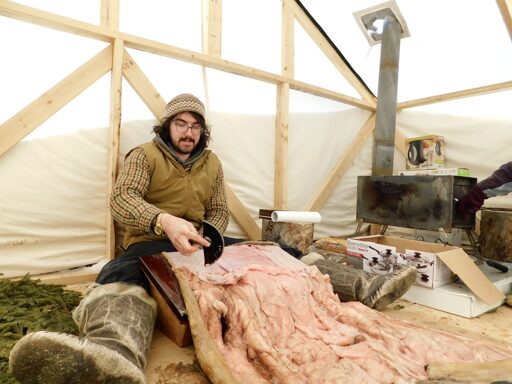

Nicholas Flowers cleans a seal skin in Inotsiavik’s tupik in Hopedale. Photo by Frey Blake-Pijogge
This story was originally printed in The Independent and appears here with permission and minor style edits.
In a tupik (tent) next to the Inotsiavik Centre shed in Hopedale, Nicholas Flowers is preparing a sealskin.
The 23-year-old sits on cardboard and spruce boughs covering the snow beneath him, using his grandmother’s ulu to clean the material that will be used to make kamek — a type of boot — for an upcoming program.
On a woodstove beside him, a kettle is boiling for tea.
The Inotsiavik Centre is a Youth-led nonprofit that offers Inuit cultural and Inuttitut (a dialect of Inuktitut) programs. In 2024, the group behind the centre won the $1-million Arctic Inspiration Prize.
With that money, the team has been providing programming in Nunatsiavut in-person and online.
“I think we were flabbergasted,” recalls Flowers, Inotsiavik’s director of community outreach, Inuttitut and skills instructor, and a group co-founder, about receiving the funding.
Each year, the AIP awards up to $3.7 million: one $1-million prize, up to four prizes of up to $500,000 each, and up to seven Youth prizes of up to $100,000 each.
“It was very unexpected. We put our name in for the application knowing that we had good hopes that someday we would actually get some sort of funding,” he explains during an interview at the centre in February.
“But starting off with the Arctic Inspiration Prize of $1 million was like a huge start.”

A sealskin hangs outside of the centre in February. Photo by Frey Blake-Pijogge
Translated to English, Inotsiavik means “The place to live well.”
Nine people make up the Inotsiavik team, most of them in Hopedale, one of five Inuit communities in northern “Labrador” and the legislative capital of Nuntasiavut. The community has around 640 residents.
Kim Pilgrim, who lives in Hopedale but has roots in Makkovik and Postville, is Inotsiavik’s director of administration and a group co-founder.
“We really wanted to come together and put our strengths together to make a place that’s non-governmental, with a cozy atmosphere, just to be dedicated towards Inuttitut revitalization and cultural revitalization,” she explains.
The group started Inotsiavik when Pilgrim and the others were “at times in our life where we felt like we wanted to do something regarding language and culture . . . so our team just kind of naturally formed.”
The centre offers Inuttitut lessons, Kisiligik (sealskin cleaning) workshops, snowshoe-making, beading workshops, sewing circles, ulu (traditional woman’s knife) making, wooding programs, Kamutik (traditional sled) building, kamek-making, and more.

im Pilgrim says the Inotsiavik group came together through a shared desire for language and cultural revitalization. Photo by Frey Blake-Pijogge
Pilgrim, 26, facilitates the Inotsiavik Indigenous Book Club, a virtual program that holds monthly discussions on books written by Indigenous authors.
The club usually has around eight participants at a time joining the discussions, with 26 participants signed up so far.
Pilgrim also helps facilitate the MitsuKatigevik Sewing Circle program, which offers participants beading supplies for their projects and the opportunity to connect with other community members.
Inotsiavik offers drop-in Youth programming every Tuesday, where young people ages 12 to 18 play board games, do crafts, bead, play video games, or just hang out.
The TetuKatigevik Elders Tea Time is an opportunity for Elders to get together and connect in the community.
Inotsiavik also partners with the Amos Comenius Memorial School in Hopedale to facilitate Inuttitut book-reading sessions with primary grades. The partnership includes school trips to the centre so students can see and participate in cultural activities like sealskin-cleaning.
The programs are facilitated in either the Inotsiavik Centre, situated in a house in Hopedale, or the Inotsiavik shed, which is used for Kamutik-making, snowshoe-making, partridge-plucking workshops, and other activities better suited for a shed.
Inotsiavik also offers some land-based themed programs in town, like illuvigak (igloo) building. Inuttitut lessons are also offered online, with beginner, intermediate, and advanced lessons being taught by the Inotsiavik team.

The Inotsiavik centre in Hopedale. Photo by Frey Blake-Pijogge
A family at the core
“I feel like we’ve given people a place to come and just learn,” Pilgrim says, adding that she’s seeing a positive impact on participants who attend Inotsiavik’s programs.
“We try our best to make people feel comfortable, and I think it’s succeeding so far.”
Nicholas Flowers’s father, Reuben Flowers, is a skills teacher and maintenance worker for Inotsiavik.
“It’s really good to see a lot of people having an interest in the language revival; it’s really important,” Reuben says.
“That’s one of the big things to see — to put into my words, to see the coals, the brands in the stove, begin to light again that were nearly put out. The fire is still there; it’s just smouldering, and the young people will bring back the language.”
At 57, Reuben is a former life-skills teacher at Amos Comenius Memorial School. He’s been working for Inotsiavik full-time since last fall.
He likes the changes he sees in the community as a result of Inotsiavik’s programs, especially language revitalization.
“It’s the only way, because the Elders are passing on,” he explains.
“But the young ones who show an interest — and to know that Inotsiavik has a real role in the revival of the language — you know, it’s really satisfying.”

Reuben Flowers works on a kamutik in the Inotsiavik shed in Hopedale, Nunatasiavut. Photo by Frey Blake-Pijogge
Two of Reuben’s other children, Vanessa and Veronica, are also involved in the organization, making Inotsiavik something of a family project.
Vanessa, a former schoolteacher, serves as the group’s director of education, an Inuttut instructor, a skills teacher, artist, and program developer.
Veronica, who lives in “Ottawa,” is Inotsiavik’s director of programming. Also an artist, she co-facilitates Inotsiavik’s sewing workshops.
Reuben attributes his children’s talent and skills to his late mother, Andrea Flowers. Those skills have been passed down to them, and now they are being passed to other Inuit, helping them reconnect with language and culture.
“I knew my children spent a lot of time with their nan, but I didn’t quite realize to what extent they were learning and observing from her way of life,” he says.
“There’s a kind of losing out on the traditional ways, but as an older person myself — like, growing up, it was really different than children growing up here now. And to see it being carried on is a big, big thing.”
Building community
Last fall, Inotsiavik facilitated a program for community members interested in receiving traditional Inuit tattoos, called kakiniit and tunniit.
“We’re really working to revitalize [traditional tattooing] in Nunatsiavut, and it hasn’t been as big here as in some other Inuit regions,” Pilgrim says of helping to revive parts of Inuit identity, including kakiniit and tunniit, in Nunatsiavut.
In the fall, the group brought Inuit tattoo artists Malaya Kisa-Knickelbein and Sarah Whalen-Lunn to Hopedale, originally from Iqaluit and Alaska respectively.
“Inotsiavik was able to cover their costs and stuff, so we paid them to be able to offer these tattoos for free to community members,” Pilgrim explains.
Inotsiavik does its community outreach largely through social media platforms like Facebook and Instagram. As it welcomes more participants, the group hopes to expand and offer more programming online and in other Nunatsiavut communities within the next five years.

Hopedale, population 300, is the capitol of Nunatsiavut. Photo by Frey Blake-Pijogge
Nicholas Flowers says the wooding program is a partnership with the Nunatsiavut Government, which sometimes contracts Inotsiavik to collaborate on certain programs and language lessons.
In the wooding program, members of the team travel outside the community to harvest firewood for Elders and other community members. Many homes in northern Labrador use woodstoves as their main source of heat.
“Over the last few weeks, whenever the weather permitted, we’ve been going to get dry firewood for Elders in the community who don’t have access to getting wood themselves,” Flowers says.
He estimates that Inotsiavik and the Nunatsiavut Government have supplied dry firewood to more than 20 Hopedale households, which would otherwise not have been able to get it themselves.
Reversing ‘what colonization has done to our people’
Nicholas explains that his grandparents’ generation was made to believe that culture and speaking Inuttitut was going to keep them behind in life.
“But right now, we’re in a time [when Inuit] realize that relearning our culture and relearning our language is actually one of the most beneficial ways of getting ahead, because it allows us to maintain self-government that we need to thrive as a people.”

The cultural centre’s shed, with posters depicting language and other teachings. Photo by Frey Blake-Pijogge
Nicholas says that “the majority of Nunatsiavummiut speak English” but that he and the team believe that “it’s not always going to be that way. We believe that with cultural programming and with individual interest among Inuit, [Inuttitut is] going to come back.
“And we just want to be one of those non-profit groups, as supporters, as we are Inuit ourselves, to foster a safe and healthy place to go against what colonization has done to our people.”
Pilgrim says the Arctic Inspiration Prize funding will support Inotsiavik’s staff to work full-time and maintain the centre’s programming for another five years.
The prize, she says, “allowed us to have the freedom to just do what the community wants to see.”
Once the funding is spent, the group says, they will apply for more grants to keep their programs running.
The post In Nunatsiavut, the Inotsiavik Centre is connecting Inuit with their culture appeared first on Indiginews.
From Indiginews via This RSS Feed.