

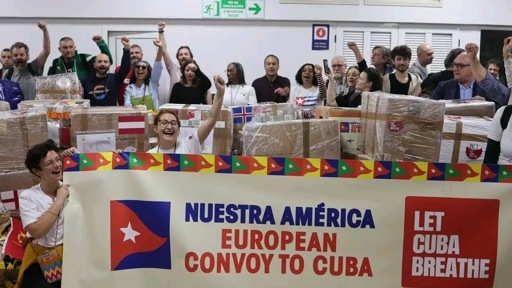
On the night of Tuesday, March 17, a convoy arrived in Havana with humanitarian aid. The convoy carried five tons of medicines and medical supplies to help alleviate the critical situation facing the Caribbean island.
The aid, delivered as part of the Convoy Nuestra América initiative, crossed the Atlantic from Europe and arrived at José Martí International Airport in Havana. According to some estimates, nearly 700 people contributed to the shipment of medicines. The aid amounts to approximately USD 500,000 in medical supplies.
Along with the aid, nearly 100 people arrived in Cuba, representing more than 50 solidarity organizations, trade unions, political groups, and others from 13 different European countries, in addition to individuals from Morocco and Algeria. Also present were four members of the European Parliament and several representatives from various left-wing political parties in Europe.
Rodrigo Zarza, director for Europe at the Cuban Institute of Friendship, emphasized that the aid is not merely a material donation, but also an expression of solidarity in the face of the difficult situation regarding health, education, food, and other areas that the Cuban people are enduring due to Washington’s actions. “This demonstrates the magnitude of the battle being waged around the world today for Cuba, which is to fight for the example we represent,” Zarza stated.
A long-term aggression aimed at destroying the Cuban Revolution
For more than 60 years, Washington has imposed a trade and economic embargo that has caused a series of hardships and economic losses for the island. Beyond any specific excuses, the embargo has had the historical and sustained intention of destroying the Cuban Revolution that began in 1959.
Although the situation has been extremely difficult, Cuba has managed to successfully maintain and develop its social, educational, sports, and health programs (leading in several of these areas throughout the region for decades) thanks to the solidarity of other countries and friendly governments, such as China, Vietnam, and – especially in the 21st century – Venezuela, since the Chavista process began in the late 20th century.
However, following the US attack on Venezuela on January 3, which culminated in the capture of President Nicolás Maduro and his wife Cilia Flores, the United States banned the sale of Venezuelan oil to Cuba, which meant the loss of its main source of energy.
In addition, Trump has threatened to impose a significant tariff increase on any country that decides to sell oil to Cuba, which has deterred countries like Mexico that were prepared to send oil to the Caribbean nation.
Read more: Why the US wants to destroy Cuba
Not a single drop of fuel has entered Cuba since the start of 2026, and this has created what some experts in humanitarian law have described as a “humanitarian crisis” affecting food production, hospital operations, care for pregnant women, transportation, water supply, and more.
Despite the severe crisis and suffering caused by Washington’s decision (as well as the disapproval of most Americans), Trump has remained intransigent in his stance toward the Cuban government. At a recent press conference, he said: “[The Cuban government] has no money. They have nothing. They have a nice landscape … They’re not in a hurricane zone, which is nice for a change. They won’t be asking us for money for hurricanes every week … I do believe I’ll have the honor of taking Cuba.”
More humanitarian aid convoys are announced
Despite Trump’s constant threats, solidarity with Cuba endures. The humanitarian convoy that arrived on March 17 was not the first, nor does it appear it will be the last. Several ships are scheduled to depart on March 19 to deliver humanitarian aid to Cuba from Yucatán, Mexico, carrying several tons of food, medicine, hygiene products, and solar panels.
Read more: Cuba will survive: a diary
The boats is expected to arrive in Havana on March 21. The fleet is supported by the renowned Global Sumud Flotilla, which attempted to reach Gaza in recent months amid Israeli aggression. “We are very proud to stand in solidarity with Cuba, the most supportive country in the world,” said Thiago Ávila, spokesperson for the Global Sumud Flotilla.
The post New humanitarian aid convoy arrives in Cuba appeared first on Peoples Dispatch.
From Peoples Dispatch via This RSS Feed.