

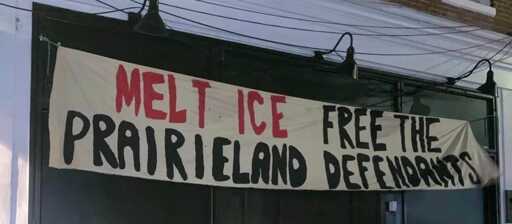
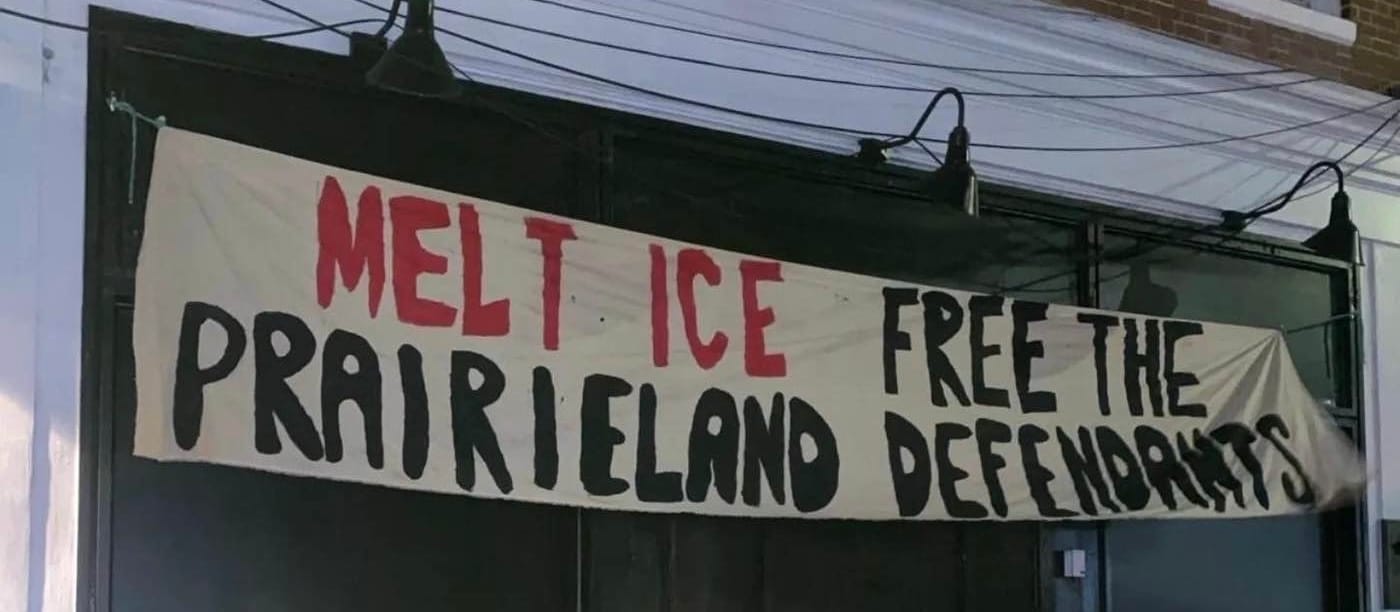
For two weeks in a federal courtroom in Fort Worth, Texas, the government attempted something extraordinary: to transform a noise protest outside a detention facility into a domestic terrorism conspiracy.
On July 4th, 2024, a group of people gathered outside the Prairieland Detention Center in solidarity with those held inside. One person fired a weapon. Nine people now face decades in federal prison after being found guilty on a list of federal crimes.
That is the case, stripped down to its bones.
And it should make every single one of us stop and pay attention. Because what was put on trial in that courtroom wasn’t nine individuals. It was the act of showing up at all.
After days of testimony riddled with contradictions—no breach, no coordinated plan, one shooter—the jury, selected entirely by the judge, still returned sweeping guilty verdicts against all nine defendants.
Seven others had already pleaded guilty in late 2025 and are awaiting sentencing. All nine now face decades in federal prison while simultaneously fighting state charges alongside eight additional defendants.
What unfolded in that courtroom wasn’t just a trial.
It was a test case. And now, it is precedent.
The Verdict
Batten, Evetts, Hill, Morris, Rueda, Song, Soto, and Soto were each found guilty of:
- riot
- providing material support to terrorists
- conspiracy to use and carry an explosive
- using and carrying an explosive
Song was additionally convicted on three counts of discharging a firearm during a violent crime. Song was also convicted of attempted murder of an officer.
Rolando Sanchez-Estrada and Rueda were found guilty of conspiracy to conceal documents. Sanchez-Estrada was also convicted of corruptly concealing a document.
Several defendants were acquitted on other serious charges:
- Hill, Evetts, Morris, and Rueda were found not guilty of discharging a firearm and attempted murder
- Song was found not guilty on two of the three attempted murder counts
One Shooter. Nine Convictions.
By the government’s own admission, only one person discharged a firearm that night. That fact never changed. What did change was how far prosecutors were willing to stretch the concept of responsibility to make the numbers work.
Some defendants were not in any planning communications. Some arrived late or left early. At least one never exited their vehicle. Cell phone data placed one defendant nowhere near the scene. Another, Autumn Hill, had allegedly already left before the shot was fired.
None of that mattered.
All nine were convicted, not because the government proved what each person did, but because it argued they should have known what someone else might do.
The legal mechanism was Pinkerton liability, a doctrine that allows the state to hold an entire group responsible for the actions of one person if those actions were “reasonably foreseeable.”
In practice, that meant attending the same protest, being in the same group chat, or sharing the same politics could be enough to make you responsible for someone else’s choices.
That isn’t accountability.
It’s a trap.
And now it’s been tested, and it worked.
Some of the people convicted in this case were barely present at all. People who never approached the facility. People who stayed in their cars. People who were leaving. People whose only connection was knowing the same people or existing in the same political orbit.
The government collapsed all of that into one thing: guilt.
Ownership of literature became evidence. Zines became evidence. Stickers became evidence. A printing press became evidence. None of it illegal. All of it reframed as proof of intent.
Daniel “Des" Sanchez-Estrada, a Green Card holder who now has an ICE hold and is facing deportation, was convicted for transporting zines from one place to another, or, according to the indicting document, “a box that contained numerous Antifa materials.” Des was not even remotely close to the noise demonstration, but rather was arrested two days later after getting a call for familiar support from his incarcerated wife, a Prairieland defendant.
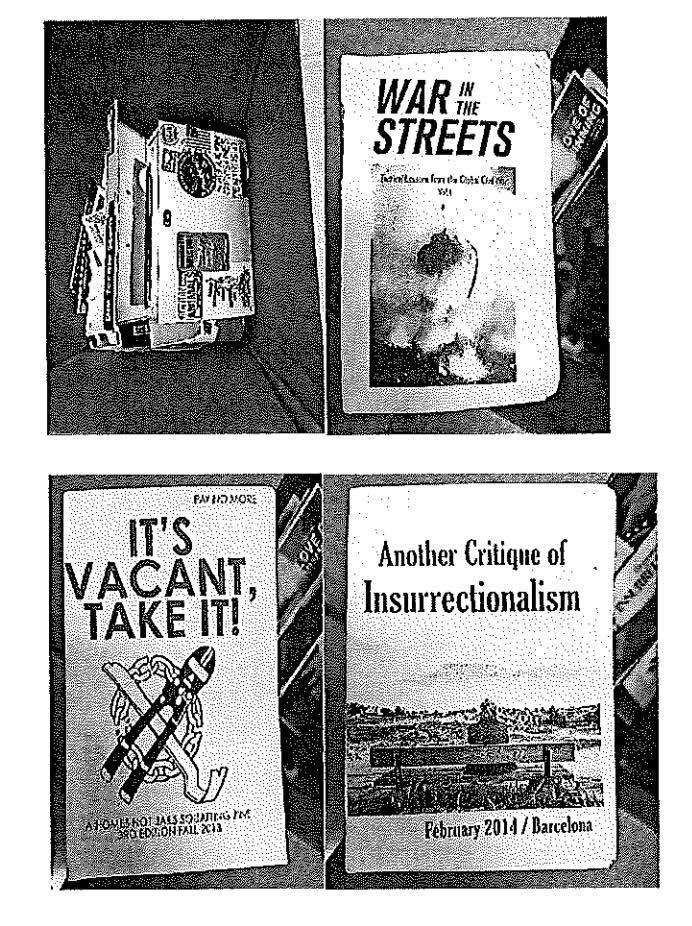
Some of the zines Des transported
This is what it looks like when the state stops trying to prove what you did and starts prosecuting who you are.
When Evidence Fails, Ideology Steps In
The prosecution’s factual case was shaky from the start. Their own witnesses undermined it.
An officer testified he drew his weapon first and aimed it at someone running away. He couldn’t identify any defendants. His statement was written weeks later with legal guidance. Other officers confirmed there was no breach, no coordinated movement, and no meaningful damage to the facility. One officer contradicted his own report on the stand. Another admitted to conducting an illegal search.
Although it was acknowledged in court that the officer drew his weapon first, the defense was still barred from using self defense as an argument.
The “explosives” described in court were fireworks—the kind used in celebrations across the country every Fourth of July. Fired mostly into the air. No structural damage. No injuries.
But language did the work evidence could not.
Fireworks became “explosive devices.” A scattered protest became an “attack.” A demonstration became “terrorism.”
Rather than grapple with the contradictions, prosecutors pivoted. If the facts wouldn’t carry the case, ideology would.
Jurors were shown zines, pamphlets, antifascist artwork, a printing press, and a sticker reading “Make Amerika Not Exist Again.” None of it illegal. Every witness admitted as much, as did the judge.
That wasn’t the point.
The point was to equate shared beliefs with shared intent and demonize the defendants.
The government’s “antifa expert,” Kyle Shideler of the Center for Security Policy—designated a hate group by the Southern Poverty Law Center—has a documented history of Islamophobic fear-mongering and far-right political alignment. His own methodology was acknowledged to be non-scientific and with no direct evidence of planning. And yet his testimony sat at the center of this case, framing a community’s politics as evidence of a conspiracy. At one point during the trial, defense asked Shideler if this case was good for his career, to which he responded “I guess it will depend on how it goes.”
At one point, an FBI agent admitted he had to Google what an “antifa flag” looked like.
Another FBI agent, who was responsible for reviewing the phone calls between Sanchez-Estrada and Rueda, was incapable of translating even the most basic Spanish phrases, and yet his translation was used as the basis to convict on conspiracy to conceal documents. The jurors were not provided a transcript of the call and instead were forced to rely solely on the agent’s review of the conversation.
This is the expertise used to prosecute people for terrorism.
The Cooperators: Pressure, Deals, and Manufactured Narratives
If the evidence was weak, the government had another tool: cooperators.
And cooperation in cases like this doesn’t happen in a vacuum. It is manufactured.
Witnesses described being held without adequate medical care, under extreme stress, facing unclear and escalating charges, and even tortured. They were presented with deals and told, in effect: give us the story we need, or face what comes next.
Some testified they did not write their own plea statements. That key language, like “antifa cell,” was written for them. One witness said they were told they had to “snitch, even if I have to make shit up.”
What the cooperators actually said often contradicted the prosecution’s narrative. One described the event simply: a noise demo. Another testified firearms were present defensively, not as part of a plan. One said they radioed others to leave when officers approached, undermining the idea of a coordinated attack.
But by then, the framework was already built.
Let’s be clear about what this is.
It is testimony produced under pressure, shaped to fit a theory the government could not prove on its own.
This tactic is not new. Informants and cooperators have been used for generations to fracture movements, from labor struggles to Black liberation organizing to environmental activism.
You can understand the pressure without excusing the outcome.
The damage is real.
And it worked.
This Is Not New. But It Goes Further.
None of these tactics emerged from nowhere. From the Haymarket affair to the Red Scare, to COINTELPRO, to the Green Scare, the pattern is consistent: when the state feels threatened, it expands conspiracy law to criminalize movements, not just actions.
The J20 inauguration protests attempted—and ultimately failed—to use that same framework, arguing that protesters could be convicted simply for wearing black bloc, turning clothing into evidence of conspiracy. The Red and Green Scares similarly show how the state repackages political organizing as an existential threat whenever it needs to justify repression.
More recent cases suggest that strategy is evolving, and succeeding.
In 2024 in San Diego, a jury found Brian Lightfoot and Jeremy White guilty of conspiracy to riot, as prosecutors argued they had acted not as individuals, but as part of “Antifa” treated as a criminal organization. Defense attorney Curtis Briggs warned at the time: “I think the door is wide open to now hold lawful protesters in violation of conspiracy law.”
Just three months later, journalist Alissa Azar was convicted of felony riot after defending herself while covering a demonstration countering Proud Boys in Oregon. For weeks in court, the focus of the trial drifted away from her actions and toward her political alignment.
The Prairieland case borrows from all of them, but it goes further.
It refines the playbook. It proves the state can secure convictions not despite weak evidence, but alongside it, by filling the gaps with ideology, informants, and fear.
Here, the government didn’t just target organizers. It swept up friends, acquaintances, people who shared rides, people who stood in the same field.
It argued that proximity is guilt.
And it won.
This case also marks the first time that people have been convicted of material support to terrorists who are not alleged to be part of designated foreign terrorist organizations.
None of this began with Donald Trump. But under his administration, it has been accelerated, formalized, and openly embraced.
What was once quieter repression is now explicit policy.
The administration has repeatedly framed this as the first legal case against “antifa,” while directing federal law enforcement to prioritize antifascism as a domestic terrorism threat under National Security Presidential Memorandum 7. At the same time, federal officials publicly labeled the defendants “antifa-aligned anarchist violent extremists” before the trial had even concluded.
These weren’t just political statements. They were prejudicial signals, ones that made the possibility of a fair trial increasingly impossible from the outset.
What was once done through infiltration and surveillance is now stated outright: antifascism is being framed as a domestic terror threat, and the legal system is being used to make that framing real.
That shift signals not just repression, but confidence.
Confidence that the courts will allow it.
The National Lawyers Guild stated that this is all taking place against the backdrop of the ongoing “Antifa Scare,” which paints those who oppose fascism as the problem, instead of fascism itself.
What This Verdict Actually Does
This is the precedent, written plainly:
A protest can be reframed as terrorism.
Political beliefs can be introduced as evidence of intent.
Group chats can become conspiracies.
One person’s actions can justify decades in prison for many.
You do not have to commit violence to be convicted of it.
The judge acknowledged that political speech is protected.
And then allowed a case to proceed that criminalized it anyway.
That contradiction is the point.
What We Do Now
The nine defendants are awaiting sentencing while fighting additional state charges. They remain incarcerated. They are not abstract symbols. They are real people who need real support.
When letter-writing information is released through the defendants’ support committee, use it. Write. Show up. Donate. Share accurate information. Challenge misinformation.
Isolation is one of the state’s most effective tools. Breaking it matters.
But this moment demands more than support for nine people.
It demands attention.
The J20 defendants weren’t acquitted because the state showed restraint. They were acquitted because people organized—through media, court support, fundraising, and sustained public pressure that made the government’s narrative harder to maintain. Just like they did during the Stop Cop City RICO cases where 61 defendants had their charges dropped after years of organizing and noncooperation.
That kind of collective defense matters.
And it is not optional now.
Because what this case establishes is a blueprint: identify a political moment, target a loosely connected group, inflate one act into a mass conspiracy, fill the gaps with informants and ideology, and secure convictions.
The state now knows this works.
It will use it again.
This was not a legal misunderstanding.
It was a political prosecution carried out successfully.
They put dissent on trial.
They got a conviction.
What we build in response, the solidarity, the defense networks, the refusal to be isolated or silent, is what determines what comes next.
Because there will be a next time.
And whether this precedent expands or collapses depends on what happens outside the courtroom.
We don’t disappear. We don’t shrink ourselves into safety.
There is no version of being quiet enough to avoid a system willing to criminalize association, belief, and presence.
What exists instead is each other. And whether we act like it.
Sentencing for the defendants is scheduled for this upcoming June. We will continue to update as necessary. Defendants are planning to appeal this unjust outcome.
Recommended Reading:
We recommend reading through the detailed notes published by the support committee for an in-depth look into the trial, which can be found here-
[First Week of Landmark Prairieland Trial Exposed Contradictions, Weaknesses in Government’s Case, Trial Resumes Tuesday - Support the Prairieland Defendants
Cross-Examination of Government Witnesses Leaves Defendants’ Supporters Feeling Confident as Trial Enters Second Week, Despite Attempts by the Prosecution to

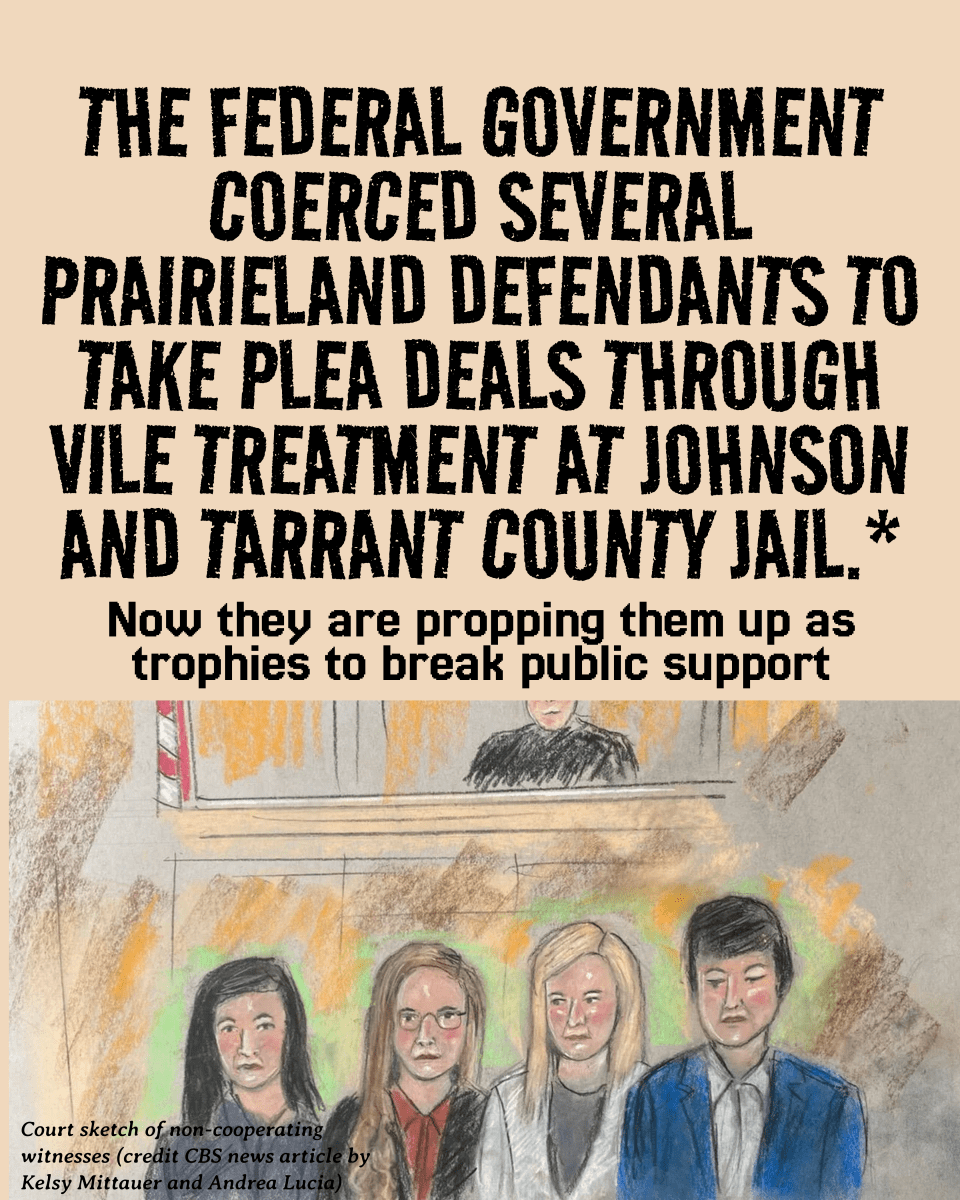
 ](https://prairielanddefendants.com/press-release/first-week-of-landmark-prairieland-trial-exposed-contradictions-weaknesses-in-governments-case-trial-resumes-tuesday/?ref=wewillfreeus.org)[The Federal government coerced several Prairieland Defendants to take Plea deals through vile treatment at Johnson and Tarrant County Jail*.
Now they are propping them up as trophies to break public support In July 2025, a group of people were arrested after holding a noise demonstration outside the Prairieland Detention Center. Origina…
 Dare to Struggledaretostrugglenyc
 ](
](Ways to Support:
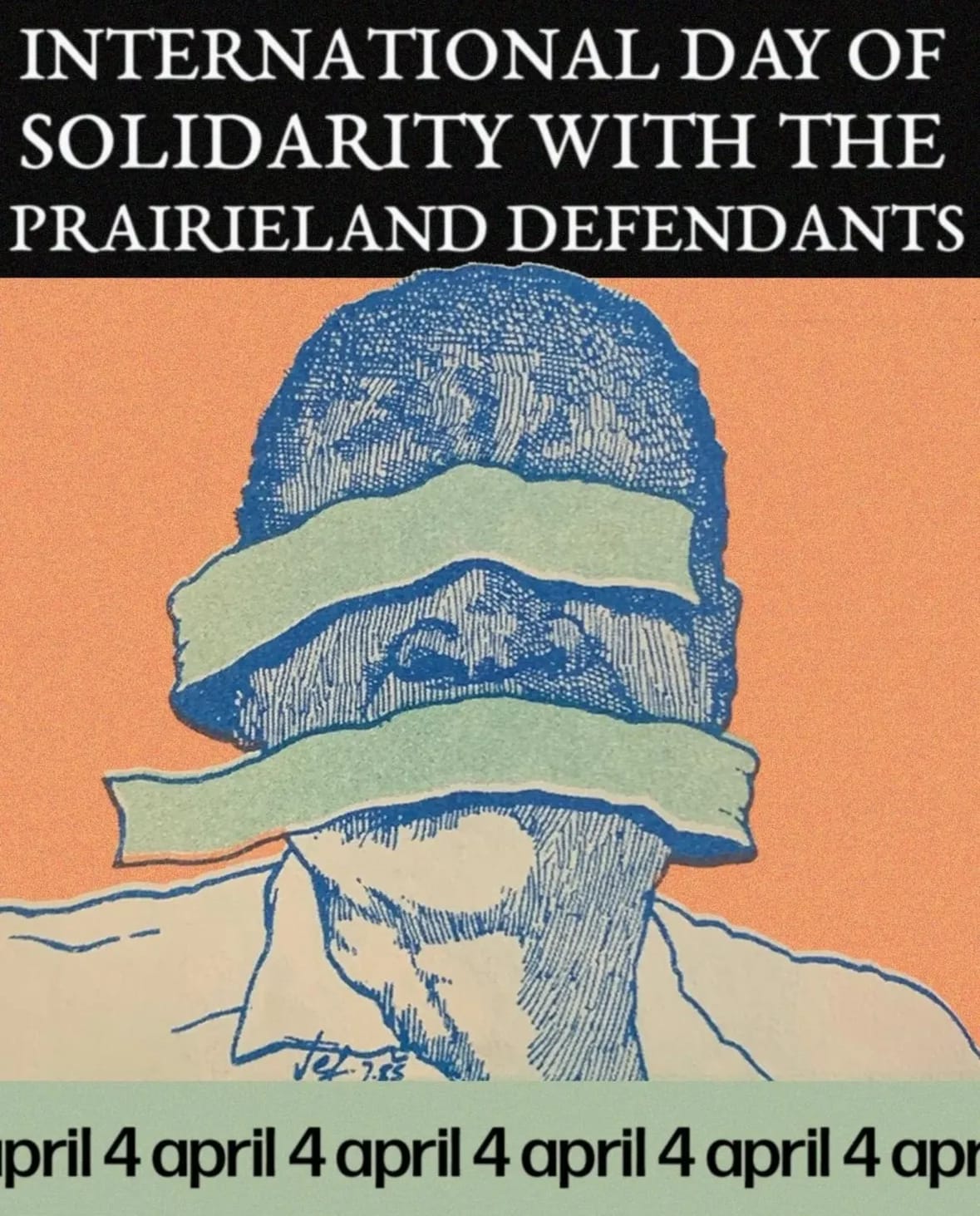
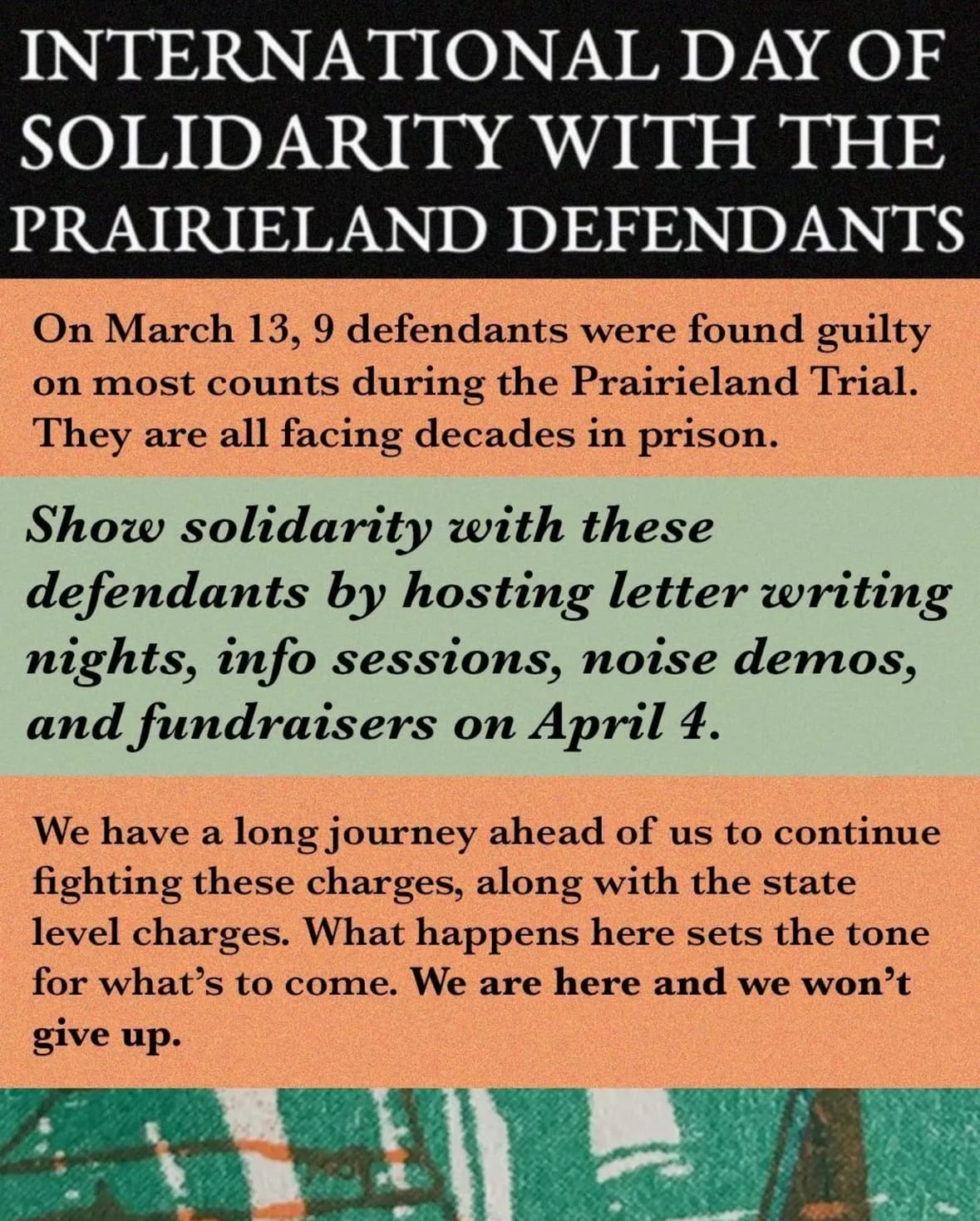
International Day of Solidarity with the Prairieland Defendants is on April 4th, 2026:
Write to the defendants-
[Write to the Defendants - Support the Prairieland Defendants
Many of them have been incarcerated since July—let them know they are not alone! This page has addresses and guidelines to help ensure that your letter gets

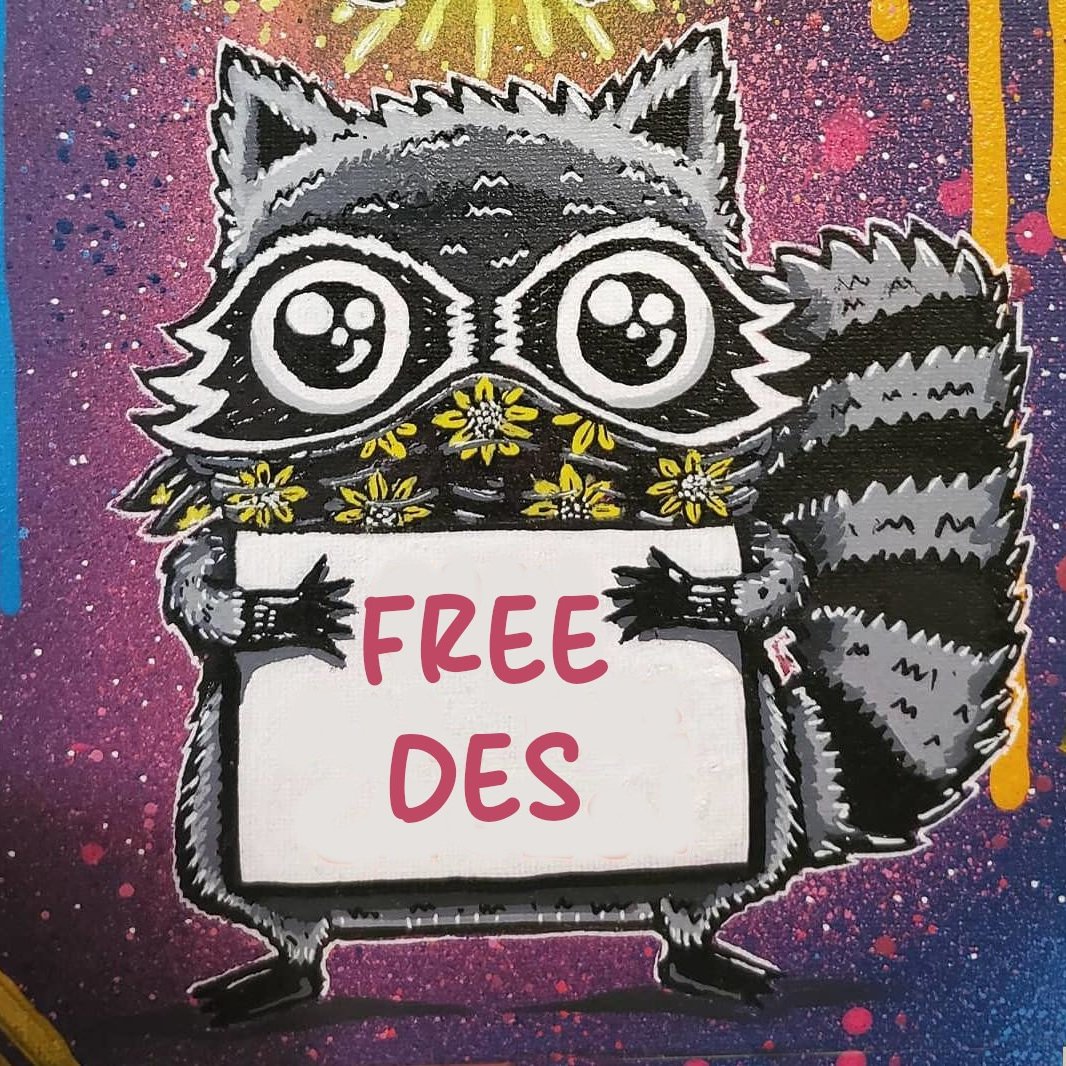
 ](https://prairielanddefendants.com/write-to-the-defendants/?ref=wewillfreeus.org)[ZINES ARE NOT A CRIME!
 ZINES ARE NOT A CRIME!
 ](https://freedes.net/?ref=wewillfreeus.org)
Donate:
[Support DFW Anti ICE Protesters
Please visit our website at https://prairielanddefendants.com/ for more updates, articles, and letter writing information.Español abajo Support DFW Anti ICE…

 ](https://www.givesendgo.com/supportDFWprotestors?ref=wewillfreeus.org)
From We Will Free Us via This RSS Feed.