

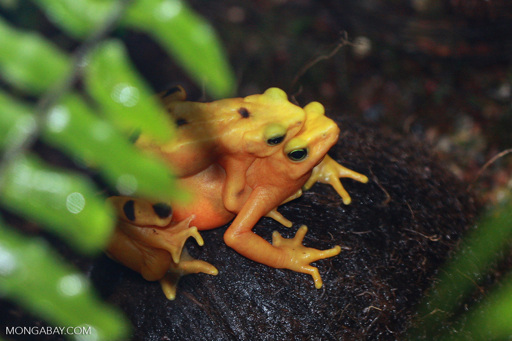
Since 2009, no one has seen a Panamanian golden frog in the wild. These bright yellow frogs disappeared completely when an amphibian fungal disease, chytridiomycosis, swept through Panama reaching El Valle de Anton, the last stronghold of golden frogs. Researchers at the Smithsonian Institution predicted these declines based on the pattern of disease spread, but to get ahead of the disease, a coalition of organizations built the the Panama Amphibian Rescue and Conservation Project (PARC) with a mission to safeguard golden frogs (Atelopus zeteki) and other amphibians most at risk of extinction. After successfully breeding them in captivity, the project has begun releasing frogs to understand the science of rewilding these imperiled animals. “We provide care for some of the most endangered amphibians in Panama, and now we are entering a new phase of our work to study the science of rewilding,” said Roberto Ibañez director of PARC. The golden frog is endemic to Panama and was found only near fast-running streams flowing from the mountainous region of central Panama. Chytridiomycosis, the deadly fungus that infects a frog’s skin leading to death, can swim through water and hitch a ride on other wildlife, even on people’s shoes. The disease is still present in many other areas of Panama, so the release trial presents an opportunity to understand how frogs transition from human care to the wild. Researchers released 100 golden frogs in soft-release pens, known as mesocosms, and came back to monitor them post-release. The frogs initially spent 12 weeks…This article was originally published on Mongabay
From Conservation news via This RSS Feed.