


Richard Arlin Walker
Special to ICT
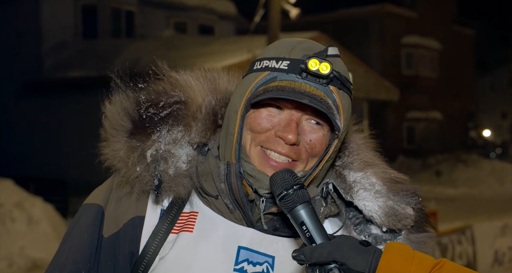
High-velocity winds over Topkok Hills, a coastal ridge about 50 miles east of Nome, Alaska, tipped Anishinaabe musher Jesse Terry’s dog sled over a few times in the last stretch to the finish line of the Iditarod Trail Sled Dog Race.
It was his first time in the Iditarod, but he and his team persevered.
“They just kept charging,” Terry said of his dogs in a finish line interview carried on the Iditarod website. “Seeing them perform got me excited, and they knew I was excited and they kept going.”
Their efforts paid off. Terry and his team placed 14th in the race and had the fastest time from Safety to Nome. In addition, Terry won Rookie of the Year honors for being the first rookie to cross the finish line.
Terry and his dog team finished the 975-mile race at 3:36 a.m. local time on Thursday, March 19, with an overall time of 10 days, 13 hours, 36 minutes, and 3 seconds.
He was cheered by fans and received a long embrace from his wife, Mary England, near the famed burled arch that marks the finish line in this Norton Sound city of 3,700 residents.
The 2025 Iditarod winner Jessie Holmes of Brushkana, Alaska, was the first to cross the finish line in Nome to win his second consecutive title on Tuesday, March 17.
Past champion Peter Kaiser, Yup’ik, finished ninth, and past champion Ryan Redington, Iñupiaq, finished 13th. Rookie Kevin Hansen, Iñupiaq, was expected to cross the finish line on March 20 in 21st place.

Peter Kaiser, Yup’ik, placed ninth in the 2026 Iditarod Trail Sled Dog Race. It was the 10th time he’s placed in the top 10. He won the race in 2019. Credit: Courtesy Iditarod Insider
Terry’s finish capped a high-performance two months for him and his dog team. He finished third in the 300-mile John Beargrease Sled Dog Marathon on Feb. 6 in Duluth, Minnesota, and won the 200-mile Canadian Challenge on Feb. 19 in Saskatchewan. Terry’s wife, Mary England, finished second in the Canadian Challenge and ninth in the Beargrease, but she did not compete in the Iditarod.
ICT could not reach Terry for comment about the race. But in a finish-line interview carried on the Iditarod website, he said he was drawn to the Iditarod by “the love of running my dogs in new places and seeing new lands.”
Terry beamed over the experience. “I’m living the dream,” he said.
Terry vied with Sam Martin for Rookie of the Year for most of the race. Martin arrived in Koyuk (mile 804) ahead of Terry by three hours. Terry and his team picked up the pace when it counted, clocking a speed of 8.37 mph to Martin’s 6.22 mph to Elim (mile 852) to close the gap. Terry and his team continued to outpace Martin, arriving in White Mountain (mile 898) 1 hour 10 minutes ahead.
IDITAROD 2026: Jessie Holmes wins second consecutive Iditarod title
Martin finished 15th, arriving in Nome 3 hours and 23 minutes after Terry.
Kaiser, who won the Iditarod in 2019, was in position to finish 10th but outpaced fellow veteran Michelle Phillips from Safety to Nome to place ninth, finishing the race with an overall time of 10 days, 3 hours, 35 minutes, and 32 seconds.
Ten is Kaiser’s magic number this year. He now has 10 top-ten finishes in the Iditarod. And in January, he won his 10th Kuskokwim 300, widely considered to be the premier mid-distance sled dog race. Kaiser is to date the only Yup’ik musher to win the Iditarod, and he and is the winningest musher in the Kusko 300.
Redington, who won the Iditarod in 2023, crossed the finish line with an overall time of 10 days, 7 hours, 2 minutes and 20 seconds. He led early in the race but was slowed by illness. At the finish line, he thanked Phillips and mushers Paige Drobny and Mille Porsild “and the others that helped me when I was sick. It was great sportsmanship and I really appreciate them.” He then congratulated Holmes, the winner.
All told, 37 mushers started the race on March 8 in Willow. Five scratched during the race, including Jody Potts-Joseph, an experienced Han Gwich’in musher and the sixth Alaska Native woman to compete in the Iditarod in its 54-year history. She dropped out March 17 some 714 miles into the race when one of her dogs showed signs of kennel cough.

Ryan Redington, Inupiaq, overcame illness to finish 13th in the 2026 Iditarod Trail Sled Dog Race. He won the race in 2023 and has five top-10 finishes. Credit: Courtesy Iditarod Insider
Porsild dropped out when one of her dogs, Charley, died March 17, some 852 miles into the race. Charley was four years old. A necropsy conducted by a board-certified veterinary pathologist did not identify any obvious traumatic or medical abnormalities to explain Charley’s death, race marshal Dan Carter reported.
“Further laboratory testing is being conducted in accordance with race protocol to support a thorough investigation and complete the necropsy, with every effort made to determine the cause of death,” Carter said.
Rookie Adam Lindenmuth scratched March 19 in White Mountain (mile 898) when a windstorm east of Nome compelled him to signal for help. Iditarod veteran Grayson Bruton dropped out March 17 in Unalakleet (mile 714), saying it was in “the best interest of his dogs.” Rookie musher Jaye Foucher scratched for personal reasons on March 10 in Rainy Pass (mile 153).
The post Anishinaabe musher Jesse Terry is Iditarod’s Rookie of the Year appeared first on ICT.
From ICT via This RSS Feed.