

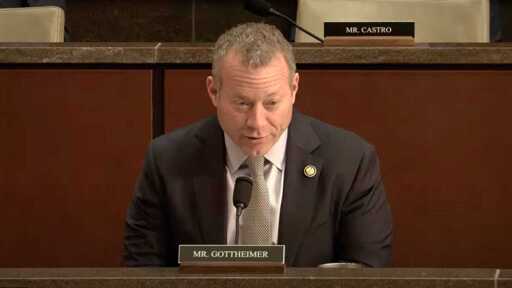
Gottheimer questions CIA Director John Ratcliffe during a House Permanent Select Committee on Intelligence on March 19, 2026.
With the House Eyeing Another Iran WPR Vote, Pro-Israel Democrats Explore Routes to Delay
Story by Julian Andreone
Democrats in the House are preparing to force a vote on another War Powers Resolution as early as next Wednesday. House Minority Leader Hakeem Jeffries told reporters that, this time, he is optimistic the effort to cease American hostilities in Iran will win the votes of the Democratic holdouts on the Massie-Khanna effort earlier this month.
Jeffries was referring to Democrats who voted against the WPR introduced by Rep. Ro Khanna (D-CA) and Rep. Thomas Massie’s (R-KY), which failed 212-219 in a March 5 vote on the House floor, favoring instead a proposal by Rep. Josh Gottheimer (D-NJ). The text of Gottheimer’s resolution—which provided a watered-down alternative when the Khanna-Massie WPR was gaining momentum, but did not end up going to the floor—sets a 30-day maximum on hostilities from the day the bill was filed.
The bill was designed to give Trump the leeway to continue bombing without congressional approval for 30 days. But if reintroduced and passed now, it would force Trump’s war efforts to come to a close by March 30, putting the cosponsors who voted against the Khanna-Massie WPR in a position where they may be forced to vote to effectively end the war immediately.
Gottheimer told Drop Site that he’s been communicating and collaborating with Rep. Gregory Meeks (D-NY), who has introduced a War Powers Resolution of his own that foreign policy experts claim is ripe to call for a vote while Gottheimer’s is still ripening.
“Have you talked to Meeks? Get him,” Gottheimer told Drop Site. “Ask Meeks. It’s relevant to what I’m doing too, but I want to defer to him.”
Last week, however, in an appearance on MSNOW, Meeks indicated that he intends to allow Trump to continue waging his assault for two more months before bringing his resolution, despite acknowledging that, “this is a war that has not been authorized by Congress.” This approach stands in stark contrast with the timeline that Gottheimer’s resolution would achieve, ending the Iran War in the next ten days.
“In about 60 days, this war will probably still be going on,” Meeks said. “I have another War Powers act and we are able to bring it forward at that time as a privileged resolution.”
Executive branch lawyers have long argued that the War Powers Act permits the president to engage in military action for 60 days without any authorization from Congress. Congress has historically rejected this interpretation, saying it runs afoul of the requirements of the Constitution and War Powers Act, which both state that only Congress can authorize war or offensive military action.
Meeks’ 60-day delay appears to be intended to reaffirm the false claim that Trump is allowed 60 days of military action, even after House Democrats voted overwhelmingly that Trump must cease his unauthorized war immediately. More than 40 anti-war groups, including the Quincy Institute for Responsible Statecraft, Demand Progress and Just Foreign Policy, are now calling on Meeks to bring his resolution for a vote immediately and abandon the arbitrary and self-imposed 60-day wait period he discussed.
Meeks, according to AIPAC Tracker, has accepted more than $2.2 million from the pro-Israel lobby throughout his career in Congress and has consistently voted in line with the lobby’s policy priorities.
Cavan Kharrazian, senior policy advisor at Demand Progress, called for members to “be put on the record regularly” on whether they will act to end the war, especially given what he called a “real and growing” risk of further U.S. involvement and ground troops. He also chided Democrats for using delay tactics to prolong the war and deepen Trump’s political liability.
“We were deeply troubled to see Rep. Meeks say earlier this month that he would wait 60 days before forcing a vote on his resolution to end this unpopular and illegal war, effectively giving Trump a free pass on his own timeline for escalation,” Kharrazian said. “That was unacceptable given the urgency of the moment and the daily escalation we are seeing, and it falls short of what anti-war leadership demands. We welcome indications that Rep. Meeks may now be considering bringing a vote next week”
The delays come amid reports that prominent Democrats are eyeing the partisan electoral benefit of Trump continuing a disastrous war, while other pro-Israel Democrats support the military assault generally but oppose Trump’s lack of planning. Drop Site reported in February, for instance, that, according to an unnamed foreign policy advisor to Senate Minority Leader Chuck Schumer (D-NY), a “substantial number” of Senate Democrats privately supported a regime change war in Iran and hoped Trump would pursue it so that he and the Republicans would absorb the political repercussions.
Anti-war advocates have thus openly speculated whether the Democratic establishment would deliberately allow the war to drag on in order to benefit the party politically in the 2026 midterm elections.
Sunrise Movement Executive Director Aru Shiney-Ajay told Drop Site that Democratic and Republican voters alike are calling for “leadership against Trump’s immoral and illegal war,” rejecting the partisan electoral games some lawmakers seem to be playing.
“Anything less than a forceful condemnation of war is a pro-war position,” Shiney-Ajay said. “Voters see through this attempt to leave the door open to funding the next war and will remove spineless politicians from office.”
Days before Gottheimer introduced his WPR, he filmed a video with AIPAC about the importance of the U.S.-Israel relationship in fighting Iran. “When we look at Iran, continuing to rear its head, you understand, whether it’s fighting their ballistic missiles, fighting their nuclear program, we have to stand up to Iran and what they’re doing to their people,” Gottheimer said.
When Gottheimer introduced his alternative WPR in early March, eight pro-Israel Democrats signed on as co-sponsors: Greg Landsman (Ohio), Henry Cuellar (Texas), Jared Golden (Maine), Jimmy Panetta (Calif.), Tom Suozzi (New York), Adam Gray (Calif.), Jim Costa (Calif.) and Vicente Gonzalez (Texas). Among these eight Democrats, three voted against the Massie-Khanna War Powers Resolution: Greg Landsman, Jared Golden, and Henry Cuellar.
Rep. Juan Vargas (Calif.) was the fourth and final Democrat to join House Republicans in killing the WPR and extending Trump’s war of aggression, seemingly waged to carry out the Israeli government’s regional ambitions. A Democratic dissenter on the Massie-Khanna resolution and notably missing among co-sponsors of the Gottheimer resolution, Vargas is expected to be the primary target of Democratic leadership’s whipping efforts.
At the time of the Massie-Khanna vote, the war was in its first days. Advocates argue now that the war has spiraled and lawmakers should once again go on the record, particularly as strikes on energy facilities affect gas prices in the United States and indications grow that Trump may be looking to deploy ground troops in Iran.
The Senate voted down another War Powers Resolution, spearheaded by Sen. Cory Booker (D-NJ), on Wednesday by the same 47-53 margin that Sen. Rand Paul (R-KY) and Sen. Tim Kaine’s (D-VA) resolution failed earlier this month. Booker told Politico that Senate Democrats plan to bring War Powers Resolutions “again and again and again” to continue to force colleagues on the record as the war drags on.
In addition to Senate Democrats’ sustained WPR push, Sen. Bernie Sanders (I-Vt.) introduced a Joint Resolution of Disapproval on Thursday to block any further arms sales to Israel. The motion specifically targets three particular sales: $298 million for 5,000 “defense articles” relating to 250-pound small-diameter bombs, $209 million for 10,000 500-pound bombs and $151.8 million for 12,000 1,000-pound bombs.
The Senate Foreign Relations Committee now has five calendar days to consider Sanders’ resolution in committee, a timeline the Arms Export Control Act requires for foreign military sales to NATO allies and major non-NATO allies, of which Israel is the most prominent. After this period, Sanders and the three co-sponsors of the resolution, Sen. Chris Van Hollen (D-Md.), Sen. Jeff Merkley (D-Ore.) and Sen. Peter Welch (D-Vt.), can force a Senate floor vote on a motion to discharge the resolution, which is privileged and thus cannot be amended or filibustered, from committee. It would require a simple majority to pass.
From Drop Site News via This RSS Feed.