


Corporate media political reporting has always been a clubby endeavor, but a recent reporting experience suggests that the insider culture in Washington, DC, is more insular than ever.
It’s often a challenge for independent media to get responses from Washington insider sources—especially on stories critical of powerful actors—but it’s become increasingly difficult even to pose the questions to those sources. Corporate news sources now issue press releases without bothering to include any information about who to contact with follow-up questions, as if the source is handing the truth down from on high.
When I first encountered this phenomenon after returning to journalism three years ago, I assumed it was a function of the laziness and/or incompetence of individual PR hacks. In my previous life, I had written a few dozen press releases, and “who’s the contact person?” was always a key question to answer in planning media outreach. But today, a failure to offer contact information increasingly appears to be a deliberate strategy to stymie journalistic inquiry.
‘No Surprises’ unsurprising fiasco
Last November, my healthcare politics online newsletter, Healing and Stealing (11/7/25), published an investigation of a national coalition of health insurers and other big businesses. The Coalition Against Surprise Medical Billing includes major business lobbying trade associations like the National Retail Federation, National Restaurant Association, National Association of Manufacturers and the health insurance industry trade group AHIP. Through those associations and business/labor health policy alliances, most of the largest employers in the US and many major labor unions are part of the Coalition, in alliance with the health insurance companies that sell them health plans for their employees.
The Coalition lobbied for passage of the No Surprises Act. The law, passed in December 2020 and signed by President Donald Trump, limits the amount that patients have to pay out of pocket when they unknowingly see a doctor or use another service that is not covered in their health insurance plan’s network. The law also set up a new arbitration system to resolve disputes—between employers and insurers on one side, and hospitals, labs, doctors’ offices and ambulance companies on the other—over the rest of the bills.
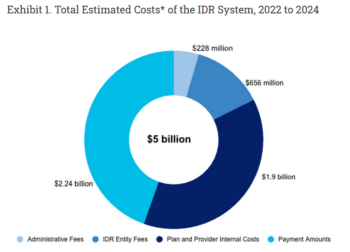
Health Affairs (8/25/25)
The No Surprises Act eased a little of the enormous out-of-pocket costs that burden patients, but otherwise it’s a fiasco. The arbitration system has been swamped with 50 times more cases than federal officials expected. Arbitrators have ruled in favor of extreme prices requested by providers in more than 80% of cases. Cases are adjudicated by supposedly “independent” corporate consulting firms with blatant conflicts of interest on both the provider and insurer sides. And the whole mess has added more than $5 billion worth of higher prices and bureaucratic costs to the world’s most expensive healthcare system.
The insurers and employers in the Coalition are now running a strange, self-contradictory campaign to shift the arbitration rules in their favor. Insurers are pointing fingers at hospital financial consultants as “middlemen” who drive up costs, though what are insurers but the ultimate middlemen?
A coalition that includes hundreds of billions of dollars’ worth of private equity–backed businesses is raising alarms about the dangers of private equity. It’s trying to stop a PE-backed consulting firm from becoming an arbitrator, because the firm consults with the hospital industry. Never mind that the majority of the already-certified arbitrators consult with the insurance industry.
Details of the policy weaknesses in the No Surprises Act can be found at Healing and Stealing (2/22/24, 9/8/25), along with the investigation of what we call America’s Silliest Policy Campaign (11/7/25). But as self-contradictory as the content of the Coalition’s campaign may be, their behavior as a news source is even stranger.
Contact-free press releases

The website of the Coalition Against Surprise Medical Billing.
Healing and Stealing wanted to ask the Coalition to respond to a series of detailed questions. It also sought comment from the private equity firm and Coalition member CVC Capital Partners about its purchase of two of the certified “independent” arbitration firms, each of which also consults for CVC’s fellow Coalition members in the insurance industry on claims sent to insurers by providers.
CVC Capital Partners claims $236 billion in assets under management, as of March 2026, and holds investments in major retail outlets and brands like Petco, Lipton Teas and the sports apparel maker Authentic Brands Group, owner of Reebok. CVC sits on the executive committee of the board of directors of the National Retail Federation, a member of the Coalition Against Surprise Billing. In recent years, CVC bought two of the 16 approved No Surprises Act arbitration firms.
The CVC webpage describing the firm’s portfolio links to numerous imperious 21st century press releases with no contact information, including the announcements of its Lipton and Authentic Brands deals.
But at least CVC has a communications department. If you poke around on the website, you can fairly easily find the name of someone to email, who in all likelihood won’t respond to your questions. The Coalition Against Surprise Medical Billing itself posed a greater challenge.
Taking the ‘public’ out of PR
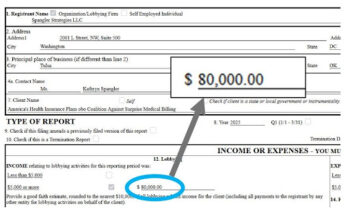
AHIP disclosure form (1–3/25).
The Coalition includes hundreds of US-based Fortune 500 companies and has been up and running since 2019. Not only are their press releases devoid of contact information, their entire website has no information about how to ask them questions—no media contact, no staff name, nothing.
We dug into congressional lobbying records and found that the insurance industry (through its trade association AHIP) pays two lobbyists on behalf of the Coalition. So we emailed an extensive list of questions to the more expensive of the two—former Republican Senate Health, Education, Labor and Pensions Committee staffer Kathryn Spangler. We also sent the communications team at CVC Capital a similar list of questions.
The insurance industry paid Spangler’s “boutique consulting firm focused on healthcare policy, advocacy and coalition building” $80,000 in each of the first two quarters of 2025. Apparently that doesn’t pay for responding to media requests—or at least those from relatively obscure Substack newsletters. We received no reply to questions about the contradictions in the Coalition’s campaign, and the fact that some arbitrators appear to have the same conflicted relationships with the Coalition’s insurance company members as others have with the hospitals and doctors opposing the insurers in arbitrations.
Surprise billing had its moment in the sun as the Next Big Horrible Healthcare Thing in 2019–21. The visible horror stories used to sell the law were “fixed”: Individual out-of-pocket costs for specific types of out-of-network care were limited. This left the insurance industry, and the employers who hire them, begging the federal government to do the job that the for-profit entities keep failing to do: control costs and deliver decent healthcare.
With a twist, of course: The insurance industry wants the government to do their job, but leave intact their profits, as well as the power that their employer “customers” hold over our healthcare. The comical failure of the No Surprises arbitrations doesn’t prompt corporate media to ask the obvious question of why we keep allowing the Coalition’s members to loot the country and fail to take care of us. So rather than concede that they’ve failed at cost control for 50 years and support public social insurance like Medicare for All, or publicly set uniform prices, the Coalition gets away with seeking a “fix” to yet another layer of the world’s most bureaucratic health system.
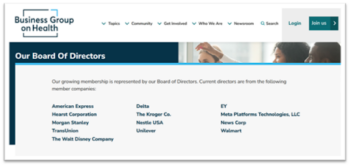
Corporations represented on the Business Group for Health’s board, including Hearst and News Corp.
All of which is normalized in US media. In fact, many major media companies have taken a position on the issue, although reporters for their outlets may not even know it. In their role as employers, Hearst Corporation and News Corporation sit on the board of directors of the Business Group on Health, a national lobbying organization, dedicated to improving employer-sponsored healthcare, that belongs to the Coalition.
With the credibility conferred by trillions of dollars in corporate power backing them, the Coalition Against Surprise Medical Billing doesn’t really need media attention beyond the journalists embedded in the DC hothouse and healthcare industry trade press, all of whom can be contacted without the trouble of fielding questions from the broader media who might question their talking points, not to mention the general public. Even absent any media attention at all, they can feel confident that congressional staff and regulators will read their press releases and “In Case You Missed It” blog posts.
The contactless press release and public-free public relations campaigns reflect the dominance of corporate sources who now pronounce the Truth from on high without even bothering to solicit questions. And that, in turn, is yet more evidence of the growing gulf between policymakers and the public at large.
From FAIR via This RSS Feed.
I love it
