

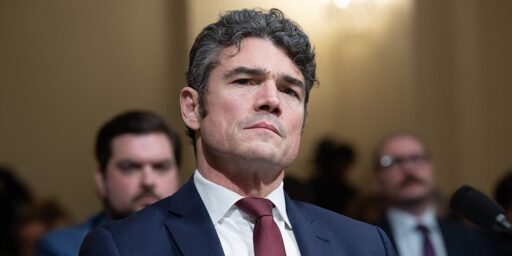
Joe Kent, a top counterterrorism official in the Trump administration, resigned Tuesday citing his opposition to the ongoing war in Iran.
Kent’s resignation came as the most recent and perhaps most consequential of a series of rifts opening on the far right over the war in Iran. While most of the defections had come from MAGA media figures, Kent’s departure from his role as director of the National Counterterrorism Center was the first major defection from the administration.
In his letter of resignation, Kent condemned the war as a violation of the president’s campaign promises to steer clear of foreign wars, criticizing what he described as Israeli pressure as a catalyst for dragging the U.S. into a deadly potential quagmire.
“I cannot in good conscience support the ongoing war in Iran,” wrote Kent in a letter posted to X, where it had received nearly 100 million views as of Friday morning. “Iran posed no imminent threat to our nation, and it is clear that we started this war due to pressure from Israel and its powerful American lobby.”
[
Related
“Utterly Dismayed”: Air Force Engineer Resigns as Dissent Against Gaza War Slowly Spreads Within Military](https://theintercept.com/2024/06/18/israel-gaza-war-military-resign-dissent/)
Kent is not the only government national security professional disaffected by Donald Trump’s war in Iran, according to advocates for conscientious objection who say they’re fielding nonstop calls from distressed service members. Many service members could refuse to take part in the war, either by refusing outright — and risking punishment — or by declaring as conscientious objectors, according to Mike Prysner, executive director of the Center on Conscience and War, a group that counsels members of the military on their rights in objecting to participation in or support of combat operations.
“This is the kind of thing that really resonates: seeing respected people in positions of power validating what many service members feel, which is that this is bad and people shouldn’t take part in it,” Prysner said. “There are a lot of people who may be inspired by what Kent did.”
Skyrocketing Objections
Prysner said that in the weeks since the war began with joint U.S.–Israeli airstrikes on February 28, the group’s phones have been ringing around the clock. Active-duty military personnel and military families are scrambling, he said, to figure out what their rights might be in refusing to take part in the war. His group has helped dozens of service members explore or start applications to declare as conscientious objectors.
“We’ve started more people in the CO process in the past two weeks than we typically do over the period of a year,” Prysner said.
Prysner said the group has spoken with service members occupying ranks from major to private, including three fighter pilots.
Prysner’s numbers could not be independently confirmed, and representatives of the Army, the Navy, and the Air Force did not immediately respond to a request for comment regarding the number of new applications for conscientious-objector status.
Kent, an Army veteran who later served in the CIA before running as a hard-right House candidate in Washington state, is the most senior member of the administration to resign over the war in Iran. Until Tuesday, he served under Tulsi Gabbard, the director of national intelligence and herself a former critic of pressure to the U.S. and Israel to carry out regime change in Iran.
[
Related
Air Force Academy Prepares Ideological Overhaul, With Erika Kirk Bringing “Bold Christian Faith”](https://theintercept.com/2026/03/19/air-force-academy-charlie-erika-kirk/)
The resignation came amid a broader split in the MAGA movement, with some Trump loyalists backing up the president’s decision to go to war while others, perhaps most notably conservative pundit Tucker Carlson, questioning the logic of attacking Iran in concert with Israel. In the wake of Kent’s announcement, Trump called his departure “a good thing,” while White House spokesperson Karoline Leavitt said the letter was brimming with “false claims.” Kent, according to media reports, was the subject of a leak investigation by the FBI.
“Sooner the Better”
The U.S. military offers service members avenues to avoid combat or even be discharged from the ranks if they can prove that they hold religious, moral, or ethical objection to “war in any form.” The practice in the U.S. of declaring as a conscientious objector goes back as far as the U.S. military, although the regulations around it and the reasons cited by would-be conscientious objectors have expanded over time, and in the current, all-volunteer military, regulations require that one’s believes have “crystalized” since signing on.
“It’s totally valid for people to cite a specific conflict in their CO application, as long as that leads them to the broader realization that they cannot participate in any war,” Prysner said. “It’s absolutely valid for service members to look at the war in Iran and make the conclusion that they can’t be part of this in any form.”
Prysner is himself a veteran who served in the Iraq War, and came to anti-war activism after his deployments there. He said he began to question the violence unleashed in Iraq after coming into contact with Iraqis. In the age of the internet, however, the horrors of war can be quickly beamed into people’s phones and social media, potentially spurring more members of the military to question their role in that violence.
That dynamic was on display in Iran, Prysner told The Intercept. The surprise nature of the U.S.–Israel attack caused the families of service members to reach out to loved ones stationed abroad, while numerous active-duty members who reached out had been motivated by the clear and devastating impact of the war on civilians, notably a U.S. airstrike on February 28 that killed 168 people, most of them children, at a school in the Iranian city of Minab.
“By far the most common thing we’ve heard from people for a specific thing that caused them to reach out was the Minab school massacre,” Prysner said. “It’s not wanting to be a part of what they see as crimes against people they have no reason to hurt.”
[
Related
Daniel Ellsberg Wanted Americans to See the Truth About War](https://theintercept.com/2023/06/16/daniel-ellsberg-pentagon-papers-dead/)
Hundreds of service members resisted participation in the Iraq War, including many who successfully applied as conscientious objectors. But many had a difficult time successfully proving that their opposition to war was not simply a fear of serving overseas. Others went AWOL, with at least 200 service members fleeing to Canada to avoid fighting.
Some, such as former Marine Stephen Funk, served jail time for refusing to deploy. Funk also faced discrimination in the Marines as a then-closeted gay man and spent months in the brig for his refusal to ship off to Iraq. In the years after his discharge, he worked with anti-war groups like Iraq Veterans Against the War and Veteran Artists to promote peace and work with other vets to reintegrate.
Funk told The Intercept he has been horrified to see the U.S. yet again charging into a war that has already killed hundreds of civilians and stands to kill, injure, and morally compromise members of the U.S. military. He urged service members facing a crisis of conscience to listen to their heart.
“I would say go for it, the sooner the better,” Funk told The Intercept. “You don’t want to have injuries, or moral injuries, that you’ll carry for the rest of your life.”
Correction: March 20, 2026, 12:25 p.m. ET
Due to an editing error, this story contained an errant reference to Mike Prysner’s military service; he did not serve in Syria.
The post Joe Kent’s Resignation Could Bolster a Wave of Conscientious Objectors to Trump’s Iran War appeared first on The Intercept.
From The Intercept via This RSS Feed.