

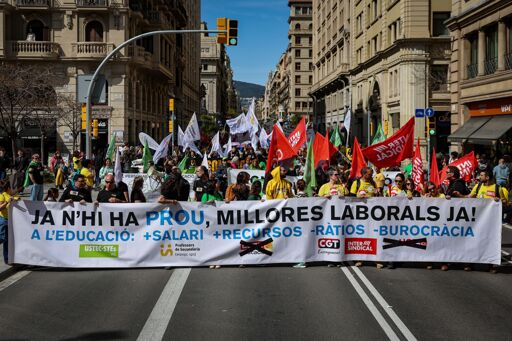
The following article was published on March 15, on the eve of the ongoing March 16-20 educators’ strike in Catalonia, which has brought out tens of thousands of teachers, staff, students, and families taking the streets and blocking highways in support of the educators’ demands.
While the February 11 education strike in Catalonia was historic, the actions planned for March 16–20 promise to be equally significant, despite the betrayal by the leadership of Comisiones Obreras (CCOO) and Unión General de Trabajadoras y Trabajadores (UGT) and their shameful pact with the Department of Education (DOE). Our message is clear: we are growing stronger every day.
The February 11 strike has earned its place in history, not only for its 85 percent participation rate but also for something rarer: genuine self-organization through assemblies and territorial coordination, real unity across all education sectors, deep demands, and solid alliances with families and students. This energy was built through intense weeks of assemblies and demonstrations, pushing back against the DOE’s proposals. Yet the CCOO and UGT leadership signed an agreement with the DOE anyway — a complete betrayal of the educational community.
With new strike actions from March 16 to 20 across Catalonia, it’s worth taking stock of what this movement has achieved, what the unions have done, what we’re demanding, and how we continue to fight for public education.
The Unity of All Education Workers, from Classrooms to Streets
Walking into a classroom feels like stepping onto a stage — you’ve spent years studying, training, failing, and trying again. Although you stand alone in front of the students, there’s an entire crew behind you. The faculty operates like an assembly line to make it all happen: lesson planning, learning projects, supervision duties, supporting students with special needs, coordination meetings, department meetings, evaluation meetings — and that’s just the teaching side. Then there’s the administrative staff keeping the building running, the educational support staff whose work often goes unrecognized, the people supervising cafeterias and playgrounds, those organizing summer camps and field trips, and the counselors guiding students through everything.
If all of us — civil servants, temporary workers, and outsourced staff on the edge of precarity — are carrying this load together, why not tear down the barriers that divide us? In this struggle, that’s exactly what we are doing. In one assembly and one struggle, we’ve come together: teachers, special education instructors, early-childhood educators, support staff, administrative personnel, lunch aides, playground and cafeteria supervisors — everyone. We may have different roles and contracts, but we are united by the same fight for better pay, more resources, smaller classes, and, above all, for a public education system that’s truly public — 100 percent funded and 100 percent accessible.
None of this happens without building alliances. There’s no wall between the classroom and the world outside, and our movement only grows stronger when we stop walking alone. The solidarity we’ve built with families through the parent-teacher associations (PTAs) and the support from the student movement demonstrate that defending public education is a shared issue for all of society.
The Assemblies Built This Movement: No Agreement without Consultation!
This movement has grown from the ground up. School assemblies met whenever possible — during recess, during staff meetings, after hours, or over lunch. Every step was debated right there in the schools, and then we brought our discussions to the regional coordinating meetings — an innovative dynamic that has allowed neighborhoods and cities to act together instead of fighting alone.
This dynamic developed gradually. On February 28, over 150 education workers from more than 80 schools gathered in Barcelona to strategize how to handle negotiations with the DOE. In a significant step forward for our self-organization and coordination, we voted to elect delegates from each school assembly and to use the regional coordinating body to convey proposals from school-level discussions and to record votes and positions. Whatever we decided would then go to the unions to define the negotiation strategy with the DOE.
The day before our first round of negotiations, the DOE circulated insulting proposals. In the following days, the slogan “No agreement without consultation!” was everywhere. We sensed something was coming — and we were right. What came was a betrayal: an unacceptable deal, far from meeting our demands, agreed by the DOE and the leadership of CCOO and UGT.
CCOO and UGT Leadership: Another Betrayal in a Long History
Let’s be clear: this isn’t the first time these unions have sold out workers — in education or anywhere else. But this time they did it when we were stronger than we’ve been since the 1980s. These strike days have already surpassed the 2022 and 2023 strikes against the last education minister, Josep González-Cambray, both in scale and in the dynamics of self-organization. Signing a deal against the educational community’s wishes, following the DOE’s carefully chosen timing and location, is a blatant betrayal, though not a surprising one. CCOO and UGT represent barely 20 percent of teachers at the bargaining table. Their bureaucratic leadership is completely disconnected from those actually working in schools, tied hand and foot to the Socialist Party of Catalonia (PSC). They need to end this strike so Catalonian president Salvador Illa can push his budget through with his alliance with the ERC (Republican Left of Catalonia) and Comuns parties. So they signed whatever the DOE put in front of them.
An Agreement of Crumbs: The Reality behind the DOE’s Numbers
What the union leaders signed isn’t the “minimum acceptable” deal, as the CCOO and UGT are claiming. It’s effectively a carbon copy of the DOE’s latest proposal. There is a glaring gap between our demands and what has been accepted. We asked for a 100 percent pay increase, but they offered us just 3 percent. We sought to recover the 25 percent of purchasing power we’ve lost over the past 15 years, yet they’re giving us only 7.5 percent, spread out over several years. As for the 60-euro bump they’re promising? Inflation will erode that within a year, even at 2 percent, which is a fantasy.
For educational support staff, the situation is even worse: less than 200 euros over four years. Infant education technicians and social integration aides will continue to earn poverty wages. And the “compensation” for summer camp chaperones? Just 50 euros per overnight, with fewer spots available than we need. That works out to less than 3 euros an hour for 18 hours of extra work, and some people won’t get paid at all.
Regarding class size, student-teacher ratios, and resources, all we got was empty promises and vague language, with no timeline and no numbers. While the policy of “double-counting” students with special education needs appears to be a victory on paper, it won’t alleviate overcrowding without the opening of new classes. Without new buildings, classrooms will remain packed.
Ninety-Five Percent of Teachers Rejected This Deal: What It Says about the Unions
The other unions at the table — USTEC, CGT Ensenyament, and ASPEPC — represent about 80 percent of teachers. All of them rejected the deal and are still calling for a strike.
They conducted an online consultation, with over 40,000 participants — about half of all public school staff. The result completely undermines the DOE and CCOO and UGT’s attempt to end this fight without addressing our main demands. The unions’ position was overwhelmingly rejected. Meanwhile, those who signed the deal represent a tiny minority and never put it to a vote in any assembly.
This raises larger questions about the role of the unions. It’s easy to be disgusted with bureaucrats who’ve been making deals behind our backs for years — years of inaction, endless backroom agreements, and no general strikes since 2012. But we must not fall for the right-wing anti-union rhetoric used to disarm us. Unions are a historic achievement and a tool of struggle. The issue is who controls them. The challenge is not to abandon unions but to reclaim them as tools for working-class resistance. Right now, the CCOO and UGT leadership answers to the PSC, not to us. The solution isn’t to abandon unions; it’s to take them back from the political parties that represent employers and their governments and place them in the hands of the working class. And that’s exactly what we’re doing as self-organized education workers participating in decision-making assemblies — we’re putting forward proposals and debating everything, including the positions of every union and political faction that shows up. CCOO and UGT never put their deal to a vote; they simply signed it unilaterally from above, obeying the PSC and its government while ignoring our demands.
So why are we still strong and ready to keep striking? Because we’re organized through the power of the assemblies. The lesson here is clear: the best defense against backroom deals is grassroots self-organization.
At the same time, the unity we’ve built with alternative unions — those that genuinely represent most teachers — is a significant step forward in combating fragmentation within the unions. We must continue to strengthen those militant unions that promote real democracy, engaging in dialogue without sectarianism with CCOO and UGT members who share our anger and disappointment in the leadership. This strike, like any genuine strike, can change how people think — against individualism, against conformism, and against every divide they try to create. It teaches a fundamental truth: the democratic organization of workers from the ground up is the only way to prevent bureaucrats from selling us out.
The PSC’s Choice: More Money for Military and Police, Nothing for Schools
As this conflict drags on, it becomes clearer every day that Illa’s government is uninterested in improving public education. Nothing changes, no matter which party is in charge — whether the ERC, Convergents, PSC, or the PP.
The DOE sent out a triumphant email touting their deal as a “historic agreement” that would “inject millions” into education, claiming a “total investment of 2 billion euros.” The union bureaucrats and the government have inundated us with spin to cover up this blatant lie. The reality is that for the next four years, the Generalitat will continue to underfund public education as it always has. The 2 billion euros by 2030 they’re promising? It amounts to barely 500 million euros a year, bringing the budget to about 8 billion euros annually. The Catalan Education Law states that we need 6 percent of GDP — that’s 19 billion euros. We’re nowhere close. The deficit keeps growing, and the future of public education becomes more precarious each year.
Starving public education is a political choice. There are other figures that reveal what they are prioritizing instead. The Spanish state is spending 10.5 billion euros on its Defense Industrial Plan. Illa and the new Catalan “warlords” want 20 percent of that — 2.1 billion euros of public money for rearmament. That tells you everything about the priorities of the Catalan government: the PSC and Foment lobby are working overtime to shower the military industry with cash, while education and healthcare workers are told “there’s no money” to reverse the cuts or recover what we’ve lost over the past 15 years.
This crisis in public services doesn’t exist in a vacuum. It’s tied to every government’s imperialist rearmament, whether “progressive” or conservative. Our struggle, then, is also against the arms race, against the warmongering that impacts the working class the hardest, and against the horizon of war and barbarism that our own imperialist government is driving toward.
That’s why we built the “Education for Palestine” platform. That’s why we’ve been organizing in schools and on the streets, creating educational resources to talk about Palestine at Aulapalestina (Palestine Classroom) and supporting the Palestinian people with strikes and mobilizations, including the strike on October 15 last year.
It’s never been about whether there’s enough money; it’s about who is prioritized. Illa and Minister Núria Parlon had no problem approving a 4,000 euro annual raise for the Mossos d’Esquadra (Catalan police) — the very force that represses protests and evicts people on behalf of vulture funds — while public schools get crumbs.
Our Message: We’re Coming Back Even Stronger for March 16-20
While the union leaders have made their political choice, we in the assemblies have made our own. We’re striking even harder, and we’re expanding our assemblies. The students are organizing as well. On February 11, groups like Contracorriente joined our picket lines, and together with SE, they called for a student strike in high schools. Now, SEPC (Student Union of the Catalan Countries), SE, and Contracorriente are planning another strike for May 20. Contracorriente aims to involve universities as well. The PTAs are supporting us with statements, actions, and backing for the strike.
The DOE, defensive about its agreement with the union bureaucracy, has begun sending threatening messages through its leadership, instructing us to adhere to the “Workers’ Code of Conduct” and the “Coexistence Project” if any “conflict arises that violates workers’ rights.” They want to use their own rules to silence our anger and combativeness in a pact that condemns us to further exploitation.
Here’s our message: No intimidation campaign or threats will deter us from fighting for our demands. They’ll find us on strike, in the streets, and in our assemblies growing stronger. The week of March 16-20 is shaping up to be as historic as the betrayals that preceded it. We’re also adding new demands: Not one more euro for rearmament or military budgets! Fund schools and hospitals instead! We need to coordinate with every other public sector worker fighting the same fight — aiming for a genuine general strike across the sector.
This isn’t just about our paychecks. It’s about workloads that crush us, class sizes that make effective teaching impossible, and resources that keep shrinking. We refuse to let our students lose their right to a genuine public education. We refuse to condemn them to a future of precarity and exploitation — the same precarity we’re fighting every day in education, health care, and social services.
None of this is new to education workers. Our demands reflect the crisis of a whole system, one whose problems extend far beyond the classroom. That’s why we fight for more resources — because special educational needs often align with basic social needs: we have students without housing, without enough food, without a place to study. We’ve been organizing around these issues for years. The “Teachers for the Right to Housing” platform articulates our stance best: “The educational teams of Barcelona say enough is enough. Decent housing is a right, and we cannot separate it from the right to education.”
The government’s policies make one thing clear: defending public education is no longer sufficient. We need to transform the entire system, which is authoritarian, elitist, and designed to reproduce inequality while indoctrinating and disciplining people to accept the social order. We’re fighting for something different: a fully public, high-quality education that genuinely serves working-class families.
Published on March 15, 2026, in La Izquierida Diario.
The post Educators’ Strike in Catalonia: A Historic Struggle against the Betrayal of Union Leadership appeared first on Left Voice.
From Left Voice via This RSS Feed.