

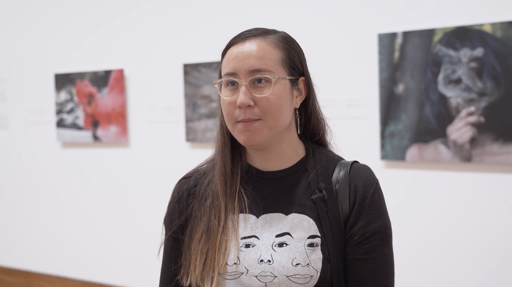

Katherine Takpannie, standing in front of three of her photographs, offers a video tour of the National Gallery of Canada’s New Generation Photography Award exhibition in ‘Ottawa’ in 2021. Screengrab courtesy National Gallery of Canada/Youtube
Content warning: This story mentions suicide, and contains details about missing and murdered Indigenous women, girls and Two-Spirit people (MMIWG2S+). Please look after your spirit and read with care.
Katherine Takpannie’s photography has risen quickly in the country’s art landscape.
From sharing her daily images on social media, to being showcased by the National Gallery of Canada, the Inuk photographer has captivated her audiences with striking scenes that are as unexpected as they are memorable.
“Some things stay with you,” she tells IndigiNews in an interview. “A part of healing, and a part of letting go, is creating.”
The 36-year-old artist has had an unexpected journey, starting at age 15 when her uncle gifted Takpannie her first camera. From there, the self-taught photographer reveals she’s learned through “trial and error.”
In 2020 she received a surprising call: she’d won the National Gallery of Canada’s New Generation Photography Award.
Takpannie’s images can be found on her website, where detailed descriptions give voice to what each image means to her.
Her celebrated photograph Our Women and Girls are Sacred #2 was auctioned to fundraise for the CONTACT Photography Festival on Feb. 24 at the Museum of Contemporary Art — where it sold for $1,800, alongside works donated by Edward Burtynsky, Kent Monkman, Shelley Niro, Ken Lum and Carrie Mae Weems.

She spoke with IndigiNews about her artistic journey — and why photography has become essential to telling her story, and finding healing.
This interview has been edited for length and clarity.

Katherine Takpannie’s 2016 photograph Our Women and Girls are Sacred #2. Photo courtesy Katherine Takpannie
IndigiNews: Can you talk about your piece, Our Women and Girls are Sacred #2?
Katherine Takpannie: Back in 2015, I was a part of this program [for] at-risk Youth — I had been on the streets — and they provide employment opportunities and training, then they place you into an internship, so you get to try something that you’re interested in.
SAW gallery in Ottawa were working with Annie Pootoogook at the time … She provided an entirely new way to showcase Inuit. She was actually really close to my uncle.
So when she came to SAW gallery, she would come up and hug me and give me a kunik, an Inuk kiss. So we often saw each other at SAW gallery while I was interning.
And one day she went missing and then, soon after, her body was found in the Ottawa River. And so Our Women and Girls was a way to honour Annie Pootoogook and others just like her.
The red smoke was the symbolism of the spirits of the women we lost — the women and girls. The smoke was a way to make their spirits tangible.
I’ve always expressed myself through photography, and by honouring her and others was a way to work through my grief of her being missing and murdered.

A portrait of late Inuk artist Annie Pootoogook is displayed in the Cutting Ice exhibition held in her memory at the McMichael Canadian Art Collection in ‘Kleinburg, Ont.’ in 2017. Photo courtesy McMichael Canadian Art Collection
That’s very powerful.
Thank you. I didn’t expect it to get so much attention.
I actually ended up becoming an artist on accident. I had my photography online, and in 2020 the National Gallery of Canada called me.
I was on maternity leave with my first-born, and they’re like, ‘Hi Katherine, you won the New Generation Photography Award — a curator found your photographs and submitted them, and you won.’
And what started off as a hobby ended up becoming a career.
That’s so exciting; it just shows what’s meant to be in the moment.
I am learning as I go. I haven’t been trained in the art world.
My background is political science-based. Nunavut Sivuniksavut [College] taught Inuit students … about our history, our language, the land-claims agreement, the process it took to get Nunavut.
So a lot of my art was politically charged from my experiences … I wanted to be a voice, share my experiences, and share my art with everyone.
I can definitely feel the political stories behind many of your collections.
A lot of people, I’ve realized, don’t understand just how much policies affect our day-to-day.
All the socioeconomic, spiritual impacts of acculturation from Indigenous Peoples becoming enfranchised to Canada — it impacts every facet of our life.
I have a series called Return If Possible. My brother committed suicide, and Inuit have the highest suicide rates in Canada.
I know with many Indigenous groups is very similar, because we have very similar experiences with acculturation — being colonized — having that change in our ways of knowing, being and doing to become Canadian.
Everything is just inherently political.

Katherine Takpannie stands in front of two 2017 photographs featuring her brother — Return if Possible #1 (right) and Why Are You Wearing That Stupid Man Suit? (left) — in a video tour of the National Gallery of Canada’s New Generation Photography Award exhibition in ‘Ottawa’ in 2021. Screengrab courtesy National Gallery of Canada/Youtube
Your photos all seem to have a story behind them. What is your process from beginning idea to the finished photo?
I’ve always carried my gear with me. I started photography when I was 15. My uncle had gifted me a little point-and-shoot [camera], but I started this project called 365 — where you take one photo a day for a year, and you have a year to look back on.
So sometimes, when I create my pieces, it’s almost in the moment — sometimes it’s not planned, sometimes it is. A lot of my photography had been a documentary style.
If I do plan a series or shoot, the most time it takes is to gather certain materials, scout out certain locations. The most-planned shoots moreso involved Inuit creation stories, myths, things of that nature.
I have animal masks; back in the day, Inuit believed shamans would, with animism, be able to transform to a raven or an owl or amaruq [wolf].
It fascinated me. Some of those [animal] series were ones where I wanted to make sure took more planning than some of my others.
With every animal, you can really feel the differences within the pictures and the stories behind them.
Thank you. The tulugoq — our raven — he’s known as a trickster. He was known as the creator of the universe, but it wasn’t necessarily out of good.
So I did want to capture that. I wanted that slight little deviance to Tulugoq. I wanted the owl symbolized like wisdom and some oversight into the spiritual world.
You said you have had your camera since you were 15. Has all of your photography been self-taught?
Yes, I have not taken any course — I just picked up my camera and I started playing around with it.
There were definitely some really bad photos. It only became gradually better the more and more and more and more and more I used it, and especially with 365, having my camera on me, like 24/7.
You can only get better through practice. It was just a lot, a lot, a lot of practice.
In 2015, I was doing a lot of urban street photography. I was climbing cranes and bridges and rooftops, and it was not very smart. I don’t recommend it!
Photography is such an interesting medium to use, because there’s so much that can be done with all of the different settings.
Watching photography is seeing how people view the world, and some people view it so beautifully. The way they see things it’s so awe-inspiring. That definitely inspires me to continue photography, trying new things.
I’ve noticed in some of your photo collections — including Urban Inuk— that you have incredibly detailed descriptions that include your language. Is that so people understand your process?
Oh, absolutely — I never had long captions prior to becoming an artist. People would ask about the photograph, and I realized that exhibitions have statements and people just wanted to know more.
Because photography was my words; that’s how I expressed myself … it was my poetry.
Starting to share more about what it was about came along with the avenue I went down.
Katherine Takpannie offers a video tour of the National Gallery of Canada’s New Generation Photography Award exhibition in ‘Ottawa’ in 2021. Video courtesy National Gallery of Canada/Youtube
Some people really want all of the explanations behind it, while some just let the feelings radiate through from seeing the images.
Yeah, I remember in the National Gallery of Canada, when they put Our Women and Girls are Sacred into [the exhibition] Movement: Expressive Bodies in Art, their little plaque beside the work was like, ‘Katherine and her Indigenous rage.’
I laughed so hard. So I wanted to put words that were my words. I had brought my anaana — my mother — and my father and my nuka — my younger sister — to go see the art when it was in the National Gallery of Canada. And all four of us were laughing our faces off.
Art can be taken however the viewer perceives life and things. One person — on an Ottawa Citizen post when I won the award — they’re like, ‘Oh, the red smoke is you huffing gas.’
So part of adding my own words is to counteract some of the other comments that people make that are way left-field.
That just shows the bias that is still there, and how important it is to have our words describing ourselves.
Yes, because for a very long time it had been outsiders who spoke for us … anthropologists to scientists, whatever the title would be.
Historically, we weren’t the architects of our lives. But now there’s a reclamation that even our parents, even a generation ago, didn’t have.
Your self-portraits have such layered meanings. How long is the process of capturing the perfect image that accurately encompasses those feelings?
I never actually know if I have a good image until I get back to the computer.
I’ve done entire shoots where I’m just slightly not focused, and everything’s blurry. I’m like, ‘Oh, that was a huge waste.’ Some of them were not planned.
We were driving by [a] pond, and there were so many lilies one year and I was like, ‘Pull over, pull over! I need a photo’ … It was a place where I had walked quite frequently to the river, because I’m always down by the water — especially since my brother died.
The water had truly been what helped save me.
So some of the self-portraits that I’ve taken were accidental and not planned. But some pieces — like when my brother passed — are things that I had ruminated for a long time.
Some things stick with you. Some things stay with you … A part of healing, and a part of letting go, is creating.
That really shows the beauty of art and some pieces coming from the unexpected.
It’s just like life; it’s ever-changing. I go with the flow of life.
With the Sedna series, you describe exploring the epistemology of Inuit societal values, alongside the violent disruption of Inuit homelands through resource extraction. Do you think you help people understand these issues?
There was actually a book by Tanya Tagaq — she’s an artist, a throat singer — she wrote a book called Split Tooth. So I read the book, I was in love; I picked it up, and I didn’t stop reading until I was done. It was so good.
That inspired me — my brain was firing on all cylinders.
I’m just one voice and one of hundreds of thousands of Indigenous people who have all the same story, all the same messages.
I just want to help raise awareness, especially to the non-Indigenous Canadians who are a little like they’re wearing blinders … They don’t see what’s not in their own reality.
Opening up all these conversations into our lived experiences — especially as we’re both treaty partners supposed to be living side by side — having conciliation before reconciliation, having these conversations over and over again, having people learn.

Katherine Takpannie’s artwork raised $1,800 in a silent auction for the CONTACT Photography Festival in ‘Toronto’ on Feb. 24, sold alongside works donated by Edward Burtynsky, Kent Monkman, Shelley Niro, Ken Lum and Carrie Mae Weems. Photo courtesy Ryan Emberley
Do you have favorite subjects that you enjoy taking photographs of?
Everything has been an expression and an extension of my life and my journey and my experiences. I’m in love with my whole journey. There’s no shameful parts. I love how far life has taken me.
I actually probably should have been dead. Most of my friends are past and gone. I’m just grateful for every single day that I still have here, and I’m still just going to keep creating.
You’re currently on maternity leave; does that time with your family influence your art?
Yes, especially with the state of the world — and looking at these two little bundles of joy I created — I can only have ridiculous hope to try to make things better.
I want my boys to understand the way we’re living now doesn’t have to be the way things are done. I want my boys to know things can be better, and we have to be the voice and the agents of that change. We have to speak up about our difficult experiences.
Now more than ever, my voice is so important, as I have to teach my children. Everything matters to me so deeply much right now, and I just want a better world for all the children.
Especially through art, there’s so much that you can show and have the emotions behind to just hopefully put some changes out there.
Art can be so healing. It can be a way to raise awareness. It can be a way to process.
It can be a tool in so many different ways, a way to foster relationships, a way to build connections, a way to grow, a way to learn.
Even just all of us doing our small little things, we can all just be the change. We can continue to carry on for them.
Do you have any advice for other Indigenous artists?
I’ve made so many mistakes. I highly recommend taking grant workshops … There’s a lot of people who are going to undercharge you — and a lot of missed opportunities if you don’t apply for grants.
For that aspect I got so discouraged with my first few ‘No’s.’ I had a bit of self-doubt.
I highly recommend taking any workshop being offered, speaking to mentors, mentees — for emerging folks to connect with mid-career [artists]. To not give up and to know that sometimes ‘No’s’ are a redirect.
There’s certain experiences that are just to learn. We don’t have to necessarily get a win, 24/7. I’ve been [told] ‘No’ to lots of calls for submissions, lots of grants.
I’ve had so many ‘No’s.’ But keep going when you get those ‘No’s’ — learn from those experiences. There will be rejections, and it’s hard because art is personal, so you feel personally rejected.
Keep going. Just like in life, we’re going to hit some roadblocks. But it’s all there to teach us something.
The post ‘Art can be so healing’: A conversation with Inuk photographer Katherine Takpannie appeared first on Indiginews.
From Indiginews via This RSS Feed.