


Nika Bartoo-Smith
Underscore Native News+ ICT
PENDLETON, Oregon — Thanks to a $1 million federal investment, the Confederated Tribes of the Umatilla Indian Reservation and Oregon Department of Fish and Wildlife are preparing for critical engineering and design work at McKay Creek Reservoir Dam to improve fish passage.
The initial investment will go toward an alternative analysis to determine what fish passage options at the dam would be feasible, starting the process of hopefully reconnecting more than 100 miles of historic salmon and steelhead habitat. This would open up fish passage in that section of the McKay Creek for the first time in nearly 100 years.
“For the [Confederated Tribes of the Umatilla Indian Reservation], it’s a priority area, both for the traditional use that had occurred in the past before the dam [was] there, but also a lot of the upper basin there exists within the reservation boundary,” said Jerimiah Bonifer, the tribe’s fisheries program manager and citizen of the Confederated Tribes of the Umatilla Indian Reservation.
“Increasing the availability of resources in proximity to our tribal members to provide harvest opportunities, on top of those ecological benefits that we should see from getting some mid-Columbia River steelhead up there, are really important,” he added.

The McKay Dam is located on the McKay Creek Reservoir, a tributary of the Umatilla River in Umatilla County, Oregon. (Photo courtesy of the U.S. Fish & Wildlife Service)
The McKay Creek Reservoir Dam was built in 1927 and has completely blocked fish passage to 108 miles of upstream habitat since then. Currently, native migratory fish are only able to access the lower six miles of the creek, though historically it supported Chinook salmon, lamprey and bull trout.
McKay Creek still provides some of the coldest water in the Umatilla River Basin. The dam currently blocks about 25 percent of suitable steelhead spawning and rearing habitat in the Umatilla Basin, according to a press release.
Fisheries managers with the Confederated Tribes of the Umatilla Indian Reservation and the Oregon Department of Fish and Wildlife are confident that native fish populations will be successful above the dam once passage is created.
Since 2020, they have already begun to study how fish would use McKay Creek once passage is restored by releasing radio-tagged hatchery summer steelhead above the dam. This resulted in the first documented spawning of steelhead above the dam since it was constructed nearly a century ago.

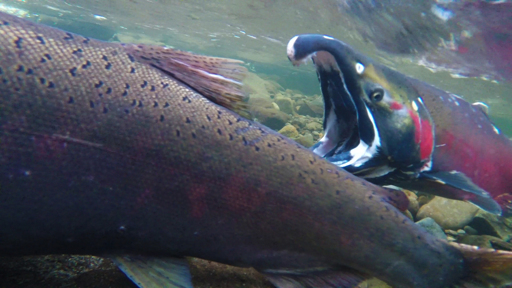
Salmon swim home to spawn in an Oregon river. (Photo courtesy of the Bureau of Land Management)
“Ultimately, we know that by putting fish up there, all we’ve got to do is just get them up there and they will be successful,” said Taylor McCroskey, Oregon Department of Fish and Wildlife’s Umatilla district fish biologist, referencing the work already being done at the dam.
Designing fish passage at McKay Creek Reservoir Dam will be no easy task as there is currently no fish passage built into the dam. The dam itself is an earth-filled dam that stands at 165 feet tall.
Following the alternative analysis, the next step will be securing more funding to design and construct the chosen fish passage method.
“We’re looking at least a decade or more when you start talking about this, as far as really getting to a point where you can have feasible fish passage,” Bonifer said.
This story is co-published by Underscore Native News and ICT, a news partnership that covers Indigenous communities in the Pacific Northwest.
The post Federal funding kicks off exploration of fish passage solutions in Oregon appeared first on ICT.
From ICT via This RSS Feed.