


Bullets:
Fertilizer prices are skyrocketing as cargo ships are denied access through the Gulf of Hormuz.
Major natural gas refineries in the Middle East, the source of massive volumes of urea and other nitrogen-based nutrients, are offline and have declared Force Majeure on previous contracts.
Food prices are closely correlated with crude and diesel fuel costs, and will go up as a result of the doubling in energy prices.
But the crisis in fertilizer markets is an urgent problem, and the window will slam shut in just days on farmers who need urea for Spring planting.
Inside China / Business is a reader-supported publication. To receive new posts and support my work, consider becoming a free or paid subscriber.
Report:
Good morning.
We have yet another crisis in the Persian Gulf, as traffic through the Strait of Hormuz has been shut off for almost everybody.
Many of the ships that are unable to pass through are transporting fertilizers that are needed by farmers across the world to get Spring plantings done. We’ve seen a boom in oil prices since the war began, and what typically follows is a big jump in food prices:
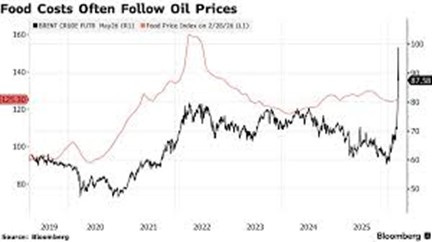
That’s because of the transport and shipping costs of food itself. Those price spikes are coming too, on harvested crops and other agricultural products, because it costs more to put a ship on the water or a truck on the road. But we face a much more urgent problem, if fertilizers don’t make it in time to the farmers who need it, right now, to get the food grown in the first place.
North American farmers need fertilizer for corn, which is 95% of the grain and feed grown in the US. High prices for the fertilizers, if they can be gotten at all, are likely pushing corn farmers to consider other crops. Problem with that is that the crops which demand fewer nutrients, like wheat and soybeans, are also at surplus, and prices are falling.
Countries in the Persian Gulf supply half of the world’s exports of urea, and 30% of ammonia. Here is the price chart for Urea, up 25% in the first several days of the war, and today far above $600 per ton:
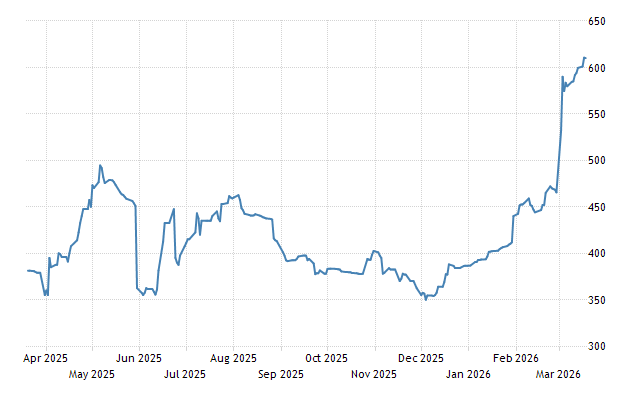
That is up 75% since December, when it was $350 a ton. Besides Urea, other crucial fertilizers pass through the Strait of Hormuz and are unavailable to the agriculture sector:
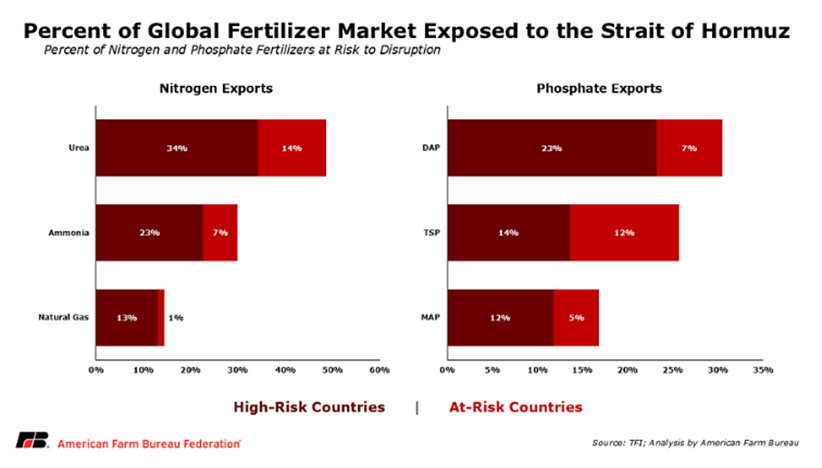
For American farmers, their import dependency on Middle East fertilizers is not as pronounced as other countries, where this is already a crisis. But these markets are global—so the higher prices are hitting stocks everywhere, and it’s coming at the worst possible time: Whether and how much fertilizer is applied, in the coming weejs, will affect yields and prices later.
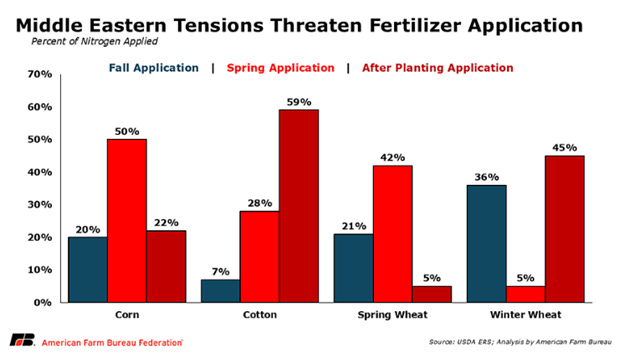
The red bars show the percentage of fertilizer applied to crops at the beginning of the crop cycle, and ongoing through the season. Corn and Spring Wheat are most affected by the fertilizer supplies that should be coming out of the Gulf.
Another major issue for farmers is that many of the fertilizers for the season have already been ordered, and paid for, but not yet delivered.
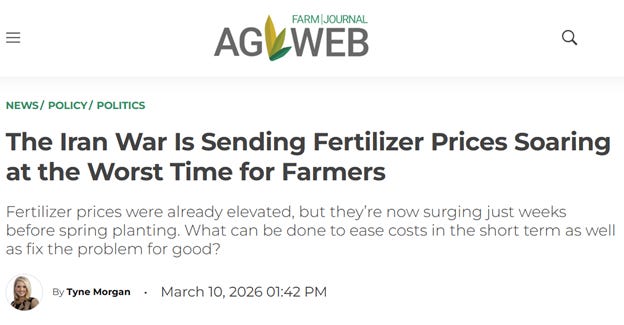
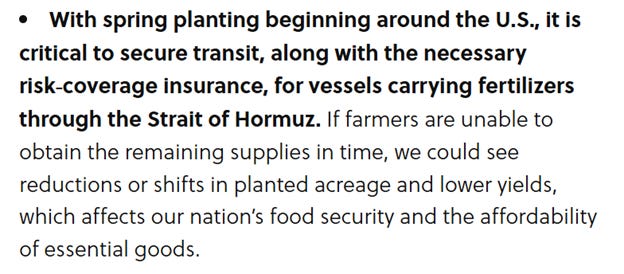
Analysts are recommending that farmers act now to ensure their orders are in transit, and suggest risk-coverage insurance for shipments coming through the Strait. That’s obviously a big problem; insurers were canceling insurance coverage for ships in the region, starting on the first day. Iran itself makes up 10% of Urea exports.
Ras Laffan is in Qatar, and is a major producer of LNG, and downstream products like Urea. After Iranian attacks on the facility there, they declared force majeure, and stopped production of urea.
The Force Majeure declaration means that their customers, in this case farmers who bought urea already to plant crops, cannot sue them for breach of contract when the urea price goes up, or they cannot produced the urea at all.
It’s a race against time, now. If the Hormuz is closed for more than two weeks, or Qatar can’t get their plants repaired, supply chains for fertilizers will freeze up, no matter where they are coming from. And that assessment is already over one week old.
Be good.
Resources and links:
Surging fertilizer prices threaten global food security
https://ukragroconsult.com/en/news/surging-fertilizer-prices-threaten-global-food-security
Fertilizer prices soar as Strait of Hormuz tensions rise—forcing U.S. farmers to rethink spring planting
https://fortune.com/2026/03/12/fertilizer-prices-strait-of-hormuz-farming-spring-planting-iran-war/
Middle East Tensions Raise Spring Planting Concerns
https://www.fb.org/market-intel/middle-east-tensions-raise-spring-planting-concerns
QatarEnergy announces force majeure following Iran attacks: statement
https://www.arabnews.com/node/2635251/business-economy
Middle East Conflict: Urea supply disruptions could be catastrophic
https://www.crugroup.com/en/communities/thought-leadership/2026/Middle-East-Conflict-Urea-supply-disruptions-could-be-catastrophic/
Marine insurers cancel war risk cover, tanker costs to rise as Iran conflict intensifies
https://www.reuters.com/world/middle-east/ship-insurers-cancel-war-risk-cover-due-iran-conflict-2026-03-02/
Inside China / Business is a reader-supported publication. To receive new posts and support my work, consider becoming a free or paid subscriber.
From Inside China / Business via This RSS Feed.