

Sidebar story: Caring for the defenders
Tabuk, KALINGA – Beatrice “Betty” Belen’s life has been dedicated to defending their ancestral land.
At 18 years old, Belen became aware of the reason behind the deployment of the military in their community.
“When I became a member of the women’s group of the Episcopal Church, I became aware of the struggle against mining,” she said. Since then, she got involved with the community’s fight against militarization of their community because of the Batong Buhay Gold Mines.

The Batong Buhay Gold Mines operated in Pasil in the 1980s. Pasil and Lubuagan are neighboring municipalities of Kalinga. The Batong Buhay mines closed down after full blown operation in 1985. Around 21,000 hectares of Kalinga rice fields were silted as a result of its operation, a Northern Dispatch report said.
Belen recalled how the soldiers restricted their movement, protecting the mines. “Mahirap na lumalawak yung sinasakop ng mining (companies) kasi lahat pinagbabawal, kahit magtanim sa bundok,” she said. Farming is the main source of livelihood in Uma del Norte, Belen’s village. They get their food and medicines from the mountain.
Now 55 , Belen finds herself still at the frontline of the struggle to defend their land. She is not alone as the older generation of Kalinga women as well as the younger generation are doing the same.
Cordillera’s rich natural resources have attracted local and international companies eager to profit from them. But for the Indigenous Peoples of the region, everything is interconnected. The destruction of their land means the destruction of their life, culture, and identity. Their resistance to so-called development projects has spanned many decades.
In the 1970s under the Marcos Sr. administration, the Kalinga and Bontoc communities opposed the planned construction of four large hydroelectric dams along the Chico river.
Leticia Bula-at, 77, recalled that in 1974, men came to their village in Dupag, Tomiangan Tabuk to survey the land. “We didn’t know that what they were doing then was a survey,” Bula-at told Bulatlat in an interview. Two years later, she said that people from the state-owned Philippine National Oil Corporation (PNOC) told them that they would be relocated to make way for the construction of the dam. She was 28 years old then, a widow and a mother to two children.

Leticia Bula-at. (Photo by Carlo Manalansan/Bulatlat)
“They told us that our place would be submerged once the dam is constructed. But we should not be worried, they said, because we would be relocated,” she said in her vernacular.
She stressed that the relocation site was not developed at the time, unlike their community where they were born and raised and had already established their systems and livelihoods. The relocation site was located at the lower part of Tabuk where there were no trees and only had cogon grass. “That is why we resisted,” she said.
The elders from their tribe, along with those from other tribes that would be affected by the construction of the dams, initiated a traditional peace pact, or bodong, to collectively resist the destruction of their communities.
They would dismantle camps set up by members of the police and the military. “We dismantled their camps about five times,” Bula-at said.
When the state forces began to arrest and harm male members of their community, the women strategized and took on key roles.
“In our culture, women are respected. No one is allowed to harm us. So all women in our village took on roles in the council, from being the chief to members of the council. This way, we could avoid interrogation by the military and rights violations,” Bula-at said, adding that when men were the village officials they were being investigated by the state forces. Bula-at was a member of the village council then.
She said that women also led negotiations as men tended to be hot-headed. “Because they believed that if it were men talking to men, it would surely lead to violence. Someone would end up killing, blood would be shed. So it was the women who always took charge of negotiating with the soldiers,” Bula-at told Bulatlat. “If some soldiers tried to talk to someone after we had dismantled their camps, we would face them ourselves.”
She also remembered how they would remove the stick or label installed on the ground of the surveyed area.
The resistance against the Chico River dam project gathered support outside of the Cordillera and mobilized different non-government organizations, church groups, and human rights advocates in the Philippines and even abroad. With the widening pressure and support, the World Bank withdrew from funding the project and the government reportedly shelved the project.
The historic victory against the Chico River dam project is not lost on the younger generations.
Rogyn Beyao, 37, from the Mabaca tribe knew that the river continues to flow in the Cordillera villages because of their ancestors’ sacrifices.
Beyao said that they enjoy clean, free and fresh water in their community. “That is why we vehemently oppose these so-called developments led by big companies because we don’t want to see a day when the water is no longer free. The next generation should inherit it too,” she said, adding that in the city, people would have to pay for everything.
Beyao also learned how collective action could improve their lives.

Rogyn Beyao is the secretary general of Innabuyog-Gabriela in Kalinga. (Photo by Carlo Manalansan/Bulatlat)
“Life was really difficult then. There was a severe lack of services. No farm-to-market roads, electricity, or health services. If an emergency occurs, […] he or she would eventually die because it would take many hours before we reach the city, sometimes even a day depending on the pace,” she said.
In 2001, the elders formed the Mabaca Farmers Alluyon.
After identifying the most needed services of the community, the organization proposed to build a micro-hydro power project intended to serve the entire village. Components of the project included electricity, rice mill, irrigation and blacksmith.
In 2003, the 25 kilowatt micro-hydro plant became operational and for the first time, the village experienced electricity.
It ceased operation in 2017 when the Kalinga Electric Cooperative entered the community. Beyao said aside from the mechanical problem of the micro-hydro and poor maintenance, the red-tagging that intensified in their community also caused the people to operate their own rice mill. But now, she said, there is a move by the village council to rehabilitate the micro-hydro power in their community.
All sitios now have power but the road leading to Balbalan is still not developed. “We have to walk one to two hours to reach our community because there is no concrete road going to our village,” she added.
Big companies want their minerals and rivers too
Like her ancestors, Beyao is compelled to continue defending their land.
During her childhood, Beyao would see helicopters hovering above their village in sitio Mabaca, Balbalan, Kalinga. Her hometown, Balbalan, is rich in mineral resources such as gold, nickel and copper.
“There is a gold reserve in our territory so there are many (mining) companies that have interest in our land,” Beyao told Bulatlat in an interview.

“We’re so afraid then, because we see this white thing flying in our community. Later on, when I was able to attend a forum about mining, I learned that it was aerial mapping,” Beyao said. She recalled that it was the Newmont Philippines Incorporated which she said had plans of exploration activities in their territory which was strongly opposed by the elders of their community.
Balbalan is a third class, remote mountainous municipality in the western part of Kalinga. Aside from its minerals, Balbalan is also known as “the land of the living waters.” It has a rich biodiversity, its forested lands are part of the Balbalasang–Balbalan National Park, one of the most ecologically important protected areas in the Cordillera.
The Balbalan municipality is crossed by the Saltan River, and rivers like the Mabaca eventually flow into the Chico River, making Balbalan rich in watersheds and freshwater systems.
At present, her tribe and neighboring communities are opposing the 40-megawatt (MW) Buaya “Mabaca River” Hydroelectric Power Plant also in Balbalan municipality. The said project was awarded by the Department of Energy to Australian-owned JBD Water Power Incorporated (JWPI). The same company is also the proponent of the 49 MW Saltan D and Saltan D River Hydroelectric Power Project.
“It’s within the territory of the Buaya tribe—the barangay adjacent to ours. However, the watershed actually comes from our area,” Beyao said, adding that should the project push through, a portion of their village will be submerged.
In 2023, members of the Mabaka tribe filed a petition against the hydropower project.
Elsewhere in the Cordillera region, there are other renewable energy projects. According to the Department of Energy, there are 13 awarded renewable energy contracts in the region.
The Philippines is among the many countries in the world that are transitioning to renewable energy. The administration of Ferdinand Marcos Jr. has announced that it would push for the transition to renewable energy and that it will increase the use of renewable energy sources such as hydropower, geothermal, solar and wind.
Dirty tactics for ‘clean energy’
The push for these projects also resulted in rights violations.
“Where there is a project, there is a deployment of the military,” said Belen.
On September 11, 2025, hundreds of soldiers came to their village asking their residents to let them spend the night inside their homes. “Maybe there is an exploration in Batong Buhay mines that’s why they are everywhere,” she said.
According to the Cordillera People’s Alliance, these are Investment Defense Forces of mining companies under the Armed Forces of the Philippines 5th and 7th Infantry Division.
Read: Special Report | Push for renewables threatens lands and livelihood in the Cordillera
Read: Indigenous peoples face rights violations in Asia’s renewable energy boom
Belen, chairperson of Innabuyog-Kalinga, the local chapter of Gabriela in the region, has become a target of relentless harassment because of her consistent advocacy.
In the early morning of October 25, 2020, several dozens of state forces in full battle gear came to her house and arrested her. Her grandchildren and husband were at the house at the time. The police told them to go out of the house as they searched inside and later claimed that they found firearms. The charges were eventually dismissed.
After her release from detention on February 12, 2021, Belen noticed frequent surveillance in her community.

Beatrice Belen (Photo by Carlo Manalansan/Bulatlat)
“How much is a CCTV camera?” she asked. In this part of the mountainous village which is two hours away from the city center and where the nearest houses are about 100 meters apart, she and her children felt it was necessary to install one for their security.
Like Belen, Beyao and Bula-at were also subjected to various forms of harassment.
Beyao shared that members of the National Task Force to End the Local Communist Armed Conflict (NTF-ELCAC) talked to her parents, telling them to stop her from what she does.
Beyao said her father felt the pressure even more when the Department of Interior and Local Government (DILG) would hold forums where activists are being red-tagged. “They were worried especially when the soldiers started talking to my father to tell me to stop (from activism). My mother understands what I do but because of the harassment, she can’t sleep at night,” Beyao said.

Beatrice Belen in one of the lands they cultivate in barangay Lubuagan. She said they often visit this place as they fear for their safety. (Photo by Carlo Manalansan/Bulatlat)
In 2019, Beyao was accosted by men who identified themselves as military personnel. The soldiers tried to coerce her to avail of the government’s program for former rebels. In 2021, her parents and relatives were among the 95 persons in her village “forced by the military to clear their names” for allegedly supporting the New People’s Army, the armed wing of the Communist Party of the Philippines.
Beyao and some of the leaders of the Cordillera Peoples Alliance filed a writ of amparo in 2022 but the petition was denied. They filed a motion for reconsideration in 2023 with the Supreme Court. The high court has yet to decide on the motion.
Bula-at, meanwhile, was sometimes visited by men from the provincial ELCAC. Barangay officials would also ask her about her visitors.
Brave Cordillera women
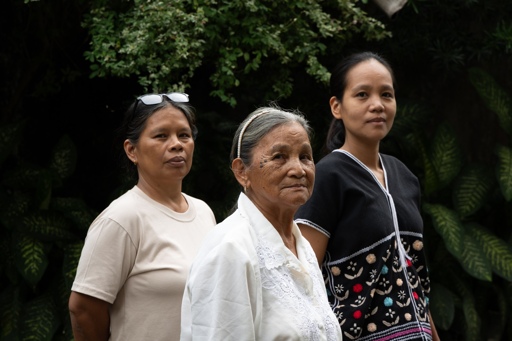
Despite the attacks, the three generations of Cordillera women remain defiant. The region’s history would show Indigenous women in the front and center of the resistance against destructive projects and for the preservation of their sacred ancestral land and identity.
Aside from Bula-at and Belen, there was also the late woman warrior of Mainit village from Bontoc, Mountain Province, Petra “Ina Tannao” Macliing.
Ina Tannao has led the Mainit women in opposing destructive projects in their ancestral land. In the 1970s, they stripped down and confronted engineers of a mining company intended to operate in their land. They raided the camps of these engineers and threw away their supplies so that they would never come back.

Photo by Carlo Manalansan/Bulatlat
Beyao could not help but marvel at their ancestors. “Women give life. They bear and give birth to children. They also cultivate the land and produce food for their family and the community. This is why when it is their life that is at stake, they are fearless,” Beyao said.
Abigail Bengwayan-Anongos, Executive Director of Cordillera Women’s Education Action Research Center, Inc. (CWEARC), said that in the Indigenous worldview, everything is interconnected. “When the land, the material base of your identity, is under attack, it is also a direct threat to the lives of your children and future generations.”
She added that Cordillera women are known not only for their courage but also for their leadership.
“There were many smaller victories at the level of mining exploration alone—projects were already being stopped there. In southern Benguet, in Itogon, where there has been more than 50 years of open-pit mining by Benguet Corporation, women have also played a huge role in leadership, mobilizing and organizing fellow women, often spontaneously and on their own initiative,” she added.

Photo by Carlo Manalansan/Bulatlat
Bengwayan-Anongos said men also did their part. “I think women are truly in the forefront when it comes to land rights struggles, but they did that alongside the men.”
“The roles have always been reciprocal and complementary. In Indigenous communities, the functions of men and women are not strictly divided according to sex; rather, they complement each other,” Bengwayan-Anongos said, adding that child-rearing for example, is not solely the mother’s role.
“Fathers also have responsibilities. In Cordillera society, you will see many men carrying babies on their backs or in front, just like mothers do. There may be more defined task assignments when it comes to work, especially in Indigenous peasant communities,” she said.
But Bengwayan-Anongos said that the traditional Indigenous structures are still male dominated like the Ato in the Mountain Province or Dap-ay in Sagada and the Bodong system.
“For example in Bontoc, membership in the Ato is usually limited to the eldest male of a household. But this does not mean that they (women) are not part of the decision making. There are gatherings where they can speak on equal footing as the men.”
The same goes in the defense of land rights, Bengwayan-Anongos said, the roles of women and men are reciprocal and complementary. “In many cases, especially when police, military forces, or company personnel are deployed, women tend to remain more calm and level-headed,” Bengwayan-Anongos said.

Here in Uma del Norte, Lubuagan, Kalinga, Beatrice Belen along others blocked the entry of Chevron to conduct its survey for a proposed geothermal project in 2012. (Photo by Carlo Manalansan/Bulatlat)
In the Chico river dam struggle, women were creative and resourceful. “For example, they pressured authorities to release those who had been detained in military barracks. The women mobilized themselves and persistently appealed to the soldiers. Because of their persistence and refusal to give up, the soldiers eventually released the detainees.”
“Overall, their roles are reciprocal and complementary, one is not higher than the other,” Bengwayan-Anongos said.
With her days numbered, Bula-at pins her hopes on the younger generations to continue defending the land.
“We have given our contributions [in our early years], it is now the duty of the younger ones to continue it,” she said. There may be setbacks, she said, but she encouraged the younger generations to focus on the positive gains.

Damsite Upper Chico River Irrigation System weir in Bado Dangwa, Tabuk City. (Photo by Carlo Manalansan/Bulatlat)
Beyao has accepted the challenge. “It is our moral obligation to continue protecting the land for future generations,” she told Bulatlat.
Beyao said that inspiration does not only come from the small victories that they have gained in the long arduous struggle for right to self determination, but also from seeing women leaders, even with their age continue to fight alongside them.
“Despite what they have gone through, they are still here, they continue. They are an inspiration,” Beyao said, pertaining to Bula-at and Belen. (DAA, RVO)
DISCLOSURE: Bulatlat produced this article through a grant from the Asia Pacific Forum on Women, Law and Development – Feminist Media Fund for Alumni.
The post Kalinga women’s lives interwoven by defense of ancestral land appeared first on Bulatlat.
From Bulatlat via This RSS Feed.