

Related story: Kalinga women’s lives interwoven by defense of ancestral land
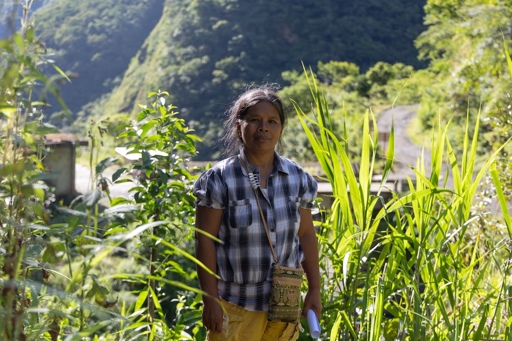
BAGUIO CITY – When Beatrice “Betty” Belen was released from jail last February 12, 2025, Rogyn Beyao, her younger colleague noticed how the jolly woman had changed.
Belen wears a smiling face and often laughs at the smallest jokes, but at times she grows serious, as if lost in deep thought. “I was starting to relax (after release from prison). But then I learned there are people looking for me,” she told Bulatlat in an interview. A soldier had just texted her daughter, telling the latter that her mother’s name is on a “list.”
Her arrest on October 25, 2025 has affected Belen’s mental health. She has become cautious, and admitted that she felt afraid. On September 28 and 29, 2025, she was once again visited by members of the 503rd Infantry Brigade of the Philippine Army.
Her experience made her hypervigilant. “Whenever I walked to the farm, I felt like someone was following me. I didn’t see anybody but that was just what I felt,” Belen said in Filipino. “I lost concentration. It was like I had lost direction.”
After she was released, Belen underwent psychosocial therapy, Beyao, who is also working with Belen in Innabuyog-Kalinga, the local chapter of women’s group Gabriela, said that through the women’s health and psychosocial support program of the Cordillera Women’s Education Action Research Center (CWEARC), Belen was able to process her trauma.
Abigail Bengwayan-Anongos, executive director of CWEARC said this program is provided for women and their organizations and communities who are pushing back against many forms of development aggression and militarization. Psychosocial support was also provided to her family.
Beyao said they once convinced Belen to stay in the city with her two grandsons and her husband. But Belen didn’t take the offer, thinking about the expenses in the city. She said she prefers staying in their community where they cultivate their own food.
Positive attitude as recovery
A big part of Belen’s recovery was her positive attitude and her determination to move forward, said Bengwayan-Anongos.
“Because of this, she was able to manage her experience and continue her work in the community, where she also serves as a health worker.”
She added that they admire Belen’s willpower to overcome her traumatic experiences.
Belen said that staying in the women’s movement and being able to attend training and seminars helped her recover from trauma. “This helps me a lot, especially the training about mental health,” she said. She is a long time barangay health worker in her community.
After her therapy, her sleep has returned to normal, and she started to feel energized and able to socialize with the people around her.
Belen continues to attend events whenever she is needed. “It has been that way ever since, she would just be here in the city whenever she has to attend events.”
“Manang Betty always smiles and has a connection with people. Lagi syang pasulong at magaling magsalita,” Beyao said.
Just last November 2025, Belen and other women leaders in Cordillera went to Manila to speak about their experience.
Aside from attending activities of her organization, Belen was able to cope through her family by also attending to what they needed. “Their parents are not present, that’s why I needed to be with them,” she said. Both of the parents are working outside of their municipality.
CWEARC
Belen is just one of many women activists and leaders who needed such services from CWEARC.
The institution was founded in March 1987 during the Cordillera Women’s Assembly. CWEARC’s name then was Cordillera Women’s Education and Resource Center (CWERC), which aimed to provide services and other forms of capacity building activities to strengthen and empower grassroots Indigenous women in the region.

Abigail Bengwayan-Anongos, executive director of CWEARC. (Photo by Carlo Manalansan/Bulatlat)
Bengwayan-Anongos said, “It was practically reaping the benefits of the Chico struggle. It was like, ‘we have gained so much as a people, as women of the Cordillera, what can we do to build on the gains of participating from that successful struggle from opposing the World Bank in the late 1970s to 1980s.’ So they organized the Cordillera Women’s Assembly on March 1 to 3, 1987.”
In 2005, the organization saw the need to develop the psychosocial support program. Bengwayan-Anongos said this was based on the assessments and evaluations with women partners. CWERC was transformed to CWEARC to include action research in its major strategies to provide for capacity building for women across the Cordillera.
The program was also in response to the worsening situation in the region. “Through this program, support was provided to women, their organizations, and communities resisting various forms of development aggression and militarization. Today, the organization’s services focus largely on women’s mental health and psychosocial support,” Bengwayan-Anongos told Bulatlat in an interview.
She added that the program includes raising mental health awareness in communities and providing psychosocial support to women experiencing state attacks due to their activism, particularly those defending land, life, and resources, and leading campaigns against development aggression, such as in the case of Belen.
“It also involves networking to mobilize support for these women and their communities, with mental health support remaining a core component of the women and human rights support program,” Bengwayan-Anongos said.
Admittedly, Bengwayan-Anongos said that their support has limits. She said that those who needed professional help are referred to specialists.
“One of the challenges we see is that there are very few licensed mental health providers available. The closest place she could go to is Tuguegarao in Cagayan,” she said. Cagayan is in the northeastern part of Luzon and is a nine-hour drive from Baguio City.
Challenges in providing support
Under then president Rodrigo Duterte, CWEARC was also red-tagged due to the nature of their work.
In 2023, the Department of Interior and Local Government (DILG) in Kalinga issued a memorandum warning local government units to be more cautious when engaging with civil society organizations seeking partnerships.
“Attached to the memo was a document reportedly from the 503rd Brigade identifying 27 organizations in Kalinga province as alleged front organizations of so-called communist terrorist groups (CTGs),” Bengwayan-Anongos said.
“This poses a direct threat, primarily to the staff and personnel of the office. It also raises serious security risks and, ultimately, denies communities and women access to the services they need because the organization has been labeled in such a way in the province,” Bengwayan-Anongos said.
The most recent attempt to discredit civil society organizations in Cordillera was in 2024 when a video was posted online accusing several nongovernment organizations like the Cordillera Disaster Response and Development Services and the Cordillera Youth Center of being linked to “communist terrorist groups.”
The video, posted by a fake account on Facebook, was later taken down after being reported. The incident was also reported to the NBI, local police, and the Commission on Human Rights.
Bengwayan-Anongos also said that they also face other risks, including false charges.
The CWEARC is a member of the Defend NGO Alliance, an alliance of organizations focused on protecting human rights defenders, civic spaces and development workers from harassment and legal threats.
Under the Duterte administration, several NGOs were charged with Terrorism Financing Prevention and Suppression Act or RA 10168. She also cited the designation of the four leaders of the Cordillera Peoples Alliance as “terrorists” by the Anti-Terrorism Council in 2023.
In all of these threats and experiences of harassment and intimidation, Bengwayan-Anongos said that it is natural to feel fear. This is why they recognize the need for their staff to also take time to pause and process what they are going through.
“As an organization, it is important to have that kind of support system, because you cannot face these things alone or deal with them only internally,” she told Bulatlat.
They also draw strength from women they work with as well as the solidarity from their partners.
“We draw strength from them. When you look at women like Manang Betty, Manang Sarah (Alikes), and many others, you see how intense the attacks against them have been, yet they continue to stand firm,” Bengwayan-Anongos said.
“It is normal to feel afraid. But if you allow that fear to demobilizd you in so that you can no longer do anything, that becomes difficult. So we always have to consider everything, especially security, so that we can continue our work safely. As an organization, we constantly have to reflect on and assess these things,” she added. (DAA, RVO)
DISCLOSURE: Bulatlat produced this article through a grant from the Asia Pacific Forum on Women, Law and Development – Feminist Media Fund for Alumni.
The post Caring for the defenders appeared first on Bulatlat.
From Bulatlat via This RSS Feed.