

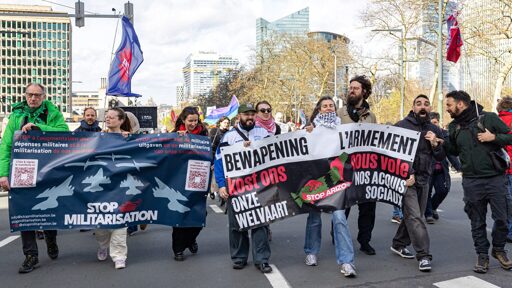
Trade unionists, activists, organizers and politicians from the region came together in Brussels on March 14 for a peace conference organized by the Stop Militarization platform.
A one-day event in the heart of the EU capital, the gathering brought together 350 participants and offered a plenary session that traced the general issues at the heart of the conference, followed by a choice between four workshops covering European rearmament, youth organizing against militarization, the false promises of military Keynesianism and the genocide in Palestine. The closing plenary centred trade unions that organize against the war industry.
At the same time, the conference offered a counterpoint to Brussels’ BEDEX arms exhibition. This took place on the same day and brought together major defense industry actors such as Rheinmetall and Leonardo, and was sponsored by the European Commission and the Belgian Army, among others.
“Si vis pacem, para pacem”
One of the main takeaways of the conference was that the militarization currently accelerating across Europe does not aim to defend the people, but to prepare them for the wars of the future. Ansje Vanbeselaere, president of INTAL Belgium, noted in her introductory remarks that those who want peace must prepare for peace, not for war. The imperialist aggression led by the United States and Israel in Iran, Israel’s genocide in Palestine, the kidnapping of Venezuela’s president by the US and the US-imposed fuel blockade on Cuba only destabilize the world, while at the same time diverting public funds from development to the pockets of the war industry. Budgetary austerity leads to underfunded public sectors, which in turn lead to de-industrialized societies and precarious, unhealthy and under-educated populations. Therefore, all wars are in fact class wars.
Read more: 100,000 join national strike against austerity in Belgium
An often cited example of the aberrations of militarization was Belgium’s decision to invest billions in purchasing 11 additional F-35 fighter jets while cutting deep into all aspects of social security, from wage indexation to retirement age to unemployment benefits. As Andrew Feinstein of Shadow World Investigations observed during the conference, “the F-35s are the biggest, most expensive piece of crap produced by a company that specializes in crap.”
Nevertheless, Belgium has chosen this model because it is compatible with US nuclear warheads stationed in the country. As arms manufacturers keep repeating to their shareholders, wars are great opportunities for their business. For this reason, the arms trade makes the world a lot less safe, as it relies on permanent wars to keep making profit.
Labor rights under attack
Speakers also underlined that militarization is not limited to the defense industry and to equipping national armies. Under the excuse of preparing for war, governments attack labor rights and deregulate climate protections. In Germany, the work week for military personnel could be extended to 54 hours under certain conditions, and the coalition in power is currently discussing abolishing the 8-hour workday, allowing up to 13 hours of work a day. This strategy is familiar: first new rules are introduced in one sector, and then extended to all other sectors through a variety of tactics. Therefore, it is in the interest of all workers to come together and oppose such changes. As Laëtitia Sédou of the European Network Against Arms Trade observed, no matter your views on militarization, you should still oppose the manner in which the process is conducted and the way it affects all sectors of society, since the entire process lacks transparency and democratic oversight.
Read more: “Militarization of rules and minds” in Europe threatens workers and welfare
Trade union representatives explained how the geopolitical crisis of the moment is linked to the industrial crisis. European industry is experiencing rapid job loss and militarization is used to re-industrialize. This means that civilian production is converted to military production, for example in the automotive industry. However, as Ulrike Eiffler of IG Metall, Germany’s largest trade union, observed, jobs in the defense industry are unsustainable and do not have long-term perspectives. An economy should focus on jobs for life, not for death.
Hillal Sor of Metallos FGTB-ABVV, the Belgian metallurgy trade union, also underlined the major contradiction at the heart of militarization: when it comes to public investments in civil industry, governments refuse them claiming they will distort the free market. But they have no problem giving subsidies to the war industry. However, the war industry does not have revenue unless wars are permanent. Furthermore, developing the arms industry promotes de-industrialization in all other sectors due to lack of public investments.
How to talk to workers about peace
In response to a question about how union leaders mobilize defense industry workers to oppose militarization, the speakers conceded that anti-militarism is not always welcome on the factory floor, as people fear for their jobs. The task is particularly difficult because war propaganda is everywhere. But if there is a strong peace movement on the streets combined with school strikes against conscription laws, union organizers also get a stronger set of arguments within the factories. Sor underlined that the emphasis should be on the erosion of labor rights, extended working hours, diminishing health protections, and wage loss. On their side, left parties must offer a policy vision for a flourishing civilian industry as an alternative to militarization.
Read more: Second school strike takes place in Germany: “The rich want war, the youth want a future”
Peter Mertens, general secretary of the Workers’ Party of Belgium, took up the challenge and reminded the audience that we are in a moment of upheaval similar to the Cold War, which, however, is a lot more dangerous because there is no USSR to block the empire’s destructive ambitions. The current militarization represents, on the one hand, a massive transfer of public wealth into the pockets of the war industry, but it is also a preparation for a new Scramble for Africa. In order to return to looting African countries for minerals and other raw materials, the imperialist bloc needs a military apparatus to support its objectives. But the peace movement fighting this is not weak, and is diligently building its own infrastructure.
What is to be done
Katerina Anastasiou of Stop ReArm Europe underlined that governments are “weaponizing the human need to be safe and using it to militarize.” This means we need to take back the concept of safety and security and demilitarize it, both in our national contexts and through international cooperation. Mertens encouraged participants to read Lenin and his analysis of imperialism as the highest stage of capitalism and added that “we don’t have the luxury to be pessimists.”
Feinstein also urged the audience not to lose hope. The powers we are up against may seem impossible to defeat, but we should remember Nelson Mandela’s example and his belief that anything is only impossible until it is done. To which Anastasiou added: “We need to swim in the noise, we have to talk about peace, we have to articulate a vision of a peaceful future.”
The anti-militarization mobilization continues on June 14 in Brussels with the Europe-wide demonstration “Welfare, NOT Warfare” organized by the Stop Militarization platform and the Stop ReArm Europe campaign. Peace movements and trade unions are expected to converge in the EU capital from all over Europe in order to express the people’s opposition to militarization and to plan future actions.
The post “We cannot eat grenades once the grains no longer grow:” European peace movements organize against militarization appeared first on Peoples Dispatch.
From Peoples Dispatch via This RSS Feed.