

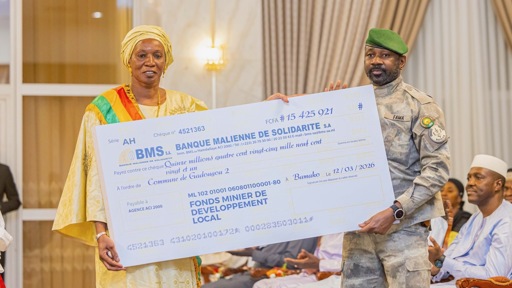
The government of Mali redistributed USD 33 million of mining revenue to the mining-affected and other underdeveloped regions of the country last week, at a ceremony in the Koulouba Presidential Palace on March 12, presided over by President Col. Assimi Goïta.
Local municipalities located in active mining zones were allocated half of this amount. The other half was shared between the regional administrations within which the mining zones are located and the non-mining areas under an equalization mechanism to address the uneven development of different regions of the country.
Mali is Africa’s second-largest gold producer. However, for decades since independence from France, most of the mining profits were captured by foreign companies, with the remainder going to local artisanal miners. The regimes propped up by France took no measures to channel the money back to the community.
Resource nationalism as a key pillar of sovereignty
However, that began to change after the France-backed regime of the then-president, Ibrahim Boubacar Keïta, was overthrown in a popularly supported coup in 2020, amid mass protests demanding the expulsion of French troops from the country.
The transitional military government led by Col. Goïta, which consolidated popular support by expelling the French troops, espouses resource nationalism as a key aspect of its assertion of sovereignty.
Mali accordingly adopted the New Mining Code in August 2023, which imposed a mandatory 10% state ownership in all new mining projects, with additional provisions for buying up to 35% stake.
The code also marks an advance from simple extraction to value addition by requiring the mining companies to refine and process the mined mineral within the country before export. The government reaped a 52.5% increase in mining revenue in 2024.
Combining limited nationalization with conditional foreign ownership
In October of that year, the government nationalized the Yatela gold mine in the western Kayes region, owned by a Canadian and a South African company. In June 2025, the government also nationalized the foreign-owned Morila gold mine in the Sikasso region.
Operations had been abandoned at both mines by their previous owners, who complained of low profit margins. However, the two mines are still estimated to contain a total of over 1.5 million ounces of gold deposits.
While retaining this ownership, the government signed a partnership agreement with the US-based Flagship Gold Corp in October 2025 to revive production in Morila. Efforts to revive mining at Yatela are also underway.
Functioning mines, however, have not been nationalized. Underdeveloped by French colonization and decades of neocolonial extraction post-independence, Mali does not have the technical capacity to operate all its mines without foreign investment.
Recognizing this limitation, the mining codes allow 60 to 85% foreign ownership of the mining sector. However, it has hiked their royalty payments to the state. In addition, the codes also imposed several obligations on foreign mining companies, including local employment and skills development, and contributions to social programs and local infrastructure development.
A West African state willing to confront global mining giants
When the Canadian company Barrick Gold resisted the implementation of these codes, the government issued an arrest warrant for its CEO and seized its stockpile from the Loulo-Gounkoto complex, the largest gold mine in Mali. The company then halted production, whereupon the state placed the mine under its provisional administration.
The conflict was finally resolved, with Barrick withdrawing the international arbitration proceedings it had initiated against Mali and paying USD 253 million to the state. The government, in turn, dropped the charges and returned the stockpile and operational control to the company in December 2025, whereupon it resumed production.
Read more: Mali takes control of one of Africa’s largest gold mines and launches its own refinery
This standoff was a demonstration of the changed power dynamics since the ouster of the France-backed regime, with the state, led by Goïta’s government, willing to confront global mining giants, enforcing their submission to sovereign will.
Channeling mining revenues back to local communities
These measures, taken against the backdrop of the rally in the price of gold, which brings in 80% of Mali’s export revenue, allowed the state to generate substantial revenue. To channel this revenue into social and developmental programs, especially into the local communities affected by mining, the government had established the Local Mining Development Fund, from which USD 33 million was distributed on March 12.
Discovery Alert reported that 25-30% of this money is to be spent on building clinics and imparting medical training. Another 20-25% is allocated for schools, 30-35% for roads, water, and electricity, and 15-20% for supporting small businesses and agriculture.
If the gold prices hold, the government could generate an even larger revenue going forward, with the operationalization of West Africa’s first state-owned gold refinery, which it began constructing last year on the outskirts of the capital, Bamako, in partnership with the Russian conglomerate Yadran.
Foray into lithium production
Alert to the growing global demand for critical minerals, Mali’s government has also opened the Goulamina and Bougouni lithium mines in the Sikasso region, with 35% stake in each, in partnership with two Chinese and a UK-based company. This has set the country enroute to becoming Africa’s largest lithium producer, allowing the government to generate even greater revenues for the Local Mining Development Fund.
The post Mali delivers 33 million dollars of mining revenue to local communities appeared first on Peoples Dispatch.
From Peoples Dispatch via This RSS Feed.
I don’t really read about this stuff, because who cares about Africa as long as they keep sending those minerals, but the few short newsies I did get seem really positive. Things are on the up an up?
