


By MICHAEL SCHREIBER
Life for Cuba’s working people is rapidly deteriorating as the Trump administration squeezes the country into what Cuban President Miguel Díaz-Canel has called a state of “economic genocide.” Events have been moving fast since Jan. 29, when Trump issued an executive order declaring that Cuba posed “an unusual and extraordinary threat” to U.S. policy. As a consequence of this manufactured “emergency,” he ordered that sanctions, including higher tariffs, be imposed on any country that supplied oil to Cuba.
Food is increasingly scarce, water pumps are often inoperable, and electricity blackouts can last for more than a day. The exemplary public health system, universal and free to all, is tottering. Medicines and medical equipment that are necessary to save lives are in short supply or only available for high prices on the black market. Ambulances lack fuel. X-rays, electrocardiograms, and other medical equipment no longer work. Many doctors have emigrated in search of decent wages.
Trump and his advisors appear for the time being to be calculating that their oil blockade will prove to be a cheaper, less risky, and more effective course of action in bringing the country to its knees than a direct military attack. Cuba has now received practically no imported oil in three months, though one or two tankers with Russian oil and gas are expected next week—in defiance of Trump’s embargo.
Even before Trump’s blockade was tightened, Cuba was facing an agonizing economic crisis. Most economic growth indicators have steadily declined since the COVID epidemic of 2020—which hampered Cuba’s tourist industry and cut off a major supply of cash. The primary cause of the shortages is undoubtedly the 65-year U.S. blockade, which has greatly obstructed international trade—both imports and exports—and constricted the growth of the country’s important hotel and hospitality sector. But bureaucratic and undemocratic measures, privatizations, drastic cuts in social spending, and the siphoning off of wealth by Cuban managers and officials have exacerbated the economic problems.
The power cuts and food shortages have sparked a certain degree of public protests in Cuba, including nightly banging on pots in some neighborhoods. On March 14, anti-government protesters attacked a Communist Party office in the northern city of Morón. Reuters and other news outlets posted videos that appear to show that a rally turned violent when protesters threw rocks through the windows of the building, and then dragged its furniture into the street and set it on fire.
Talks between the U.S. and Cuba: More economic adjustments?
By the beginning of March, talks had gotten underway between Trump administration stalwarts and top Cuban officials. The semi-formal talks included Secretary of State Rubio; to some degree, Trump himself appears to have weighed in. On the Cuban side, Raúl Castro’s nephew, Raúl Guillermo Rodríguez Castro, known as “El Cangrejo” (“the Crab”), was prominent.
On March 7, Trump told the press that his pressure tactics were working and that a deal with Cuba was imminent. “As we achieve a historic transformation in Venezuela, we’re also looking forward to the great change that will soon be coming to Cuba,” Trump said. He added, “Cuba’s at the end of the line. They have no money. They have no oil.”
On March 17, Trump gloated to reporters that “I do believe I will be having the honor of taking Cuba. … Taking Cuba. I mean, whether I free it, take it. I think I can do anything I want with it.”
The same day, the media reported that Trump administration is insisting that Cuban President Díaz-Canel must step down from office. As part of the deal, said The New York Times, it appears that the Trump administration might be inclined to allow Raúl Castro and other members of his family to remain in Cuba. However, The Times pointed out, many Cuban-Americans in Florida, including some elected officials, have indicated that they would be unhappy with that decision.
What is the response of the Cubans to Trump’s death grip on their economy? On Feb. 1, a couple of days after Trump’s executive order, the Cuban ministry of foreign affairs gave a tentative but somewhat conciliatory response, pointing to what they called “constructive engagement” with the United States. But as the social crisis deepened, significant economic adjustments were announced.
On March 2, Cuban media reported that Cuban President Díaz-Canel had stated in a meeting of the Council of Ministers, “We must focus, immediately, on implementing the urgent, most necessary transformations that must be made to the economic and social model.” Díaz-Canel called on municipalities to manage issues such as foreign direct investment; economic partnerships between the state and non-state sectors; and investments with Cubans residing abroad. Two weeks later, on March 13, Díaz-Canel told the press that new measures would be instituted to “greatly facilitate” the ability of Cubans abroad to invest in the island’s economy. (Over 2 million Cubans have emigrated overseas in the last two years.)
This was amplified by Oscar Pérez-Oliva Fraga, Cuba’s deputy prime minister, in an interview published by NBC on March 16: “‘Cuba is open to having a fluid commercial relationship with U.S. companies’ and ‘also with Cubans residing in the United States and their descendants,’ Fraga said in a sit-down in Havana, ahead of announcing the news to his country Monday night.”
Fraga said that the new economic reforms were aimed at creating what he called a “dynamic business environment.” The goal would be to revive a range of sectors, from tourism and mining to fixing and updating the power grid. “This extends beyond the commercial sphere,” added Fraga, who also serves as Cuba’s minister of foreign trade and investment. “It also applies to investments — not only small investments, but also large investments, particularly in infrastructure.”
The extent of these projected reforms remains to be seen. They would be added to a series of economic changes in recent years that have strengthened the capitalist market forces on the island. USA Today has termed the new economic measures “Cubastroika,” in reference to the radical economic readjustments undertaken in the Soviet Union in the late 1980s, a few years prior to the complete restoration of capitalism. For example, in February, Cuba allowed the importation of fuel oil by private firms; the measure is one more fissure in Cuba’s state regulation of foreign trade.
As of May 2023, Cuba already had arrangements with some 327 foreign businesses from at least 40 nations to invest capital in Cuban entities. Of those, 56 were composed totally of foreign capital, while the rest were joint enterprises with the Cuban state. Some 50 foreign companies were operating in the Mariel low-tax “Development Zone.” Official figures in 2024 estimated that 1.6 million workers were employed in private enterprises, out of a workforce of about 4 million. And last year, joint enterprises with foreign capital were expanded in the hotel sector.
In 2024, for the first time, the privatized sector in Cuba surpassed the state-owned sector in sales of goods and services. Some 55% of sales took place in privately run entities, compared to 44% the year before, and as low as 4% in 2020.
Moreover, a sizable unauthorized private sector also operates in Cuba. Some of the informal private activity engages in the marketing of scarce products that have been pilfered from state-owned enterprises; imported by foreign-based travelers, such as family members, in their luggage; or purchased in dollar stores using cash remittances from abroad.
It should be clear that as the Cuban leadership’s program of “market reforms” is extended, it will further weaken the ability of the state to control even the sector of the economy still in state hands, while subjecting the economy to fluctuating and destructive market forces.
Moreover, if not vigorously counteracted by Cuban workers, such reforms will widen income levels and enlarge the privileged layer of the population that grows dependent on protecting private property and on gaining profits from privately employed labor power and buying and selling in the market. In the meantime, the suffering of the working class and poor increases, as less funding and attention goes toward health care, education, housing, and maintaining the “social basket” of food subsidies.
What does the Trump administration hope to gain?
In the meantime, the Cuban government’s talks with the Trump administration are still proceeding. The Miami Herald has reported that, according to Rubio, the state of the negotiations are now “very advanced.” He said that Washington believes that it is close to finding success in pushing the Cubans to “change their system.”
Rubio clarified at the time that Cuba “doesn’t have to change all at once. It doesn’t have to change from one day to the next. Everyone is mature and realistic here.” But a few days later, after Fraga had spoken about opening the Cuban economy to more foreign investment, Rubio expressed a harder line: “… they have to change dramatically,” he screeched. “What they announced yesterday is not dramatic enough. It’s not going to fix it.”
The Trump administration is unlikely to be content with any piecemeal reforms to the Cuban economy and social structure. With little doubt, the U.S. would prefer to supplant the present Cuban government with one that is fully willing to grant major concessions to U.S. corporations while complying with the dictates of U.S. imperialism. In fact, that has been the goal of all U.S. administrations since the 1960s.
What would the United States achieve by opening Cuba fully to U.S. exploitation and domination? In the first place, they want to crush what remains of the socialist revolution and to erase its memory from Cuban workers and as an example for the oppressed people of the semi-colonial world to follow. The U.S. also hopes to acquire access to an island that dominates the sea entrance to the Caribbean, the Panama Canal, and the U.S. Gulf Coast, with good ports, and with a highly educated and skilled working class. Furthermore, the U.S. would like to get its hands on Cuba’s resources of cobalt (the third largest deposits in the world) and nickel (fifth largest in the world).
In addition, the Cubans might be forced to settle with many of the 5913 certified U. S. claims seeking redress for properties nationalized by the Cuban government following the Cuban Revolution of 1959. That number would include the U.S.-based families of big latifundists who want to get their agricultural lands back.
The U.S.-owned Cuban Electric Company represents the largest of these claimants. The list also includes three U.S.-owned oil refineries, three U.S. banks, the telephone company, and at least 21 sugar mills. Cuba originally offered compensation through government bonds at 2% annual interest, with payment to begin within 30 years. The hope was that this could be paid off through increased U.S. purchases of sugar, but the U.S. refused to comply.
Need for authentic workers’ democracy
Given the recent conciliatory pronouncements by Cuban officials in response to Trump’s clampdown, it appears unlikely that the Communist Party and the Cuban state will pull back from their course of increasingly opening the country to market forces. Even the Cuban leadership’s pledges to retain some sort of “socialist” framework in the country are not reliable—especially since some leading functionaries speak about following the Vietnamese or Chinese “models” that favor the capitalist market.
A key problem is that the working-class masses have only a very limited, unorganized, and indecisive voice in governmental decisions. Major policy decisions, such as the economic “reforms” enacted during recent decades are basically determined by the Cuban Communist Party (rather than by the ostensible governmental body, the National Assembly of People’s Power). The Communist Party is a rigid top-down organization, with little opportunity for organized dissent within it.
Opposition parties are banned. Government policies are often enacted after certain staged “consultations” with popular assemblies and the unions, and a few national referendums, but there is no authentic rule by democratic and independent workers’ organizations, while active opposition is generally repressed. The single trade-union federation has become bureaucratized, with hand-picked leaders loyal to the goals of the government; strikes are outlawed and street protests are put down by force.
Such repressive actions may serve to protect and perpetuate the power of the Cuban leadership, but they also serve to isolate it from any criticisms or corrections of misguided government schemes that might be expressed from among the working-class population. Ultimately, to safeguard their livelihoods and interests, working people in Cuba must supplant the current state apparatus with organs of real working-class democracy. This objective will require the construction of an authentic revolutionary socialist party, which fights to reinstitute a planned economy, reassert the monopoly of foreign trade, and renationalize the economy under workers’ control.
In the interim, perhaps within several months or even weeks, we will have the opportunity to gauge the Cuban government’s full response to the Trump administration’s heightened attempts at disruption. We will have a clearer picture of whether, or to what degree, Cuba will move toward a rapprochement with U.S. imperialism.
At this critical moment, in the United States and internationally, it is essential to express full solidarity with Cuba. We must demand that the Trump administration remove its economic sanctions against Cuba and renounce any attempt to disrupt the country and its government. Hands off Cuba! End the blockade! The world’s governments must facilitate bringing an emergency supply of oil, food, medicine, and other necessities to the Cuban people!
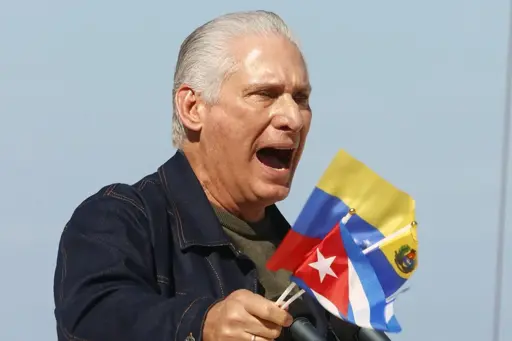
Photo: Cuban President Miguel Díaz-Canel.
The post Trump’s fuel embargo worsens humanitarian crisis in Cuba first appeared on Workers’ Voice/La Voz de los Trabajadores.
From Workers’ Voice/La Voz de los Trabajadores via This RSS Feed.