


By David Swanson, World BEYOND War, March 19, 2026
As Ms. Takaichi, the Prime Minister of Japan, meets with the U.S. President on this anniversary of the attack on Iraq with the attack on Iran underway, she should agree to nothing that violates
1. The peace Constitution of Japan, imposed on Japan by the United States.
Article 9 of Japan’s constitution states:
“Aspiring sincerely to an international peace based on justice and order, the Japanese people forever renounce war as a sovereign right of the nation and the threat or use of force as means of settling international disputes. (2) To accomplish the aim of the preceding paragraph, land, sea, and air forces, as well as other war potential, will never be maintained. The right of belligerency of the state will not be recognized.”
At the end of World War II, long-time Japanese diplomat and peace activist and new prime minister Kijuro Shidehara asked General Douglas MacArthur to outlaw war in a new Japanese constitution. The result was Article Nine of the Japanese Constitution, the wording of which is nearly identical to that of the Kellogg-Briand Pact.
Japan, which had gone centuries without war, would go another 70 years. The U.S. Outlawrists of the 1920s never imagined their work being imposed on a conquered nation by a ruling general. But they might have imagined it being taken up by the Japanese people. If Article Nine was not clearly owned by the Japanese people themselves in 1947, it was in 1950. In that year, the United States asked Japan to throw out Article Nine and join a new war against North Korea. Japan refused.
When the American War (in Vietnam) came along, the United States made the same request of Japan to abandon Article Nine, and Japan again refused. Japan did, however, allow the U.S. to use bases in Japan, despite huge protest (ongoing to this day) by the Japanese people.
Japan refused to join in the First Gulf War, but provided token support, refueling ships, for the war on Afghanistan (which the Japanese prime minister openly said was a matter of conditioning the people of Japan for future war-making). Japan repaired U.S. ships and planes in Japan during the 2003 war on Iraq, although why a ship or plane that could make it from Iraq to Japan and back needed repairs was never explained.
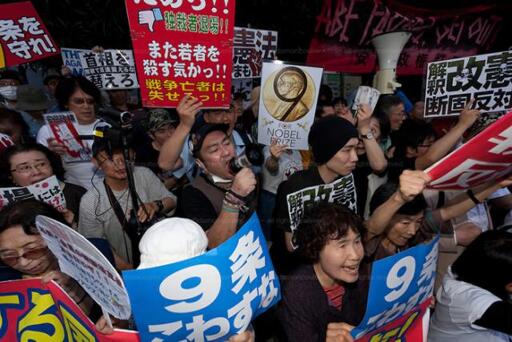
Then, at U.S. urging, Japanese Prime Minister Shinzo Abe moved to formally throw out Article Nine, or to “reinterpret” it to mean its opposite. And the Japanese people, to their everlasting credit, took to the streets defending their constitution and their culture of peace.
There are peace activists around the world struggling to uphold the idea that a modern nation can live without war. Japan is a leading example, with certain obvious shortcomings, of how that can be done. We cannot afford to lose Japan as a model of peace. We cannot afford to hear from war mongers years from now that war is proven inevitable by the return of the Japanese to war. We cannot afford to hear the United Nations credit Japan with the humanitarian service of protecting people by bombing them. We cannot afford to hear that the Pentagon must be built up to guard against the evil Japanese.
2. The Kellogg-Briand Pact, the UN Charter, and the Laws Against War
It is a little known fact that nearly identical language to Article 9 of the Japanese Constitution is in a treaty to which most nations of the world are party but which some of them routinely violate: the Kellogg-Briand Pact of August 27, 1928. Rather than following the path of militarism, Japan should be leading the rest of us toward compliance with the law.
An even deeper secret is how many undisputed laws forbid war. Someone, anyone, should tell the U.S. government that neither an imperial president not a Congress can “authorize” a blatant violation of the UN Charter.
3. The Treaty on the Nonproliferation of Nuclear Weapons
In his speech at American University, President Kennedy proposed something so amazing that most readers and listeners to his speech cannot believe it is there and so do not believe it is there. And yet, there it is in plain English. He proposed “the elimination of war and arms” and “general and complete disarmament.” Within five years, the United States and the Russian Federation had joined the Treaty on the Nonproliferation of Nuclear Weapons which uses the same phrase that Kennedy did (“general and complete disarmament”) in the following line:
“Each of the Parties to the Treaty undertakes to pursue negotiations in good faith on effective measures relating to cessation of the nuclear arms race at an early date and to nuclear disarmament, and on a treaty on general and complete disarmament under strict and effective international control.”
Notice that the general and complete disarmament is in addition to nuclear disarmament. The United Nations office currently known as United Nations Office for Disarmament Affairs is explicitly dedicated to the same goal of “general and complete disarmament” which it defines as including nuclear and also so-called conventional weapons.
Notice that immediately after saying he wanted general and complete disarmament, Kennedy claimed that the U.S. government had been working toward that goal since the 1920s. You could make a strong case that that’s laughably false, and that the Congressional hearings of the 1930s on the merchants of death by the Nye Committee made that case. But here’s my key point: there were no nuclear weapons in the 1920s.
And yet commentators seem to either avoid this bit of Kennedy’s speech or to claim that he only meant nuclear disarmament. But you cannot avoid clearly written law. Even with every peace activist on Earth shouting that the U.S. and Russia have zero nuclear disarmament treaties left, there indisputably remains one that requires nuclear and non-nuclear disarmament. Someone should tell Trump. Someone should dangle a prize in front of his nose.
4. The Treaty on the Prohibition of Foreign Military Bases and Forces
Yes, I made this up.
But I’ll wager the entire budget of the Peace Board that the people of Okinawa would approve it.
The States Parties to this Treaty,
Determined to contribute to the realization of the purposes and principles of the Charter of the United Nations,
Dedicated to facilitating all members of the United Nations in the work of refraining in their international relations from the threat or use of force against the territorial integrity or political independence of any state,
Deeply concerned by the gross violations of the territorial integrity of states constituted by the presence of foreign military bases and forces,
Recognizing the origin in many cases of foreign military bases as spoils of the threat or use of force, their maintenance constituting an incentive for those actions,
Recognizing the origin in many cases of foreign military bases through the theft of land from indigenous, impoverished, and minority populations, displacing people who in many cases continue to demand the restoration of their homes,
Concerned by the pattern of foreign military bases and forces heightening tensions and encouraging conflict, including through war rehearsal “exercises” that often function as implicit threats of force, and steps in escalating arms races,
Recognizing that foreign military bases and forces facilitate the precipitous escalation of conflicts in the surrounding regions, and that these bases and forces are frequent participants in threatening, targeting, and launching missile attacks, including from robotic aircraft,
Noting that the Treaty on the Nonproliferation of Nuclear Weapons forbids the transfer of nuclear weapons to other parties, and that the Treaty on the Prohibition of Nuclear Weapons forbids the possession of nuclear weapons, but that nuclear weapons are maintained in several states purportedly not possessing them, through the expedient of foreign military bases,
Noting that some states have been denied the ability to know whether foreign military bases in their territories will include nuclear weapons,
Recognizing that foreign military bases and forces facilitate weapons proliferation, military training, and the militarization of cultures and governments,
Deeply disturbed that foreign military bases and forces in many cases impede self-governance, incentivize loyalty to a foreign government, and provide support to oppressive and undemocratic governments, influencing host/occupied states away from international cooperation, diplomacy, unarmed civilian defense, or other alternatives to war,
Concerned that foreign military bases have in numerous instances been used for criminal human rights abuses by governments either openly claiming that a base constitutes an extra-legal zone or seeking to keep activities at a base secret,
Aware that foreign military bases and forces can make host/occupied states targets for possible attacks by other states or smaller groups, while implicating host/occupied governments in wars they play no role in,
Noting that foreign military bases contribute significantly to local and global environmental destruction, often without the host/occupied state having access to inspect the damage to soil or water or to impose any standards,
Noting that foreign military forces are often granted immunity from the laws of the host/occupied state, including laws covering kidnapping, rape, and murder,
Recognizing that the insertion of relatively highly paid forces with criminal immunity, and training in killing and destruction, into a foreign community whose members are employed for menial tasks has in many cases created local societies divided by class and characterized by bigotry and discrimination,
And, finally, in consideration of the good that could be done with the land and resources currently expended on foreign military bases and forces if used for other ends,
Have agreed as follows:
Article 1
- Each state party undertakes never under any circumstances to allow on its territory or to impose on the territory of any other state a foreign military base or foreign military forces of any number, permanently or temporarily for any number of days.
Article 2
- Each state party shall adopt the necessary measures to implement its obligations under this treaty.
- Each state party shall take all appropriate legal, administrative, and other measures, including the imposition of penal sanctions, to prevent and suppress any activity prohibited to a state party under this treaty undertaken by persons or on territory under its jurisdiction or control.
Article 3
- Each state party shall submit to the Secretary-General of the United Nations, not later than 90 days after this treaty enters into force for that state party, a declaration in which it shall declare its completion of all steps needed to bring it into compliance with this treaty.
Article 4
- Each state party shall encourage states not party to this treaty to sign, ratify, accept, approve, or accede to the treaty, with the goal of universal adherence of all states.
Article 5
- This treaty shall be open for signature to all States at United Nations Headquarters in New York as from 1 May 2025.
Article 6
- This treaty shall be subject to ratification, acceptance, or approval by signatory states. The treaty shall be open for accession.
Article 7
- This treaty shall enter into force 30 days after the fiftieth instrument of ratification, acceptance, approval, or accession has been deposited.
- For any state that deposits its instrument of ratification, acceptance, approval, or accession after the date of the deposit of the fiftieth instrument of ratification, acceptance, approval, or accession, this treaty shall enter into force 30 days after the date on which that state has deposited its instrument of ratification, acceptance, approval, or accession.
Article 8
- The articles of this treaty shall not be subject to reservations.
Article 9
- This Treaty shall be of unlimited duration.
- Each state party shall, in exercising its national sovereignty, have the right to withdraw from this treaty if it decides that extraordinary events related to the subject matter of the Treaty have jeopardized the supreme interests of its country. It shall give notice of such withdrawal to the depositary. Such notice shall include a statement of the extraordinary events that it regards as having jeopardized its supreme interests.
- Such withdrawal shall only take effect 12 months after the date of the receipt of the notification of withdrawal by the depositary. If, however, on the expiry of that 12-month period, the withdrawing state party is a party to an armed conflict, the state party shall continue to be bound by the obligations of this treaty and of any additional protocols until it is no longer party to an armed conflict.
Article 10
- The Secretary-General of the United Nations is hereby designated as the depositary of this Treaty.
Article 11
- The Arabic, Chinese, English, French, Russian, and Spanish texts of this Treaty shall be equally authentic.
The post Japan Should Not Violate Laws for the United States appeared first on World BEYOND War.
From World BEYOND War via This RSS Feed.