

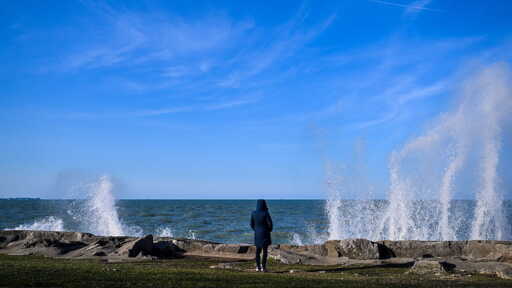
There are no wind turbines on the Great Lakes — and it isn’t for lack of wind.
This titanic network of interconnected freshwater lakes with a surface area larger than New England, New York, and New Jersey combined is theoretically ideal for wind farms. Winds sweeping across the lakes are stronger, more consistent, and less turbulent than those over land. The National Laboratory of the Rockies has estimated that the Great Lakes states have enough offshore wind potential to generate more than three times their combined annual electricity consumption.
Plus, unlike proposed wind farms along the East Coast, where the federal government controls the seabed, Great Lakes states have jurisdiction over their lakebeds. While projects would still face federal oversight, some proponents see wind development in the Great Lakes as a potential workaround to President Trump’s attacks on the industry.
“If it’s done correctly and we’re able to harness even a fraction of that, we could offset a lot of electricity demand,” said Melissa Scanlan, director of the Center for Water Policy at the University of Wisconsin-Milwaukee.
Still, the vast inland lakes remain untapped largely due to a lack of streamlined permitting processes at the state level and economic hurdles. Offshore wind is expensive, and unlike the East Coast, where a mature wind industry has built specialized ships and ports to build turbines in the sea, the Great Lakes states lack the infrastructure. Ultimately, renewable energy experts say the region doesn’t have the legal framework or technical capacity to support such massive projects.
So far, offshore wind power — which involves installing turbines in large bodies of water, typically the ocean — in the United States, has been concentrated along the Eastern seaboard. Projects are still very rare: just three are currently operating, with several more under construction, all along the East Coast.
More than a decade ago, President Barack Obama’s push for renewable energy buoyed a short-lived boom in offshore wind projects — particularly in the Great Lakes. The New York Power Authority and cities such as Toronto explored boosting their energy supply with wind power from Lake Ontario and Lake Erie. However, the initial boost only propelled one project forward: Ohio’s Icebreaker Wind in Lake Erie. After clashing with Ohio regulators over whether turbines could run through the night and battling a court case filed by local residents over impacts to bats and migratory birds, the developers eventually ran out of money and called the project off in 2023.
Building renewable energy offshore in federal waters has now become harder than ever. On his first day back in office, President Donald Trump signed a memorandum shutting down all offshore wind permitting, effectively suspending five large-scale East Coast projects. Although courts later overturned those cancellations, the uncertainty around offshore wind development under the Trump administration has persisted. And since any project on the Great Lakes would still need federal permits and reviews under the Clean Air Act and the Endangered Species Act, among others, wind developers have largely backed off their plans.
“That told us that this was not the time to reintroduce floating offshore wind in Illinois,” said Jim Lanard, co-founder of Magellan Wind, an offshore wind developer focused on the Great Lakes. “Rather, we needed to face the existential threat to the industry.”
Lanard said the regulatory uncertainty means it’s a bad time for business. His company, which in the past has submitted comments to the Illinois power regulators related to the deployment of offshore wind on Lake Michigan, has temporarily paused pursuing work on the Great Lakes.
“Governors and legislatures are so focused on trying to figure out how to run their governments with the reduced support coming from Washington, D.C.,” Lanard said. “It’s not time for them to add additional burdens onto their staff, who don’t know how they’re going to balance their budgets.”
Though Illinois’ jurisdiction over part of Lake Michigan presents some opportunities to work around Trump, Lanard said developers are not going to come to Illinois until there is a federal policy to protect the industry from whiplash elections. Moreover, Illinois and the other Great Lakes states have yet to establish a substantial legal framework to make local offshore wind farms a reality. Given these challenges, he estimated it will be some time before there are any wind farms on the Great Lakes.
“I’m looking at five to seven years from 2029,” Lanard said.
For years, state Representative Marcus Evans Jr. has championed a plan to make Illinois’ shores home to the first offshore wind farm in the Great Lakes. The legislation, known as the Illinois Rust Belt to Green Belt Pilot Program Act, was designed to direct state planners to solicit proposals for a new utility-scale offshore wind farm and begin purchasing offshore wind power. First introduced by Evans in 2022, the measure has long failed to pick up enough momentum to break out of the statehouse. In 2025, Illinois Senator Robert Peters refiled the bill, but it didn’t receive a committee assignment. Evans said he decided against refiling the bill this year.
“I didn’t have the support,” said Evans, a South Side Chicago Democrat. “I used my energy this year to focus on some other items, but it’s still something that I think is important,“ he added.
Since the bill would require a localized industry to build, transport, and upkeep the turbines, Evans saw the push as a huge boon for the region’s clean energy workforce — one that the state of Illinois has long been trying to prop up.
Illinois passed the Climate and Equitable Jobs Act in 2021, which committed the state to investing $80 million annually to build out workforce training hubs focused on clean energy-related jobs. The same bill also put the state on track to transition its energy sector to 100 percent clean energy by 2050. Evans had hoped his initiative could help achieve both goals at once.
He is still optimistic that Lake Michigan will be next.
“I will file [a bill] in the future,” he said.
This story was originally published by Grist with the headline The Great Lakes are ideal for wind energy. So where is it? on Mar 19, 2026.
From Grist via This RSS Feed.