

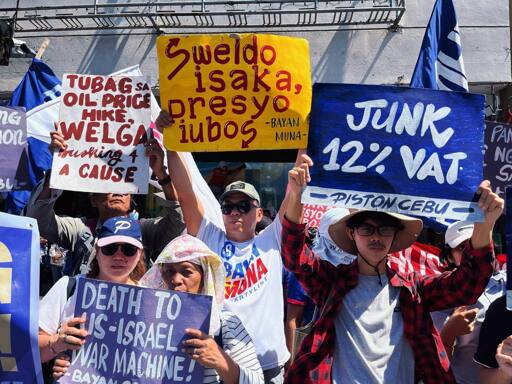
Aside from the abolition of regional wages, KMU is pushing for immediate economic relief for the workers and the junking of regressive taxes on oil, food, and basic social services.
MANILA – Because workers are affected by the astronomical oil price hikes, a labor group has renewed calls for the junking of regional wages and the adoption of a national minimum wage rate.
“This only proves that the government’s claim that ‘costs are lower in the regions’—used to justify maintaining Regional Wage Boards (RWB)—is a sham, when in reality a larger portion of workers’ wages in the regions is being eaten up by weekly fuel price increases,” Kilusang Mayo Uno (KMU) deputy secretary general Joanne Cesario said in a Filipino statement.
KMU regional chapters reported that oil price hikes in their areas showed no significant difference from the prices in Metro Manila. These price increases, they said, should already be considered a supervening event by regional wage boards.
In Southern Tagalog, the Pagkakaisa ng mga Manggagawa sa Timog Katagalugan (Pamantik) documented diesel prices increasing from P75 per liter to P90 per liter, with gasoline ranging between P64 per liter and P68 per liter.
Reports from KMU chapters in Cordillera and Southern Mindanao showed that pump prices have already climbed to P90 per liter. KMU Panay reported prices from P75 per liter to P80 per liter. In tourist destinations like Aklan and Boracay, prices reached P95 per liter to P100 per liter.
“Even in times of crisis, the Regional Wage Boards remain stingy, rotten, and sluggish,” Cesario said. “It is urgent, timely, and only reasonable to abolish the RWBs and implement a P1,200 family living wage nationwide so that workers and their families can keep up with the rising cost of basic goods.”
Regional wages are determined by the Regional Tripartite Wages and Productivity Boards (RTWPBs) for each administrative region in the Philippines, creating different minimum wage rates. As of early 2026, the National Capital Region (NCR) has the highest daily rate at P695. The lowest is the Bangsamoro Autonomous Region in Muslim Mindanao ranging from P366 to P411.
Under the rules of the RTWPB, a supervening condition like extraordinary increase in prices of petroleum products and basic goods and services demands a review of the minimum wage rates.
Last year, Gabriela Women’s Party Rep. Sarah Elago filed House Bill No. 4776 (Living Wage Act) which seeks to remove the regional wages across the regions and implement a minimum daily wage rate of P1,200 living wage to workers regardless of employment status.
The P1,200 rate was based on data from economic think-tank IBON Foundation, estimating that the amount could allow working-class families to rise above mere subsistence.
“Workers ought to receive higher remuneration for all their hardwork,” the bill read. “Increased labor productivity has not resulted in higher wages. Instead, it has generated higher profits for big businesses and further concentrated wealth in the hands of a few.”
The previous Congress did not pass wage increase bills.
Aside from the abolition of regional wages, KMU is pushing for immediate economic relief for the workers and the junking of regressive taxes on oil, food, and basic social services. (DAA)
The post Oil price hikes renew calls to junk regional wage system appeared first on Bulatlat.
From Bulatlat via This RSS Feed.