

Without government intervention, public utility drivers will continue to bear the brunt of rising fuel prices as their daily earnings steadily decline.
By Cris Fernan Bayaga
Bulatlat.com
CEBU CITY – Progressive groups and jeepney drivers denounced a fare hike of P1-2 as a mere “band-aid” solution that fails to address rising fuel prices.
PISTON Cebu projected that pump prices from March 16 to 20 would range from P80 to as high as P120 per liter for diesel and gasoline.
The transport group said the sector needs a minimum P5 fare increase to help offset soaring fuel costs and ensure that drivers can still bring home a livable income.

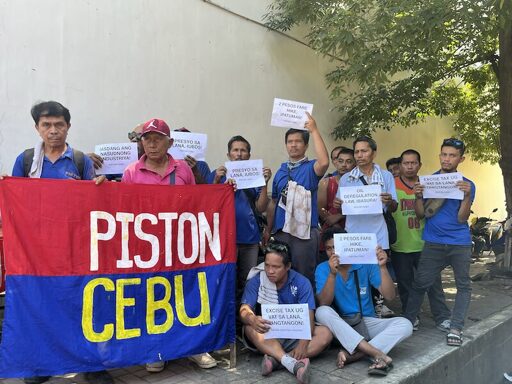
Jeepney drivers join a PISTON Cebu-led press conference on March 17 to raise calls against rising fuel prices. (Photo by Nico Booc/Aninaw Productions)
With an average daily consumption of 30 liters, a jeepney driver is expected to spend around P2,400 to P3,600 per day on fuel.
This is more than triple the previous daily expense of P800 to P1,000 prior to the US-Israel attacks on Iran.
PISTON Cebu President Greg Perez, in a protest action on March 15, said that jeepney drivers may be left with little to no daily earnings, as most of their income would be spent on fuel costs.
He also denounced the current administration’s plan to suspend the excise tax, saying it would not significantly bring down pump prices amid continuous increases.
With Marcos Jr.’s proposed cut seen to cut only around P7 per liter, an excise-only measure would be insufficient.
Mamerto Villacorta, who has been a jeepney driver for three decades, said he has been earning only around P300 compared to the usual P1,000 per day.
He still has to pay P1,000 for the jeepney unit on top of his daily fuel expenses, which have surged from P800 to as much as P1,600, effectively doubling his usual costs.
“It feels like I’m not working at all. The P300 I earned yesterday was only enough to buy rice, not even enough for my child’s school allowance, let alone to feed a family of six,” he said.
Villacorta said that amid the ongoing global crisis, the government must hold oil companies accountable for profiting from rising prices, noting that some firms may even be selling old inventory at inflated rates.

Villacorta discusses the impact of rising fuel prices on household expenses with Naparan following the press conference. (Photo by Cris Fernan Bayaga/Bulatlat)
He added that the surge in fuel costs has pushed him to consider giving up driving altogether. He said the current crisis is the worst experience he has had with fuel prices.
Rodolfo Engbino, a member of PISTON Cebu, said scrapping the Oil Deregulation Law and imposing price controls are urgent measures needed to protect both drivers and commuters from fuel price hikes.
For him, without government intervention, public utility drivers will continue to bear the brunt of rising fuel prices as their daily earnings steadily decline.
He shared that just yesterday, he only took home P200 from P1,000 in earnings, far less than what he used to make before.
Engbino also called for the suspension of excise taxes and the 12% value added tax (VAT) on fuel to help mitigate the impact of rising oil prices.
He said that removing these taxes could help absorb the increases, noting that based on the current increase, an estimated P11,000 to P15,000 from fuel costs will go to taxes.
Cristina Naparan, a mother of two and wife of a jeepney driver, fears that her family may be forced to return to their hometown in Sibonga and rely on farming to survive.
She said that they were only able to bring home P300 yesterday, and expect it to drop further to around P200 as diesel prices surged from P80 to nearly P100 per liter.
For her, the sharp decline from their usual P800-P1,000 daily income is pushing them to the brink, making it increasingly difficult to meet their basic needs.
Naparan added that their current earnings are no longer enough to cover house and vehicle rent, utilities, and their child’s schooling.
“As a mother managing our household finances, this is the lowest we’ve earned in 15 years since I started joining my husband while he drives. It’s becoming increasingly difficult to make ends meet, especially since we rely solely on this income,” she said.
Bayan Muna Central Visayas coordinator John Ruiz said that the issue of rising fuel prices is not limited to drivers, but affects the entire nation.
He explained that fuel plays a crucial role in determining the cost of goods across all sectors, creating a “domino effect” that drives up the prices of basic commodities such as rice.
Ruiz said that a fare hike, a proposed four-day workweek, and insufficient financial aid or ayuda amounting to only P5,000 are not enough to address the crisis.
He said that the government must regulate how private oil companies are able to automatically increase fuel prices, especially when there is an existing 60-day fuel supply.
For Ruiz, the current actions of the government suggest an agreement between private oil firms to prioritize profit over genuine solutions to the ongoing crisis.
PISTON and other progressive groups are set to stage a transport strike on March 19 amid what they describe as the government’s continued inaction on their demands. (JDS, RVO)
The post Cebu transport sector demands oil price rollback, junking of Oil Deregulation Law appeared first on Bulatlat.
From Bulatlat via This RSS Feed.