

By Dulce Amor Rodriguez
Bulatlat.com
MANILA — For decades, the women later known as the Malaya Lolas carried stories of abuse they endured during the Japanese occupation—stories long denied, delayed, and left without full justice.
From silence to struggle
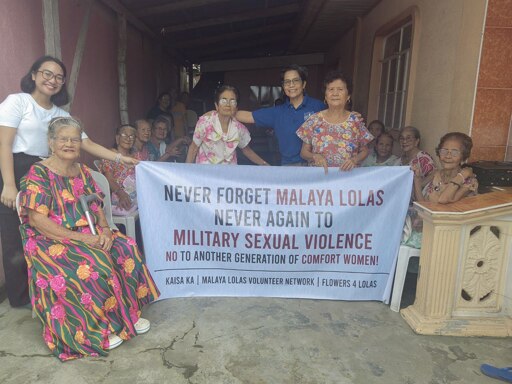
The Malaya Lolas are a group of elderly Filipina survivors of sexual slavery by the Japanese military when Japan occupied the Philippines during World War II.
Most of them come from Pampanga, where Japanese forces occupied communities and subjected women and girls to systematic rape and sexual abuse as part of the military’s so-called “comfort women” system.
The survivors organized themselves in the early 2000s, decades after the war, to seek justice, recognition, and reparations.
They formed Malaya Lolas, which means “free grandmothers,” to collectively assert their rights and break the silence surrounding their experiences.
Their organizing marked a shift from private suffering to a public assertion of their rights. For many of the women, it was the first time they spoke openly about the violence they endured.
Since then, they have pursued legal action and advocacy efforts, both locally and internationally, to demand accountability and recognition.
Their case reached the United Nations Committee on the Elimination of Discrimination Against Women, filed under the Convention on the Elimination of All Forms of Discrimination Against Women (CEDAW), challenging the government’s failure to provide adequate remedies.
In March 2023, the UN body found that the Philippine government failed to adequately address the continuing discrimination and suffering endured by the survivors.
Justice as a human rights obligation
Citing decades of delayed justice, the Commission on Human Rights (CHR) renewed its call for accountability, urging the government to provide full reparation, recognition, and justice.
In a Gender Ombud Policy Advisory, the CHR said justice for the Malaya Lolas remains an urgent human rights obligation.
The advisory said reparations must include recognition, compensation, rehabilitation, and measures to restore the dignity and reputation of the survivors.
“Reparations are not merely a form of assistance,” the CHR said in a statement.
“They are a human rights obligation grounded in international law.”
As the country’s Gender and Development Ombud under the Magna Carta of Women, the CHR monitors the Philippines’ compliance with international commitments, including the CEDAW.
Calls for concrete action
The CHR reiterated the recommendations of the United Nations body, including establishing a nationwide reparations program for victims of wartime sexual slavery, preserving historical memory sites such as Bahay na Pula, and integrating the history of Filipina survivors into the national education system.
CHR emphasized the urgency of implementing these measures, especially given the advanced age of the remaining survivors.
It acknowledged recent government initiatives, including the creation of an inter-agency technical working group and the issuance of Joint Memorandum Circular No. 2025-1, which provides humanitarian assistance to members of the Malaya Lolas.
However, the CHR said these steps remain insufficient.
CHR called for a comprehensive, rights-based reparations framework that fully recognizes the harms endured by the survivors. It also urged lawmakers to enact legislation establishing a state-sanctioned reparations program and to ensure sustained medical and psychosocial support.
Fight for dignity
CHR said it stands ready to assist the government and other stakeholders in crafting policies that will fully implement the recommendations of the United Nations body.
As time passes and the number of surviving Malaya Lolas continues to dwindle, the CHR stressed the urgency of delivering justice.
For the survivors, the decades-long struggle has never been only about compensation, but about restoring dignity and securing long-denied recognition. (AMU, JDS)
The post CHR urges full reparations for Malaya Lolas, decades after wartime abuse appeared first on Bulatlat.
From Bulatlat via This RSS Feed.