

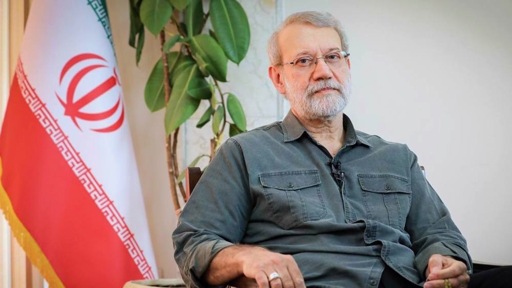
Iran confirmed on Tuesday, March 17, the assassination of the head of its Supreme National Security Council (SNSC), Ali Larijani (67), in a US-Israeli airstrike on the outskirts of Tehran on Monday.
Larijani, along with his son Mortaza and some other SNSC officials, was killed when they were visiting Larijani’s daughter in one of the suburbs of Tehran, according to Fars News Agency.
The funeral procession for Larijani and the others, as well as the victims of the Dena ship (attacked and sunk by the US earlier this month in the Indian Ocean), was held on Wednesday in Tehran.
The funeral procession was attended by thousands of people waving Iranian flags amidst one of the heaviest bombing campaigns launched by the US and Israel on Tehran and other Iranian cities.
Larijani was appointed the head of the SNSC in August by President Masoud Pezeshkian. He was considered a key figure in the country’s response to US-Israeli aggression since February 28.
In a condolence message, Pezeshkian underlined Larijani’s contributions to Iran’s politics and security, claiming his “martyrdom was a reward for decades of sincere contributions” to the country’s advancements.
Pezeshkian also warned of severe consequences for the “terrorist criminals” responsible for the killing of Larijani and other Iranians.
No effect on Iranian responses
Iran, however, denied that the killing of Larijani will have a destabilizing effect on the country’s government or its responses to US-Israeli aggression.
Iran’s Foreign Minister Abbas Araghchi, in an interview to Al-Jazeera claimed on Wednesday that Israel and the US must understand that the country’s governance does not depend on a single individual and it has a “strong political structure with established political, economic, and social institutions.”
Araghchi also underlined that the US-Israel has shown that they do not hesitate to carry out indiscriminate bombings, killing civilians, or assassinating high officials. However, that would not stop him or his colleagues in Iran from carrying out their duties as required.
A martyr
The SNSC, in its official statement, called Larijani a martyr, claiming it was a “long-held” dream of Larijani to become one.
Larijani, a PhD in western philosophy, has previously served as a commander in the Islamic Revolutionary Guards’ Corp (IRGC) during the eight-year-long Iran-Iraq war in the 1980s.
After the war, he was made a minister of culture in the 1990s and later the head of Iran’s public broadcaster where he served for ten years. He also served as the country’s chief nuclear negotiator for a while before being elected and becoming a speaker of the Iranian parliament for 12 years. He also served as a member of the Expediency Council, a body which oversees the laws enacted by the parliament.
Larijani was also the advisor to the now-assassinated Supreme Leader Ayatollah Ali Khamenei.
Khamenei was assassinated, along with several other Iranian top officials, on the first day of the US-Israeli aggression.
The US is solely responsible for the war
Araghchi reiterated the Iranian position that the war against Iran is a “war of choice” waged by the US under Israeli pressure.
He repeated, however, that his country does not seek a ceasefire at the moment, despite acknowledging that several “friendly countries” have approached them with proposals for the same.
He underlined that President Donald Trump does not have a clear objective in Iran and has been forced to revise it publicly several times in the last three weeks, moving from “regime change” and “complete surrender” to now “the destruction of the Iranian nation.”
Noting that the war was primarily waged on behalf of Israel but obviously impacting the common people all across the globe, including in Iran, in the wider region, and in the US.
Araghchi appealed to the American people to pressure their government to end the war.
End of the war cannot be achieved without peace in Lebanon
Answering a question about possible ways to end the war in the region, Araghchi emphasized that there cannot be any peace with Iran until the Israeli aggression in Lebanon also ends.
“I believe peace in the region must be comprehensive encompassing all dimensions of peace and including all countries,” Araghchi said.
Iran has previously laid down three conditions for ending the war:
- The end of US-Israeli aggression and a guarantee that no such attacks will be carried out in the future
- The closure of all US military bases in the region
- Compensation for all the losses incurred by Iran during the war
Israel started a ground invasion of Lebanon, along with carrying out indiscriminate air strikes on its civilian areas (including hospitals) in the capital, Beirut, and other major cities since March 2, after accusing the Lebanese government of failing to disarm Hezbollah.
Read more: Israel escalates attacks against Lebanon
At least 20 Lebanese citizens were killed, including six in Beirut, in Israeli attacks on Wednesday alone taking the total number of Lebanese killed since March 2 to 912, including over a 100 children. Over 2,200 Lebanese have been wounded in the Israeli attacks so far.
Over a million people have also been displaced as Israel has repeatedly targeted civilian infrastructure and issued arbitrary evacuation orders asking Lebanese citizens living south of the Litani River to leave. It has since expanded the areas for which evacuation orders have been issued.
The UN claims such orders and attacks on civilian infrastructure violate international laws and may constitute war crimes.
Hezbollah has been retaliating against Israeli attacks by launching missiles and drones inside the Israeli territories targeting its military installations and combating Israeli ground invasion.
The post Iran confirms Ali Larijani, head of the Supreme National Security Council, killed in US-Israeli attacks appeared first on Peoples Dispatch.
From Peoples Dispatch via This RSS Feed.