

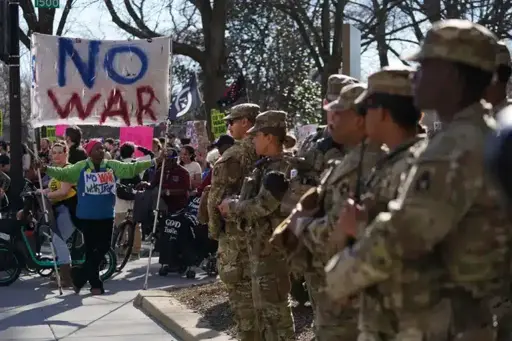
It’s now been three weeks since President Trump, in coordination with Israel, launched an imperialist war on Iran. While a massive anti-war movement has yet to emerge, poll after poll indicates that the war is widely unpopular in the United States. The socialist Left has been at the forefront of attempts to transform this anti-war sentiment into a movement, leading to extensive analysis and debate over how we should understand the war and what positions we should adopt.
From the outset, Left Voice’s position, along with that of our international organization, the Current for Permanent Revolution – Fourth International (CPR-FI), has been to support the defeat of U.S. imperialism and Israel while offering no political support to the bourgeois theocratic regime in Iran. This position diverges from much of the anti-war Left in the United States.
Aside from an influential segment of the Left that supports the Iranian regime as part of an “anti-imperialist” camp, the prevailing stance among socialists and broader anti-war sectors tends to be one of “neither, nor” — that is, supporting neither U.S. imperialism nor Iran. The argument is that both U.S. imperialism and the regime in Iran have blood-soaked histories of crushing working-class struggles, so neither deserves support. While it’s true that neither deserves political support, equating the United States and Iran militarily and politically overlooks the crucial political context: the international division of labor, in which imperialist countries dominate, exploit, and plunder oppressed nations. In fact, a deeper examination of Iran’s position within the imperialist system reveals why supporting the military defeat of the United States should be the Left’s stance if our goal is to advance the class struggle necessary to liberate our class from imperialist oppression.
The problem with the “neither, nor” position is that it fails to properly account for the uneven relationship between U.S. imperialism and Iran, placing both on the same level. But they are not on the same level, and the defeat of the U.S.-Israel camp in this conflict would yield a different outcome from the defeat of Iran. If the United States and Israel were to militarily defeat Iran, they would achieve unmatched dominance in the Middle East. Further, a defeat of Iran would grant Israel even greater freedom to continue annexing Palestine and ethnically cleansing the Palestinian people.
Conversely, if Iran were to militarily defeat the United States and Israel, the enduring burden of imperialist oppression throughout the Middle East would be alleviated, creating greater opportunities for class struggle to develop across the region. This potential for heightened class struggle also opens the door for Palestinian liberation, because not only would Israel be defeated but a scenario could unfold in which the masses begin to challenge their own regimes. These regimes have sought to negotiate favorable positions within the imperialist system while suppressing the efforts of workers and popular classes to organize against economic misery and in solidarity with the Palestinian cause.
Iran Is an Oppressed Nation
In material terms, Iran cannot be equated with the behemoth that is the U.S. Empire. The empire wields power on a global scale; its banks and corporations set the financial terms of the world economy and use tools like sanctions to discipline certain nations. It possesses an unmatched military presence, with bases worldwide and allies like Israel acting as local enforcers to protect its interests in strategic regions such as the Middle East. In contrast, Iran is a nation historically oppressed by U.S. imperialism, one whose military resources are far more modest.
For much of the 20th century, Iran was the battleground for a sustained struggle for sovereignty against imperialist intervention, led by the Iranian masses and opposed by imperialist powers, particularly the British Empire and later the United States. Imperialism manifested in the imposition of the shah’s brutal regime on two occasions, including the first-ever CIA coup, in 1953.
Then, in 1979, the Iranian people’s long-standing fight for sovereignty culminated in the revolution that overthrew the shah. Although this revolution is often remembered as an “Islamic revolution” that established the current Iranian regime, it was, in fact, led by the Iranian working class, which organized the revolution democratically from below in shoras (workers’ councils). Iranian oil workers played a decisive role in this by going on strike.
The United States, recognizing that a successful worker-led revolution could inspire similar movements throughout the region, supported the bourgeois clerics in Iran as they seized power and systematically massacred the workers and communists who had led the revolution.
Since then, Iran has lived with an inherent contradiction. On the one hand, the Islamic Republic is built on capitalist relations — bosses and large property owners dominate the workers, who must sell their labor, and a repressive state suppresses independent unions, left organizations, and oppressed minorities. On the other hand, it still bears the marks of the mass uprising that brought it to power: greater state control over oil, some degree of national independence from direct imperial diktat, and a population that once experienced its own power in 1979 and in later uprisings. The result is a regime born from a genuine anti-imperialist uprising, one that maintains some national autonomy yet rests on capitalist exploitation and oppression, necessitating the repression of workers, women, and marginalized groups whenever they attempt to push the revolution further.
That’s the contradictory reality: in the imperialist hierarchy, Iran is an oppressed country, living under sanctions, surrounded by U.S. military bases, and threatened with bombs and regime change; the Islamic Republic, meanwhile, is a political regime that defends the interests of the country’s bourgeoisie. This explains the ongoing waves of class struggle waged by teachers, oil workers, and oppressed nationalities, as well as the feminist movement, all fighting for their wages, against the sanctions imposed on them, and against state repression.
For the Oppressed, against the Oppressor
A weakened United States would empower workers in the Middle East to organize their struggles from a stronger position, since the U.S. would have less capacity to support the repressive apparatuses of the Gulf states and military regimes like Egypt, which crush any opportunity for their people to protest. Israel would be unable to continue its genocide and occupation with the assurance of U.S. backing through billions in funding for its “defense.” Even Iranian workers would find greater opportunities to organize against their own regime on their own terms. Currently, Iranians opposing the regime face the dual challenges of state repression and U.S. intervention through sanctions that exacerbate economic crises, which workers disproportionately endure, along with attempts by the U.S. to co-opt popular struggles in Iran for imperialist purposes.
A defeat of U.S. imperialism would have repercussions beyond the Middle East. As Trump focuses on war with Iran, his administration is also advancing a “Donroe Doctrine” to promote imperialist interests throughout Latin America. Undoubtedly, workers and oppressed peoples in Latin America, witnessing a defeat of the United States in the Middle East, would be inspired to renew their own resistance and draw lessons from any worker-led processes of anti-imperialist resistance that might emerge from Iran or other Middle Eastern countries. This is particularly significant for Cuban and Venezuelan workers, who are suffering under the weight of U.S. imperialism while the regimes in their countries negotiate conditions that allow U.S. interests to further encroach on their economies and political systems.
A U.S. regime defeated abroad would also bolster the struggles waged by workers within the United States. A military defeat by a weaker power would compel the U.S. to withdraw forces from the Middle East, further exacerbating the divisions within the U.S. ruling class. Each time the capitalists are divided, they are less able to respond when workers go on the offensive. The crisis that would follow such a defeat could create significant opportunities for the U.S. Left to present revolutionary socialist ideas as a solution to the ongoing international instability and wars that the U.S. regime wages at the expense of workers’ livelihoods.
Given the potential for greater class struggle arising from a U.S. defeat in mind, socialists, as the most progressive opposition should organize for that defeat. Concretely, that means building a mass anti-war movement that unites all opponents of the war in the streets, in our schools, and in our workplaces, disrupting the national stability that the United States relies on to conduct its wars abroad.
Of course, not everyone involved in a mass anti-war movement will agree on everything. Some may advocate for diplomacy to “end the war” without addressing how diplomatic agreements perpetuate the underlying system of imperialism. Others may continue to present the Iranian regime as a progressive force in “anti-imperialist” struggles. Many will probably be full of political contradictions with no cohesive analysis or perspective beyond opposition to the war. All these perspectives will be necessary to create the popular force required to counter imperialist intervention. But within these broader movements, socialists must always strive to develop positions that can help the most advanced sectors of every struggle draw profound, revolutionary conclusions. In the case of Iran, this means understanding the realities of the larger system that fosters constant wars, recognizing that defeating that system is essential to building something better, and advancing that fight by consistently standing with oppressed nations against oppressor nations as a means to further the struggle of the international working class.
The post A Defeat of the United States in the Middle East Can Pave the Way for Greater Class Struggle appeared first on Left Voice.
From Left Voice via This RSS Feed.